

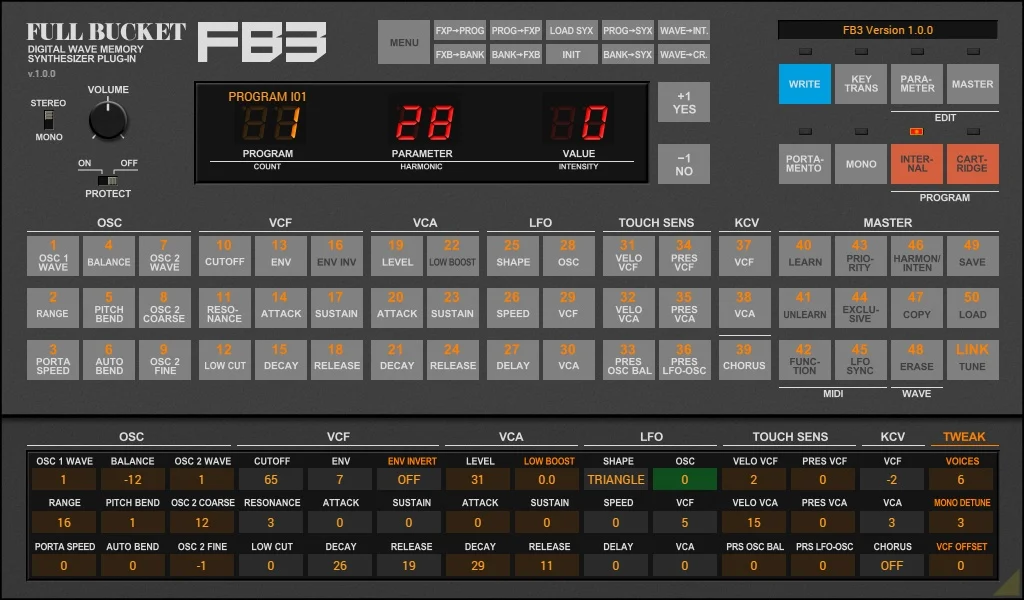
The digital music production landscape has witnessed a significant addition with the release of FB3, a high-fidelity software simulation of the Kawai K3 and its rack-mounted counterpart, the K3m. Developed by Full Bucket Music, a developer renowned for meticulous recreations of vintage hardware, the FB3 aims to preserve the unique sonic characteristics of a pivotal mid-1980s instrument. This new software instrument is available across multiple platforms, including Microsoft Windows and Apple macOS, supporting a wide range of industry-standard formats such as VST2, VST3, CLAP, AU, and AAX. By offering this tool as a free download, Full Bucket Music continues its tradition of providing high-quality synthesis tools to the global musician community without financial barriers.
The Historical Context of the Kawai K3 and the Hybrid Era
To understand the significance of the FB3, one must examine the era in which its predecessor, the Kawai K3, was born. Released in 1986, the Kawai K3 arrived at a crossroads in synthesizer history. The early 1980s were dominated by the analog warmth of instruments like the Roland Juno series and the Sequential Circuits Prophet-5. However, the 1983 release of the Yamaha DX7, which utilized Frequency Modulation (FM) synthesis, shifted the market toward digital precision and complex, bell-like timbres.
The Kawai K3 was Kawai’s response to this digital revolution. Unlike the DX7, which was notoriously difficult to program, the K3 utilized a hybrid architecture. It featured digital oscillators based on additive synthesis—where complex sounds are built by stacking sine wave harmonics—but processed those sounds through genuine analog filters. Specifically, the K3 utilized the SSM2044 voltage-controlled filter (VCF) chips, the same components found in legendary synthesizers like the Korg Polysix and the E-mu Emulator. This combination gave the K3 a "best of both worlds" reputation: it possessed the crystalline clarity of digital waveforms and the organic, resonant warmth of analog subtraction.
Despite its high-quality build and unique sound, the K3 was often overshadowed by the market dominance of Yamaha and Roland. However, in the decades since its release, the K3 has garnered a cult following among synthesists who value its distinctive "lo-fi" digital textures and lush analog filtering. The FB3 arrives as a digital preservation effort, translating this specific hardware character into the modern Digital Audio Workstation (DAW) environment.
Technical Specifications and Software Architecture
The FB3 is not merely a sample-based recreation but a coded simulation that replicates the internal logic of the original Kawai hardware. According to technical documentation provided by Full Bucket Music, the plugin features 33 built-in waveforms. These waveforms include the original 32 factory digital cycles found on the K3, plus an additional noise generator.
One of the most significant upgrades the FB3 offers over the original hardware is its polyphony. While the 1986 Kawai K3 was limited to six voices—a standard constraint for hardware of that era—the FB3 expands this capability to up to 32 voices. This enhancement allows modern producers to create dense harmonic structures and long-decaying pads that would have resulted in voice stealing on the original unit.
The architecture of the FB3 follows the classic signal path of its inspiration:
- Oscillator Section: Users can select from the 33 digital waveforms. The additive nature of these oscillators allows for a harmonic complexity that standard saw or square waves cannot achieve.
- Filter Section: The software simulates the 24dB/octave low-pass resonant filter. The developer has gone to great lengths to model the nonlinearities of the SSM2044 filter, ensuring that the "squelch" and resonance behave like the physical hardware.
- Modulation: The FB3 includes a dedicated Low-Frequency Oscillator (LFO) and envelope generators for both the filter and the amplifier.
- Chorus Effect: A staple of 80s synthesis, the built-in stereo chorus effect is also simulated, providing the width and movement necessary for authentic vintage tones.
Furthermore, the FB3 supports System Exclusive (SysEx) data. This feature is particularly valuable for owners of the original hardware, as it allows them to transfer their custom patches from the 1986 machine directly into the software. It also means the FB3 can function as a modern librarian and editor for the physical Kawai K3, bridging the gap between vintage hardware and contemporary software workflows.
The Evolution of Full Bucket Music
The developer behind FB3, Björn Arlt, has established a unique niche in the music software industry. Operating under the name Full Bucket Music, Arlt has spent years developing high-performance synthesizers written in native C++ code. His philosophy centers on high CPU efficiency and high-performance audio processing, ensuring that his plugins can run on a wide variety of computer hardware without excessive latency or resource consumption.

The FB3 joins an extensive catalog of "Full Bucket" emulations, which includes recreations of the Korg PS-3300 (FB-3300), the Korg Trident (The Trident), and the Korg Mono/Poly (Mono/Poly). The release of FB3 marks a departure from Arlt’s usual focus on Korg instruments, showing an expansion into the lesser-explored Kawai catalog. This move has been met with enthusiasm from the synthesizer community, as Kawai emulations are relatively rare compared to the abundance of Moog or Roland clones currently on the market.
Chronology of the Hybrid Synthesis Movement
The development and release of the FB3 can be mapped against a timeline of synthesis technology, highlighting why the K3 remains a relevant subject for emulation today:
- 1983: Yamaha releases the DX7. The industry moves toward all-digital FM synthesis.
- 1985: Korg releases the DW-8000, which uses digital single-cycle waveforms with analog filters, establishing the "hybrid" category.
- 1986: Kawai releases the K3. It distinguishes itself by offering user-programmable additive waveforms (via the optional K3m or external editors) and the high-end SSM filter chips.
- 1988: The industry shifts toward PCM-based "romplers" like the Korg M1, leading to the decline of the hybrid synthesis style.
- 2000s-2010s: Analog revival begins. Software developers focus primarily on emulating classic subtractive analog synths (Minimoog, Juno-60).
- 2020s: A renewed interest in "vintage digital" and hybrid sounds emerges, driven by genres like vaporwave, synthwave, and lo-fi house.
- September 2024: Full Bucket Music releases FB3, providing a free, accessible version of the K3 architecture for modern creators.
Industry Impact and Implications for Producers
The release of the FB3 as a free tool has several implications for the music production industry. First, it democratizes access to a specific "boutique" sound. While the original Kawai K3 hardware is currently experiencing a price increase on the secondary market—often selling for between $600 and $1,000 depending on condition—the FB3 provides the same sonic palette at no cost.
Second, the inclusion of the CLAP (CLever Audio Plugin) format is a forward-thinking move. CLAP is a relatively new, open-source plugin standard developed by Bitwig and u-he as an alternative to Steinberg’s VST and Apple’s Audio Units. By supporting CLAP, Full Bucket Music ensures that the FB3 is compatible with the latest developments in plugin hosting technology, offering better multi-core CPU support and improved automation handling.
From a sound design perspective, the FB3 offers a texture that is distinct from modern "clean" digital synthesizers. The 12-bit nature of the original K3 waveforms introduces a subtle grit and quantization noise that many producers find desirable for adding character to digital tracks. In a landscape often dominated by the ultra-smooth sounds of wavetable giants like Xfer Records’ Serum or Vital, the FB3 provides a "vintage digital" alternative that feels grounded in 1980s hardware.
Comparative Analysis: Software vs. Hardware
While purists often argue that software cannot fully replicate the nuances of analog circuitry, the FB3 addresses these concerns through mathematical modeling. The primary challenge in emulating the K3 lies in the SSM2044 filter. In the original hardware, these chips are known for their musical resonance and the way they saturate when pushed. Full Bucket Music’s implementation uses advanced DSP (Digital Signal Processing) techniques to mimic this behavior, providing a filter sweep that feels "stepless" and organic.
The advantages of the FB3 over the original hardware are numerous:
- Reliability: Hardware K3 units are nearly 40 years old and prone to voice chip failure and battery leaks. The software version requires no maintenance.
- Recall: In a modern DAW, every parameter of the FB3 is saved within the project file, allowing for instant recall.
- Automation: Every slider and button on the FB3 interface can be automated via MIDI or DAW automation lanes, a feat that was difficult to achieve with the original unit’s limited MIDI implementation.
- Size: The K3 was a heavy, full-sized keyboard. The FB3 occupies only a few megabytes of hard drive space.
Conclusion and Availability
The introduction of the FB3 by Full Bucket Music represents more than just the release of a free plugin; it is a meticulous act of digital archeology. By bringing the Kawai K3’s unique additive-analog hybrid sound to modern systems, the developer has ensured that the legacy of this 1986 classic will continue to influence new generations of music.
The FB3 is available for immediate download on the Full Bucket Music website. It is compatible with Windows (versions 7 through 11) and macOS (including native support for Apple Silicon/M-series chips). Given the developer’s track record for stability and sonic accuracy, the FB3 is expected to become a staple in the toolkit of producers looking for authentic 80s textures and hybrid synthesis capabilities. As the industry continues to balance the push for new technology with a reverence for the past, tools like the FB3 serve as essential bridges, maintaining the continuity of electronic music history.
