

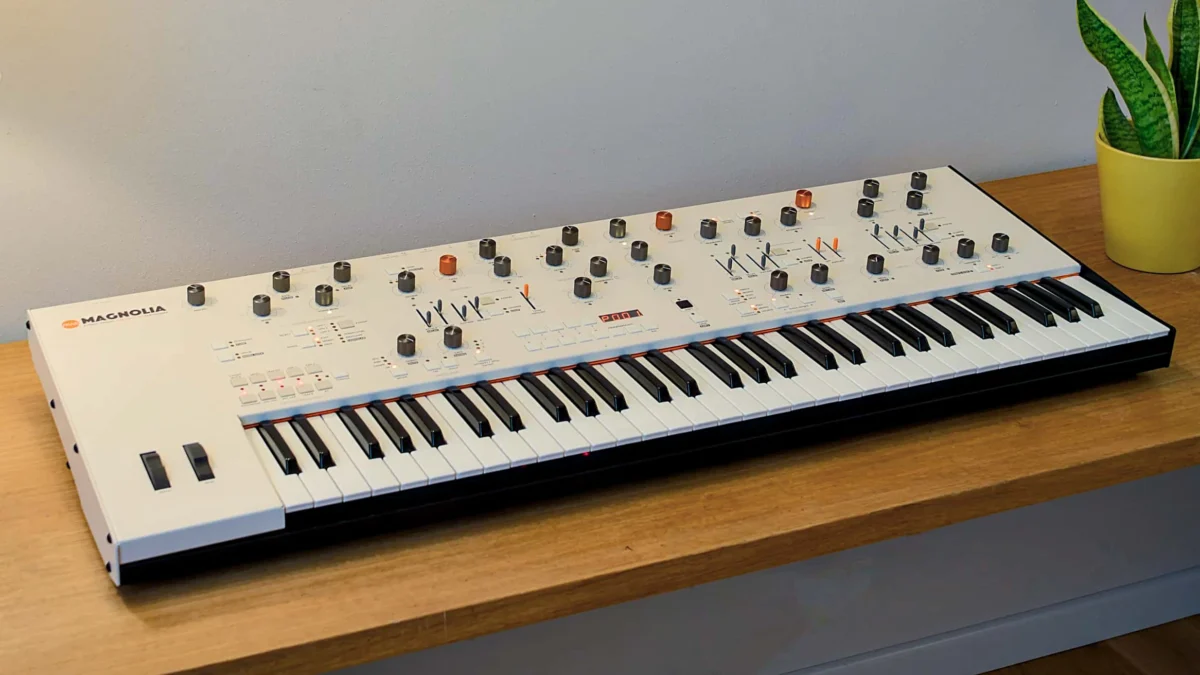
The landscape of analog synthesis has undergone a radical transformation over the last four decades, evolving from the massive, discrete-circuit polyphonic synthesizers of the early 1980s to the precision-engineered modular components of the modern era. In a detailed technical evaluation, renowned synthesist Starsky Carr recently conducted a side-by-side comparison between the Roland Jupiter-8, a flagship instrument released in 1981, and a contemporary system powered by Frap Tools Magnolia modules. The assessment aimed to determine how a modern boutique modular approach stacks up against what is widely considered the "gold standard" of vintage subtractive synthesis, focusing on five critical pillars: price, features, reliability, repairability, and raw sonic character.
The Historical Context of the Roland Jupiter-8
To understand the weight of this comparison, one must look at the legacy of the Roland Jupiter-8. Launched in 1981, the Jupiter-8 was Roland’s first truly professional long-scale polyphonic synthesizer. It arrived at a time when the industry was transitioning from the monophonic dominance of the 1970s to the polyphonic demands of the 1980s. With eight voices of polyphony, two stable voltage-controlled oscillators (VCOs) per voice, and a switchable 12dB/24dB per octave resonant low-pass filter, the Jupiter-8 became the backbone of countless hit records by artists such as Duran Duran, Howard Jones, and Michael Jackson.
The Jupiter-8 is celebrated for its "lush" and "creamy" textures, a result of its specific discrete circuitry and the cross-modulation capabilities that allowed for complex, harmonically rich tones. However, as a vintage instrument, it carries the baggage of age. The internal components, including proprietary Roland filter chips (IR3109) and VCA chips (BA662), are no longer in production, making maintenance a costly and specialized endeavor. In the current secondary market, a well-maintained Jupiter-8 often commands prices exceeding $30,000 USD, positioning it as a luxury item for high-end studios and collectors.
The Modern Challenger: Frap Tools Magnolia
Contrasting this vintage titan is the Frap Tools Magnolia, a product of the modern Eurorack modular revolution. Frap Tools, an Italian boutique manufacturer, has gained a reputation for high-fidelity audio paths and innovative circuit design. The Magnolia is a complex analog oscillator module designed for the Eurorack format. Unlike the fixed architecture of the Jupiter-8, a Magnolia-based system is modular, meaning the user must pair the oscillators with external filters, envelopes, and amplifiers to create a complete voice.
To facilitate an eight-voice comparison, Carr utilized a configuration that mirrored the polyphonic capabilities of the Jupiter-8. The Magnolia represents the pinnacle of modern analog engineering, utilizing "Thru-Zero" Frequency Modulation (TZFM) and integrated wavefolding—features that were largely unavailable or technologically impractical in the polyphonic synthesizers of 1981. This modular approach offers a level of flexibility and "surgical" precision in sound design that fixed-architecture instruments cannot match.
Technical Analysis of the Comparison Tests
The comparison was structured as a series of benchmarks designed to push the boundaries of both instruments. Carr began with a "warm pad" test, a staple of the Jupiter-8’s repertoire. The Jupiter-8 is famous for its "PWM" (Pulse Width Modulation) and its ability to create a wide, shimmering stereo field. The Magnolia system was tasked with recreating this warmth using its own high-stability oscillators.
Pulse Width Modulation and Filter Response
During the PWM comparison, the differences in oscillator stability became apparent. The Jupiter-8’s oscillators possess a certain "drift" and organic imperfection inherent in 40-year-old analog components. This drift is often cited by purists as the source of the instrument’s "musicality." The Magnolia, while capable of profound depth, exhibited the precision of modern manufacturing. However, when matched for filter cutoff and resonance, the Magnolia demonstrated an ability to mirror the Jupiter-8’s frequency response with surprising accuracy.
The filter test highlighted the Jupiter-8’s legendary 24dB/octave slope. Carr noted that the Magnolia, when routed through appropriate modern filters, could replicate the "weight" of the Jupiter-8’s low end. The comparison moved into "fat square bass" and "acid bass" territories, where the speed of the envelopes became a deciding factor. Modern modular envelopes often boast faster attack times than those found in vintage microprocessors, giving the Magnolia a slight edge in percussive, "snappy" bass patches.
Frequency Modulation and Wavefolding
The comparison took a sharp turn when exploring Frequency Modulation (FM). The Jupiter-8 features "Poly Mod," allowing Oscillator 1 to modulate Oscillator 2, creating bell-like tones and metallic textures. However, the Magnolia utilizes "Thru-Zero" FM, a more advanced form of modulation where the frequency of the oscillator can effectively go "negative" to maintain better harmonic stability and pitch tracking during deep modulation.
A significant point of divergence occurred during the wavefolding test. Wavefolding is a synthesis technique that "folds" the peaks of a waveform back onto themselves to create complex harmonics, a technique popularized by "West Coast" synthesis schools (such as Buchla). The Magnolia includes an internal wavefolder, allowing it to produce aggressive, distorted, and harmonically dense textures that the Jupiter-8 simply cannot achieve. This highlighted the technological gap between 1981 and the present day; the Jupiter-8 is a master of "East Coast" subtractive synthesis, while the Magnolia bridges the gap between different synthesis philosophies.
Reliability and Repairability: The Practical Reality
A major component of Carr’s evaluation centered on the practicalities of ownership. The Roland Jupiter-8, while a masterpiece of engineering, is essentially a "ticking time bomb" of aging capacitors, power supplies, and proprietary integrated circuits (ICs). Repairing a Jupiter-8 requires a technician with specific expertise and access to a dwindling supply of "new old stock" parts.
In contrast, the Frap Tools Magnolia is a modern product with a manufacturer’s warranty. It uses standard modern components that are easily sourced. If a Magnolia module fails, it can be replaced or repaired by the manufacturer or a standard electronics technician. For a working professional who requires a reliable instrument for touring or consistent studio work, the Magnolia presents a significantly lower risk profile.
Economic Implications and Market Value
The financial disparity between the two systems is perhaps the most stark metric.
- Roland Jupiter-8: Current market value ranges from $25,000 to $35,000 USD depending on condition and MIDI retrofitting.
- Frap Tools Magnolia System: While a single Magnolia module costs approximately $400–$500 USD, building an eight-voice polyphonic modular system (including 8 oscillators, 8 filters, 8 VCAs, 8 envelopes, and a polyphonic MIDI interface) would cost between $6,000 and $9,000 USD.
Even at the high end of modular pricing, a Magnolia-based polyphonic system is roughly one-third the price of a vintage Jupiter-8. This price-to-performance ratio is a critical consideration for modern producers who seek the "analog sound" without the "collector’s premium."
The "Sound Test Curveball" and Final Implications
The most unexpected result of Carr’s comparison was the sound test itself. While many enthusiasts expected the Jupiter-8 to easily outshine a modern modular system in terms of "mojo" or "vibe," the Magnolia proved to be an incredibly capable chameleon. Carr noted that in several blind tests, the Magnolia was able to replicate the specific harmonic signature of the Jupiter-8 to a degree that would be indistinguishable in a final musical mix.
This suggests that the "magic" of vintage hardware may be less about a unique, unreplicable physics and more about the specific calibration of filters and oscillators. Modern high-end analog modules, like those from Frap Tools, have reached a level of fidelity where they can emulate the characteristics of the past while offering the expanded features of the future.
Broader Impact on the Music Technology Industry
This comparison reflects a broader trend in the music industry: the "democratization of the elite sound." For decades, the Jupiter-8 sound was accessible only to those with deep pockets or access to world-class studios. Today, through the modular format and precision analog engineering, that same sonic power is being made available in a more reliable, affordable, and flexible format.
The findings of Starsky Carr’s evaluation indicate that while the Roland Jupiter-8 remains an iconic piece of industrial design and musical history, the Frap Tools Magnolia represents the evolution of that lineage. The "curveball" in the sound test—the fact that the Magnolia could hold its own and even surpass the Jupiter-8 in certain technical categories—serves as a testament to the current state of analog synthesis.
As the vintage market continues to see prices inflate, more musicians are likely to look toward boutique manufacturers like Frap Tools to achieve the high-fidelity analog textures once reserved for the legends of the 1980s. The debate between "vintage soul" and "modern precision" continues, but as this comparison proves, the gap is closing faster than many expected. For the modern producer, the choice is no longer between an expensive vintage relic and a digital imitation, but between two different, yet equally powerful, philosophies of analog sound.
