

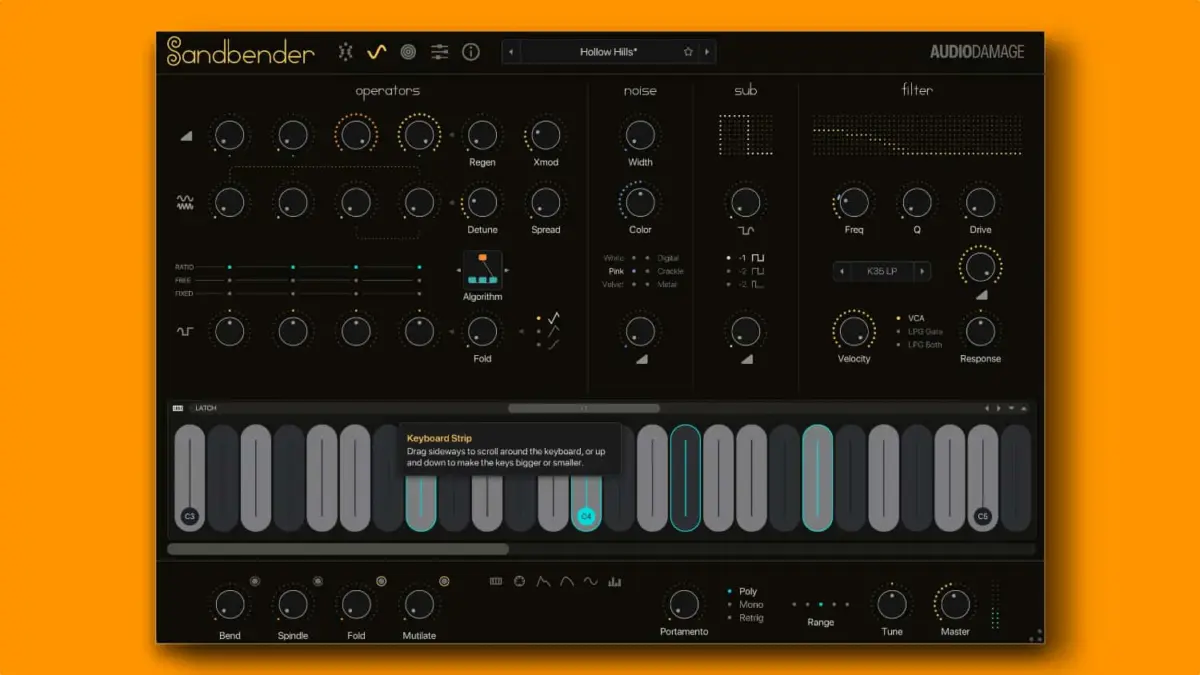
Audio Damage, a veteran developer in the digital signal processing and software instrument industry, has officially released Sandbender, a sophisticated four-operator frequency modulation (FM) synthesizer. The plugin, which is available for macOS, Windows, Linux, and iOS, represents a significant departure from traditional FM synthesis architectures by integrating elements of "West Coast" synthesis, such as wavefolding and low-pass gates, with a highly customizable modulation engine. Retailing at $99 USD, Sandbender aims to bridge the gap between the precision of digital FM and the organic, tactile nature of subtractive and additive synthesis.
The release marks a pivotal moment for Audio Damage, as the company continues to expand its portfolio of cross-platform instruments. Sandbender is designed to provide a more approachable yet deeper alternative to the complex six-operator FM synthesizers that have dominated the market since the 1980s. By focusing on a four-operator core but adding extensive per-operator waveshaping and a unique algorithm designer, the instrument offers a workflow that caters to both seasoned sound designers and those previously intimidated by the complexities of frequency modulation.
Technical Architecture and Operator Functionality
At the heart of Sandbender lies a four-operator engine where each operator serves as both a potential carrier and a modulator. Unlike the rigid structures found in legacy hardware, Sandbender provides ten pre-configured factory algorithms that cover standard FM configurations. However, its most notable technical feat is the inclusion of an integrated algorithm designer. This feature allows users to manually draw routing paths between operators, enabling the creation of bespoke modulation matrices that can range from simple linear chains to complex, self-modulating feedback loops.
Each of the four operators is equipped with independent tuning controls. Users can select from three distinct modes: harmonic ratios, which are essential for traditional tonal FM sounds; free ratios, allowing for non-integer relationships that result in metallic or dissonant timbres; and fixed frequencies, which lock the operator to a specific Hertz value regardless of the MIDI note played. This flexibility is critical for creating percussive sounds, drones, and complex inharmonic textures.
Beyond simple sine wave modulation, every operator in Sandbender features a dedicated waveshaper. This allows the base waveform of each operator to be transformed before it even enters the FM matrix, significantly broadening the harmonic spectrum available to the user. When combined with the synthesizer’s six distinct noise types—ranging from standard white and pink noise to more esoteric digital textures—the engine becomes capable of producing sounds that move far beyond the "glassy" or "electric" presets typically associated with early digital synthesis.
Integration of West Coast Synthesis Elements
While the core of Sandbender is rooted in digital FM, its processing chain draws heavy inspiration from the "West Coast" school of synthesis, popularized by pioneers like Don Buchla. Instead of relying solely on the traditional resonant filters found in "East Coast" (Moog-style) synthesis, Sandbender incorporates a modeled low-pass gate (LPG).
The low-pass gate is a specialized circuit that simultaneously controls both the amplitude and the frequency content of a signal. As the gate closes, the sound becomes both quieter and darker, mimicking the natural acoustic decay of struck objects like marimbas or drums. This addition gives Sandbender a percussive, organic quality that is often missing from purely digital FM instruments.
Furthermore, the synthesizer includes a dedicated wavefolder and a stereo filter section. The wavefolder adds harmonic complexity by "folding" the peaks of a waveform back onto itself when it exceeds a certain threshold, a technique that produces aggressive, rich overtones. The stereo filter section provides additional subtractive shaping, allowing users to polish the final output or create wide, evolving soundscapes through spatial modulation.
Historical Context and Evolution of FM Synthesis
To understand the significance of Sandbender, one must look at the trajectory of FM synthesis. Developed by John Chowning at Stanford University in the 1960s and later commercialized by Yamaha in the 1980s with the DX7, FM synthesis changed the music industry by providing realistic bell, brass, and percussion sounds that subtractive synthesis struggled to replicate. However, the DX7 was notoriously difficult to program due to its non-intuitive interface and the mathematical complexity of managing six operators.
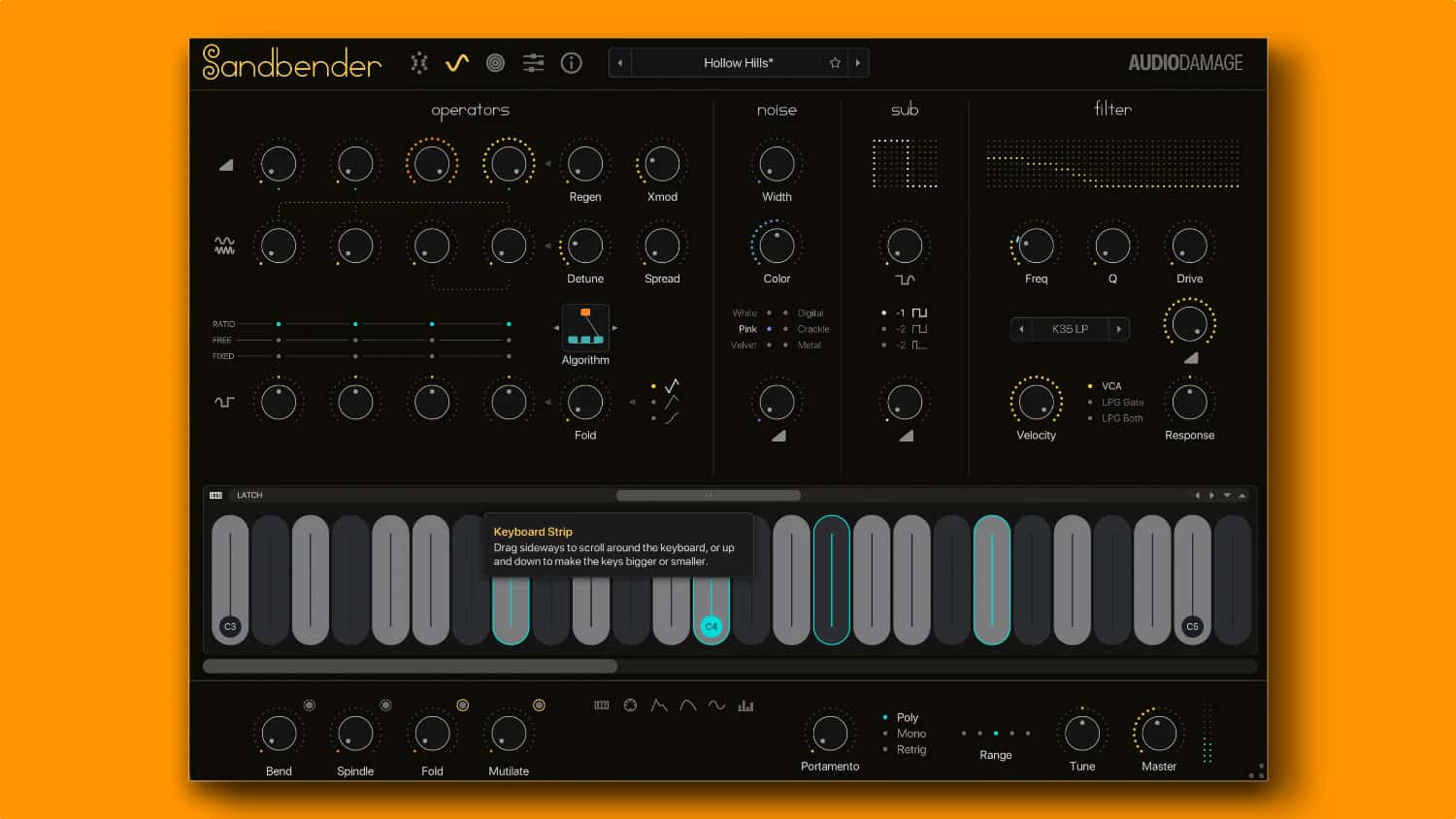
In the decades that followed, software developers sought to make FM more accessible. Instruments like Native Instruments’ FM8 and Ableton’s Operator simplified the interface while adding modern features. Audio Damage’s entry into this space with Sandbender reflects a modern trend: the "Hybrid FM" movement. This movement prioritizes ease of use and sonic character over raw operator count. By opting for four operators rather than six or eight, Audio Damage reduces the cognitive load on the user while compensating for the reduced operator count with advanced waveshaping and West Coast processing modules.
Chronology of Development and Release
The development of Sandbender follows a consistent pattern of innovation from Audio Damage. Over the past five years, the company has transitioned its entire product line to a custom-built framework that ensures parity across desktop and mobile platforms.
- Late 2022: Initial conceptualization of a "flexible FM" engine that would move away from the static algorithms of the past.
- Mid 2023: Beta testing of the algorithm designer, a feature intended to bring "modular-style" routing to a fixed-architecture plugin.
- Early 2024: Refinement of the low-pass gate modeling and the integration of the stereo filter section to ensure the plugin could handle both aggressive industrial tones and soft ambient textures.
- November 2024: Official launch of Sandbender across all major platforms, including a rare commitment to Linux support, which has made Audio Damage a favorite among the open-source audio community.
Market Position and Pricing Analysis
At a price point of $99, Sandbender positions itself in the mid-tier of the software instrument market. It competes directly with established FM plugins but distinguishes itself through its unique feature set. While many FM synthesizers are priced between $150 and $200, Audio Damage has maintained a competitive edge by offering a "one-purchase, all-platforms" model. A license for the desktop version typically includes access to the various installers, and the iOS version provides a professional-grade synthesis engine for mobile producers at a fraction of the cost of hardware equivalents.
Industry analysts note that the inclusion of Linux support is a strategic move. As more producers explore Steam Deck-based music production and Linux-based DAWs (Digital Audio Workstations) like Bitwig Studio and Ardour, the demand for high-quality, native Linux plugins has grown. Audio Damage is one of the few high-profile developers consistently meeting this demand.
Broader Implications for the Music Technology Industry
The release of Sandbender highlights several broader trends in music technology. First is the blurring of lines between different synthesis philosophies. The "East Coast vs. West Coast" debate is becoming increasingly irrelevant as modern digital instruments like Sandbender combine the best of both worlds—using FM (digital/West) for core timbre generation and LPGs/Filters (analog-modeled/East-West hybrid) for shaping.
Second, the "Algorithm Designer" in Sandbender signals a shift toward user-empowerment in software design. Users are no longer content with "black box" instruments where the internal signal path is hidden. By allowing users to draw their own routings, Audio Damage is catering to a more technically literate generation of musicians who are influenced by modular synthesis and visual programming environments like Max/MSP.
Finally, the cross-platform nature of Sandbender underscores the "device-agnostic" future of music production. The fact that the same synthesis engine, with the same presets and sonic fidelity, can run on a high-end Mac Studio and an iPad Pro suggests that the hardware gap is closing. This allows for a seamless workflow where a musician can start a sound design session on a commute using a tablet and finish it in a professional studio environment.
Official Philosophy and User Experience
While Audio Damage has not released a formal "press statement" in the traditional corporate sense, the design philosophy of founders Chris Randall and Adam Schabtach is evident in the product’s execution. The company has long advocated for "clean, vector-based interfaces" that are resizable and hardware-accelerated. This focus on UI/UX is critical in an FM synthesizer, where the relationship between modulators and carriers must be visualized clearly to be understood.
The inclusion of a sub-oscillator in Sandbender is another nod to practical music production. FM synthesis can sometimes result in "thin" sounds if the phase relationships or ratios are not perfectly tuned. By providing a dedicated sub-oscillator, Audio Damage ensures that users can maintain a solid low-end foundation, making the synth immediately "mix-ready" for genres like techno, drum and bass, and cinematic scoring.
Conclusion
Sandbender stands as a testament to the enduring relevance of frequency modulation when paired with modern innovations. By integrating custom algorithm design, West Coast processing, and a robust, cross-platform framework, Audio Damage has provided a tool that is as much an educational resource for synthesis as it is a powerful instrument for composition. As the industry continues to evolve, Sandbender’s hybrid approach may well become the blueprint for the next generation of digital synthesizers, proving that four operators, when utilized correctly, are more than enough to shape the future of sound.
