

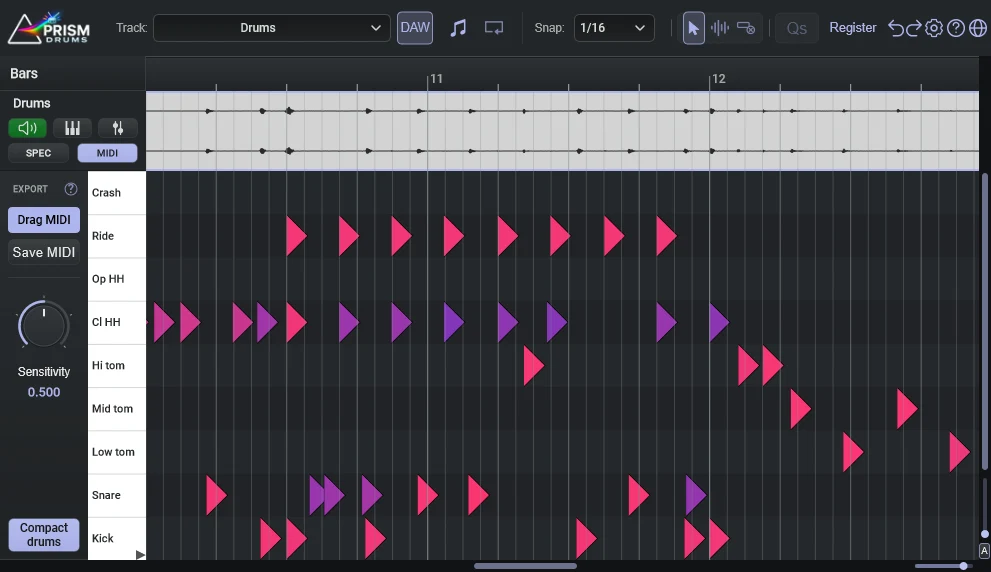
Aurally Sound has officially announced the release of Prism: Drums, a sophisticated audio-to-MIDI plugin designed to bridge the gap between organic drum performances and digital flexibility. By leveraging advanced machine-learning algorithms, the software allows music producers, engineers, and composers to convert complex acoustic drum recordings and loops into fully editable MIDI data. This technological leap addresses a long-standing challenge in the recording industry: the ability to accurately transcribe multi-instrumental percussion performances into a digital format without the need for manual, note-by-note editing or the use of cumbersome hardware triggers.
The software arrives at a time when the demand for high-fidelity drum replacement and layering is at an all-time high. In modern music production, the "drum sound" is often a hybrid of live-recorded kits and carefully selected samples. Prism: Drums facilitates this hybrid approach by identifying nine distinct drum components within a single audio file: kick, snare, closed hi-hat, open hi-hat, crash, ride, high tom, mid tom, and low tom. By capturing both the precise timing and the velocity dynamics of the original performance, the plugin ensures that the human feel—the subtle variations in timing and intensity—is preserved during the conversion process.
Technical Architecture and Machine Learning Integration
At the core of Prism: Drums is a proprietary machine-learning engine trained on vast datasets of acoustic drum performances. Unlike traditional transient detection methods, which rely primarily on volume peaks and frequency thresholds to trigger MIDI notes, the Prism engine utilizes pattern recognition to distinguish between overlapping frequencies. This is particularly crucial in drum recordings where a snare hit and a hi-hat strike might occur simultaneously, or where cymbal bleed might obscure the clarity of the tom-toms.
The development team at Aurally Sound prioritized local processing, ensuring that all machine-learning computations occur on the user’s local machine. This architectural choice stands in contrast to the growing trend of cloud-based AI tools that require users to upload sensitive audio files to remote servers. By keeping the processing local, Aurally Sound guarantees low latency and maintains the privacy of the user’s intellectual property, a critical factor for professional studios working under strict non-disclosure agreements.
The detection engine is optimized for "clean" recordings, typically those found in multi-track drum stems. However, the software is also capable of processing stereo drum loops and audio derived from stem separation tools. While the developer notes that artifacts from separated audio may occasionally impact detection accuracy, the engine’s robust training allows it to handle a variety of recording environments, from high-end studio rooms to home-recorded demos.
Evolutionary Chronology of Drum Triggering Technology
To understand the significance of Prism: Drums, it is necessary to examine the evolution of drum-to-MIDI technology over the past four decades.
- The Analog Era (1980s): Early drum triggering relied on piezo-electric sensors physically attached to drum heads. These sensors converted vibrations into electrical pulses that triggered external sound modules, such as the Simmons SDS-V. While revolutionary, these systems were prone to "false triggers" and required significant hardware investment.
- The DSP Revolution (1990s – 2000s): The advent of Digital Signal Processing (DSP) led to software like Drumagog and Steven Slate’s Trigger. These tools used transient detection to replace drum sounds in real-time. However, they were often limited to single-track processing and struggled with complex polyphonic percussion (e.g., a single overhead mic capturing the entire kit).
- The MIDI Extraction Phase (2010s): DAWs like Ableton Live and Logic Pro introduced "Audio to MIDI" functions. While effective for simple melodic lines or basic kick/snare patterns, these tools often failed to capture the nuances of a full drum kit performance, frequently requiring extensive manual correction.
- The Machine Learning Era (Present): Prism: Drums represents the current pinnacle of this evolution. By moving beyond simple transient detection into the realm of neural network-based recognition, the software can differentiate between a rimshot on a snare and a hit on a high tom, even when they occupy similar frequency ranges.
Workflow Integration: ARA and Standard Plugin Formats
One of the most significant features of Prism: Drums is its support for Audio Random Access (ARA) integration. ARA is a data-exchange extension for audio plugins that allows them to "see" the entire audio file in the DAW timeline, rather than just processing the audio in real-time as it passes through the mixer.
In compatible DAWs—such as PreSonus Studio One, Celemony Melodyne-supported environments, and certain versions of Cubase and Logic Pro—the ARA workflow allows Prism: Drums to instantly analyze large sections of audio. This eliminates the need for "real-time capture," a process where the user must play the entire song through the plugin to generate MIDI. For producers working on tight deadlines, the ARA integration can reduce the time required for drum replacement from hours to minutes.
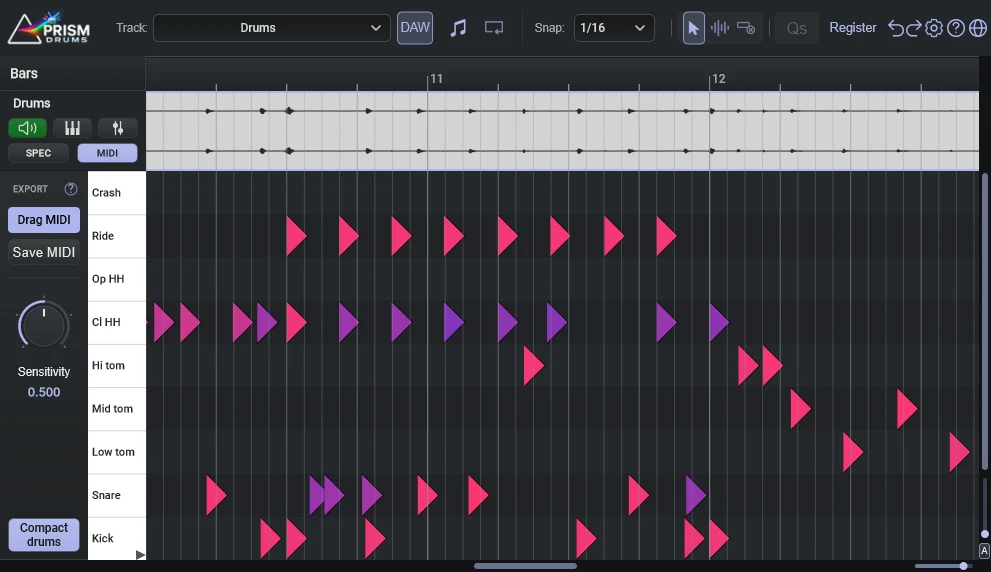
For users of DAWs that do not yet support ARA, such as Ableton Live or FL Studio, Prism: Drums functions as a standard insert effect. In this mode, the plugin captures audio during playback and generates MIDI data that can then be dragged and dropped into a MIDI track. The software is cross-platform, supporting VST3, Audio Unit (AU), and AAX formats on both Windows and macOS, ensuring compatibility with virtually every major digital audio workstation on the market.
Industry Implications and Market Analysis
The release of Prism: Drums at a $79 price point positions it as a highly competitive tool in the music technology market. Historically, high-quality drum replacement has been the domain of expensive software suites or specialized engineers. By democratizing access to machine-learning-based MIDI extraction, Aurally Sound is empowering independent producers to achieve "radio-ready" drum sounds without the overhead of a multi-million dollar studio.
Industry analysts suggest that tools like Prism: Drums are indicative of a broader shift toward "intelligent" production assistants. As machine learning becomes more integrated into the creative process, the role of the engineer is shifting from technical execution (manually aligning MIDI notes) to creative curation (choosing the right samples to layer over the extracted MIDI).
Furthermore, the ability to extract "grooves" from classic recordings opens up new avenues for remixing and educational analysis. A producer can take a drum break from a 1970s funk record, run it through Prism: Drums, and obtain a MIDI map that captures the exact swing and "pocket" of the original drummer. This MIDI can then be used to trigger modern, high-definition samples, effectively "updating" the sound while retaining the legendary performance.
Official Responses and User Experience
While Aurally Sound has focused on the technical prowess of the plugin, early feedback from the beta-testing community highlights the software’s transparency. "The goal wasn’t just to make a tool that works, but a tool that doesn’t get in the way of the music," a representative from the development team noted during a recent technical briefing. "By focusing on the nine most critical components of the drum kit, we’ve covered 95% of the needs of the modern rock, pop, and metal producer."
Producers who have integrated the tool into their workflow have noted the significant reduction in "cleanup time." Traditional audio-to-MIDI tools often produce "ghost notes"—unintended MIDI triggers caused by background noise or cymbal wash. Prism: Drums’ machine-learning engine is specifically designed to filter out these non-percussive elements, resulting in a cleaner MIDI file that requires minimal quantization or manual deletion.
Future Outlook and Availability
The launch of Prism: Drums is likely the first step in a series of ML-driven tools from Aurally Sound. As the engine continues to be refined, there is potential for expanded component recognition, including percussion elements like cowbells, tambourines, and woodblocks.
Prism: Drums is currently available for purchase through the official Aurally Sound website. The $79 USD price tag is a one-time purchase fee, a move that has been welcomed by a user base increasingly fatigued by the industry’s shift toward subscription-based models. The package includes installers for both Windows and macOS, ensuring that users can transition between different studio environments without needing multiple licenses.
In conclusion, Prism: Drums represents a significant advancement in the field of music production technology. By successfully applying machine learning to the complex problem of drum transcription, Aurally Sound has provided a tool that enhances both the efficiency and the creative potential of the modern recording studio. Whether used for drum replacement, layering, or groove extraction, Prism: Drums stands as a testament to the power of intelligent software design in the service of musical artistry.
