

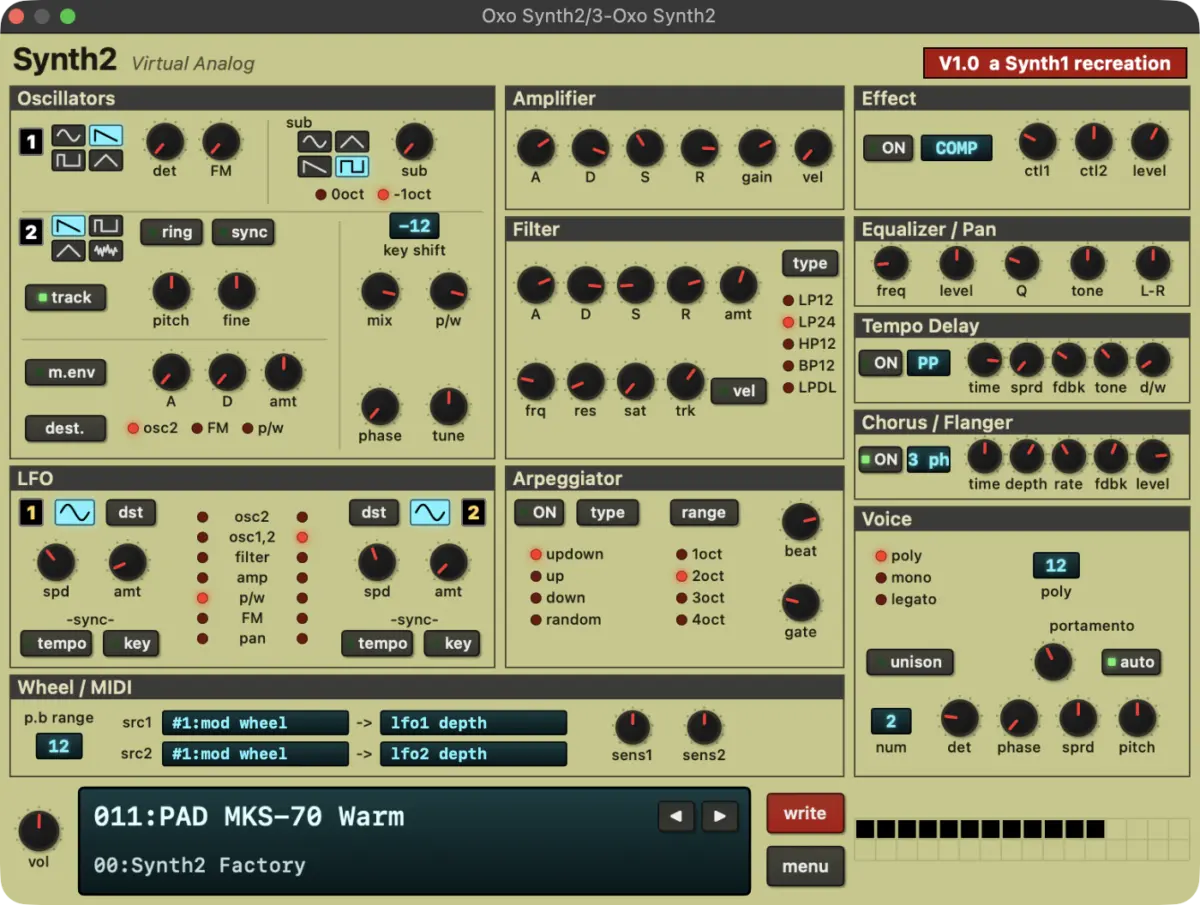
The digital music production landscape has witnessed a significant milestone with the official launch of Oxo Synth2, a comprehensive, open-source reconstruction of one of the most downloaded virtual instruments in history, Synth1. Developed by François Chabloz of Oxo Music, this new iteration aims to bridge the gap between legacy sound design and contemporary computing environments, specifically targeting users on macOS and iPadOS who have long struggled with the compatibility limitations of the original software. By utilizing modern coding standards and an extensive data-driven modeling process, Oxo Synth2 ensures that the vast library of sounds created over the last two decades remains functional for a new generation of musicians.
The Historical Significance of Synth1 in Digital Audio
To understand the impact of Oxo Synth2, one must examine the heritage of its predecessor. Originally released in the early 2000s by Ichiro Toda of Daichi Laboratory, Synth1 was designed as a software tribute to the Clavia Nord Lead 2, a legendary hardware virtual analog synthesizer. At a time when software synthesizers were often CPU-intensive and prohibitively expensive, Synth1 offered a lightweight, free, and incredibly versatile alternative.
For nearly twenty years, Synth1 maintained a dominant position in the "freeware" community. Its architecture—featuring two oscillators, a sub-oscillator, multiple filter modes, and an intuitive modulation matrix—became the foundation for countless electronic music tracks. Its popularity was bolstered by a massive community-driven ecosystem; it is estimated that tens of thousands of presets exist for the original plugin, organized into hundreds of "banks" shared across internet forums and producer hubs.
However, as operating systems evolved, the original Synth1 began to falter. The transition from 32-bit to 64-bit architecture, and more recently, Apple’s migration from Intel processors to proprietary Silicon (M1/M2/M3 chips), rendered the original code increasingly difficult to run. While Windows users could often rely on "wrappers" or compatibility modes, Mac users faced a near-total loss of access to the instrument following the release of macOS Catalina, which ended support for 32-bit applications. Oxo Synth2 emerges as the definitive solution to this technological obsolescence.
Technical Reconstruction and the Modeling Process
The development of Oxo Synth2 was not a simple port of existing code but rather a meticulous "black-box" reconstruction. François Chabloz approached the project by treating the original Synth1 as a reference hardware unit. Because the internal source code of the original Daichi Laboratory version was not public, Chabloz had to reverse-engineer the sonic characteristics of the instrument through empirical observation.
According to technical documentation released by Oxo Music, the development process involved capturing and analyzing approximately 3 gigabytes of measurement data. This data was used to map the behavior of every parameter within the synthesizer, from the specific curve of the resonant filters to the nuances of the oscillator shapes and the timing of the envelopes. This "measurement-driven" approach ensures that Oxo Synth2 is not merely a visual imitation but a functional clone capable of loading and playing original Synth1 patches with high degrees of accuracy.
The synthesis engine retains the core specifications that made the original famous:
- Dual Oscillators: Support for FM modulation, ring modulation, and sync.
- Filter Section: A multi-mode filter offering low-pass, band-pass, and high-pass options with variable slopes.
- Modulation: Two LFOs and dedicated envelopes for the filter and amplifier.
- Effects and Arpeggiation: A built-in arpeggiator and a suite of effects including delay, chorus, and flanger.
By maintaining these exact parameters, Oxo Synth2 allows producers to import their legacy .sy1 files and preset banks, ensuring that projects started ten or fifteen years ago can be opened and edited on modern hardware without losing their sonic integrity.
Platform Availability and System Requirements
In a move that aligns with modern production workflows, Oxo Music has prioritized cross-platform accessibility, particularly within the Apple ecosystem. The software is currently available in the following formats:
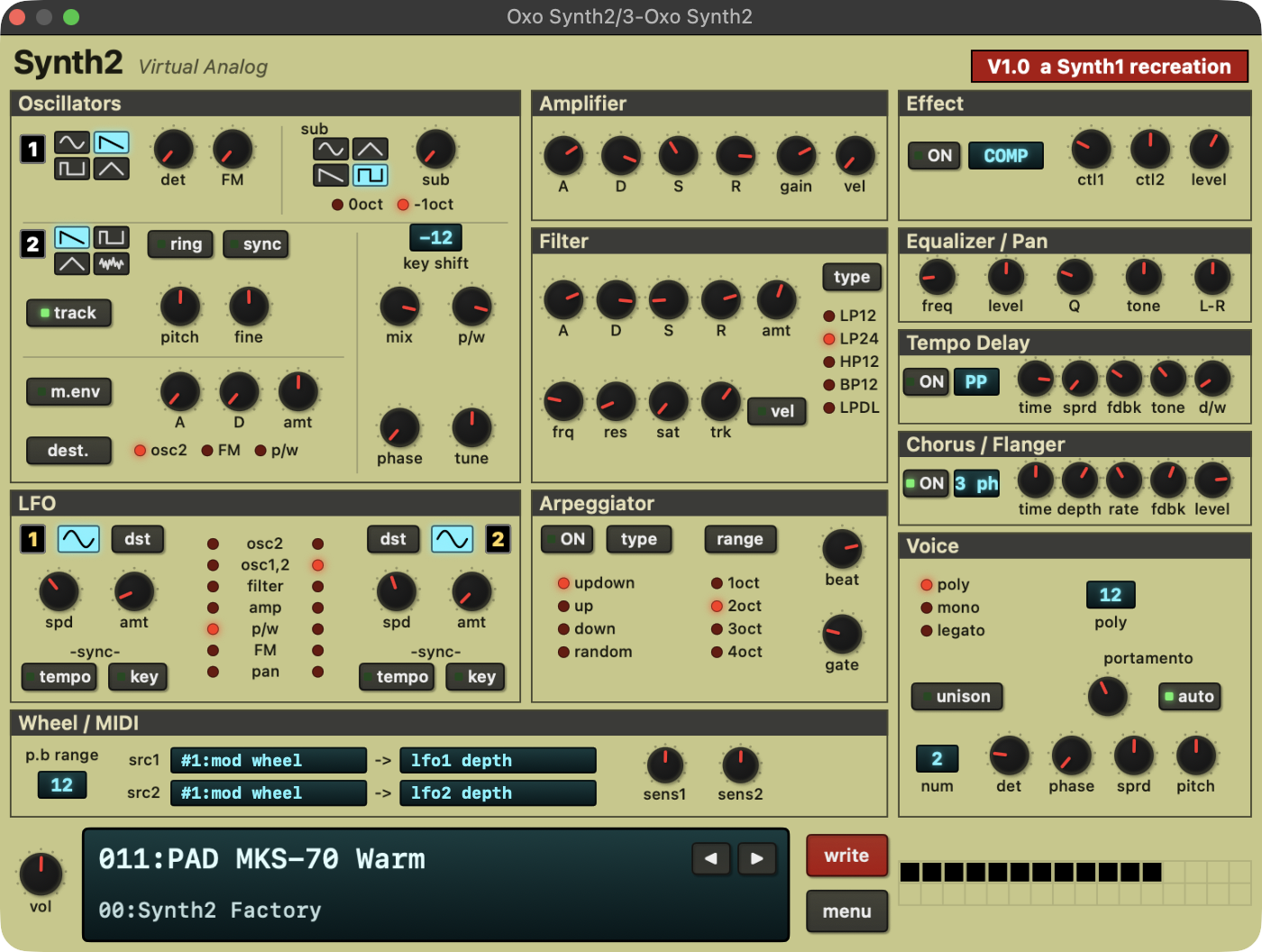
- macOS: Available as a VST3 and Audio Unit (AU) plugin. It requires macOS 14 (Sonoma) or later. This version is natively compiled for both Intel and Apple Silicon, providing optimized performance on the latest MacBook Pro and Mac Studio models.
- iPadOS: In a significant expansion of the Synth1 legacy, Oxo Synth2 is available as an AUv3 instrument. This allows mobile producers to use the synth within host applications like Logic Pro for iPad, Cubasis, or AUM. It requires iPadOS 17 or later.
While the current release focuses on Apple platforms, the developer has confirmed that a Windows VST3 version is currently in active development. Furthermore, because the project is hosted on GitHub under the MIT open-source license, the developer has invited the global community to contribute to the codebase. This open-source nature is a critical pivot from the original Synth1, which was closed-source and dependent entirely on Ichiro Toda for updates. By making the code public, Oxo Music ensures that the instrument can be maintained and ported to other platforms, such as Linux, by the community, effectively future-proofing it against further OS changes.
Analysis of the Open-Source Philosophy in Music Tech
The release of Oxo Synth2 under the MIT license represents a broader trend in the music technology industry: the movement toward digital preservation. As software becomes the primary medium for musical creation, the industry faces a "digital dark age" where classic sounds are lost when companies go out of business or developers stop updating their tools.
By releasing the source code, François Chabloz has transformed a piece of "abandonware" into a living community project. This has several implications:
- Educational Value: Aspiring DSP (Digital Signal Processing) engineers can study the code to understand how a classic virtual analog synth is constructed.
- Long-term Stability: If Oxo Music ceases operations, the code remains available for others to compile and update.
- Customization: Advanced users can modify the interface or the synthesis engine to suit specific needs, potentially leading to "forks" of the synth with new features.
Industry analysts suggest that this move puts pressure on other legacy developers to consider open-sourcing their older products rather than letting them disappear from the market.
Community Reaction and Market Impact
While official statements from Daichi Laboratory have not been issued—consistent with the developer’s long-term silence on the project—the user community has responded with overwhelming positivity. Beta testers have noted that the CPU efficiency of Oxo Synth2 remains remarkably high, mirroring the "lightweight" feel of the original, which was a hallmark of its success in the early 2000s.
Initial feedback from the Mac-based production community highlights the relief of being able to access old preset libraries. "For years, we had to keep an old Windows laptop or a legacy Mac running High Sierra just to use Synth1," noted one user on a prominent production forum. "Having a native Apple Silicon version that sounds identical is a game-changer for finishing old projects."
The inclusion of an iPad version is also seen as a strategic masterstroke. The mobile music production market is growing rapidly, yet it often lacks the "staple" freeware instruments that defined the desktop experience. Oxo Synth2 provides iPad users with a professional-grade subtractive synthesizer for free, which may disrupt the market for paid entry-level synth apps.
Conclusion and Future Outlook
Oxo Synth2 is more than just a software release; it is a successful exercise in digital archeology and modern engineering. By recreating a beloved classic through rigorous measurement and offering it to the public for free, François Chabloz and Oxo Music have preserved an essential chapter of electronic music history.
As the Windows version nears completion and the potential for a Linux port grows through community contribution, Oxo Synth2 is poised to reclaim the title held by its predecessor: the most essential free synthesizer in the producer’s toolkit. In an era where subscription models and expensive licenses dominate the software industry, the arrival of a high-quality, open-source, and cross-platform instrument serves as a reminder of the collaborative spirit that built the foundations of digital audio.
Producers interested in the project can download the installers and access the source code via the official Oxo Music website. As the project evolves, it will likely serve as a blueprint for how other "lost" digital instruments can be resurrected for the modern age, ensuring that the sounds of the past continue to shape the music of the future.
