

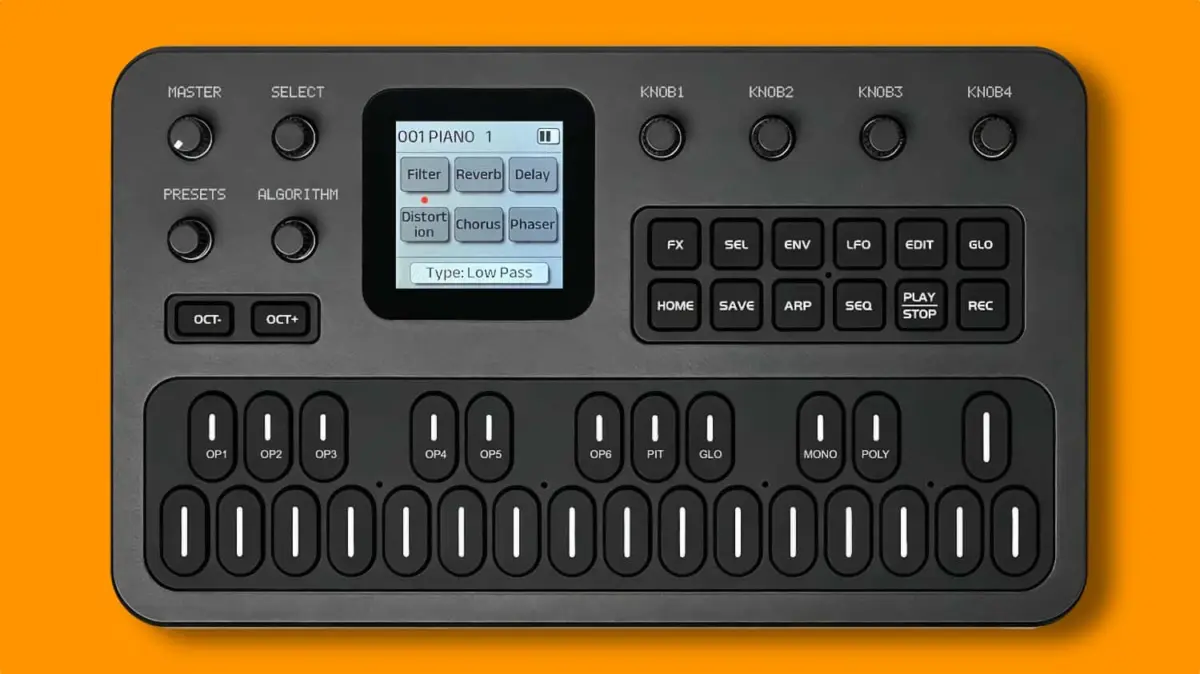
The landscape of electronic music hardware is currently witnessing a significant shift as the M-Vave FM-1, a budget-friendly digital synthesizer, evolves from a simple consumer product into a versatile platform for community-driven innovation. Originally marketed as a compact and affordable Frequency Modulation (FM) synthesizer, the device has garnered intense interest within the global synthesist community, not merely for its factory capabilities, but for its potential as a canvas for custom firmware. This movement, highlighted by prominent figures in the music technology space such as composer and developer David Hilowitz, represents a broader trend where the barriers between hardware manufacturing and software engineering are being dismantled by the democratization of coding tools and the advent of artificial intelligence.
The Convergence of Budget Hardware and Community Innovation
The M-Vave FM-1 entered the market as a low-cost entry point into the world of FM synthesis, a method of sound generation popularized in the 1980s by the Yamaha DX7. Retailing for approximately $80 USD, the FM-1 was initially viewed as a utilitarian tool for hobbyists. However, its internal architecture—which balances cost-efficiency with sufficient processing power for digital signal processing (DSP)—caught the attention of independent developers. These individuals recognized that the hardware’s physical interface, consisting of dedicated knobs and buttons, could be repurposed to control entirely different synthesis engines.
The transformation of the FM-1 is part of a larger historical context involving "hackable" music gear. Historically, devices like the Korg Monologue or the Teenage Engineering series have offered varying degrees of user customization, but often at a higher price point or within a more restricted ecosystem. The M-Vave FM-1’s low cost of entry reduces the financial risk for users who wish to experiment with flashing non-standard software onto their devices, thereby fostering a "maker" culture that prioritizes experimentation over warranty preservation.
Technical Specifications and the Original FM Engine
To understand the hype surrounding the FM-1, one must first examine its foundational specifications. The device is a multi-timbral FM synthesizer that offers a streamlined approach to a traditionally complex form of synthesis. FM synthesis relies on "operators" (oscillators) modulating one another’s frequencies to create harmonically rich and evolving timbres. While professional-grade FM synths often feature six or more operators with complex routing algorithms, the FM-1 provides a more accessible interface, making it an attractive tool for musicians who find traditional FM programming daunting.
The hardware features a compact form factor, MIDI connectivity, and a set of encoders that allow for real-time manipulation of sound parameters. Its portability and USB-C power compatibility align it with the modern "mobile studio" trend. However, the true value proposition emerged when it was discovered that the device’s firmware could be overwritten. This allowed the community to begin developing alternative "brains" for the machine, effectively turning a single-purpose synthesizer into a multi-functional audio workstation.
David Hilowitz and the Documentation of a Digital Renaissance
The recent surge in visibility for the FM-1 can be largely attributed to the documentation provided by David Hilowitz, a respected voice in the sampling and synthesis community. In his technical explorations, Hilowitz demonstrated how the FM-1’s custom-firmware ecosystem has expanded far beyond the original manufacturer’s intent. His analysis showcased projects where the device was repurposed to function as a subtractive synthesizer, a granular sampler, and even a generative sequencer.
Hilowitz’s involvement highlights a critical shift in the music technology media cycle. Rather than focusing solely on the "out-of-the-box" experience, influencers and educators are now focusing on the longevity and extensibility of hardware. By showcasing the FM-1 running community-developed code, Hilowitz has provided a proof-of-concept for the idea that hardware is no longer a static purchase, but an evolving service or platform.
The Role of AI and Vibe Coding in Modern DSP
Perhaps the most disruptive element of the M-Vave FM-1 phenomenon is the methodology behind its new software: "vibe coding." This term refers to the practice of utilizing Large Language Models (LLMs) and AI coding assistants—such as GitHub Copilot, Cursor, or Claude—to generate complex code through natural language prompts.
In the past, writing firmware for a synthesizer required deep expertise in C++, assembly language, and the specific idiosyncrasies of embedded systems. "Vibe coding" allows musicians and sound designers who may lack a formal background in computer science to describe the desired behavior of an instrument and receive functional code in return. This iterative process involves the user describing a "vibe" or a specific sonic characteristic, testing the generated code on the hardware, and using AI to debug and refine the results.
This technological leap has effectively lowered the barrier to entry for digital instrument design. It allows for a more rapid development cycle where a new synthesis engine can be prototyped in days rather than months. The M-Vave FM-1 has become the primary laboratory for this experiment because its hardware is standardized and inexpensive enough to be considered "disposable" in the event of a critical software failure during the development process.
A Comparative Market Analysis: The $80 Disruptor
When placed alongside its competitors, the M-Vave FM-1 occupies a unique market position. For comparison:
- Korg Volca Series: Priced between $150 and $200, these devices offer excellent sound but are largely closed systems with limited official firmware update paths.
- Teenage Engineering OP-Z: Priced near $600, it offers immense power and a custom "gizmo" ecosystem but at a significantly higher financial barrier.
- Daisy Seed / Teensy: These are pure development boards (approx. $30-$50) that require the user to build their own physical interface (knobs, screens, cases).
The FM-1 sits in the "Goldilocks zone." It provides the finished aesthetic and tactile interface of a commercial product with the internal flexibility of a development board. For $80, a user receives a case, a power supply, a MIDI interface, and a control surface, which would often cost more to assemble individually as a DIY project.
Chronology of the Custom Firmware Movement
The trajectory of the M-Vave FM-1’s rise can be traced through several key phases:
- Market Entry (Late 2023 – Early 2024): M-Vave releases the FM-1 as a budget FM synth. Initial reviews are positive but note the limited scope of the factory sounds.
- Hardware Probing (Mid 2024): Enthusiasts on forums and Discord servers begin identifying the internal chipsets. Early "jailbreaking" efforts successfully allow for the backup and restoration of factory firmware.
- The First Alternatives: Independent developers release basic modifications, such as expanded MIDI implementation and alternative filter curves.
- The AI Integration Phase (Late 2024): The emergence of "vibe coding" leads to a proliferation of entirely new firmware sets. Developers begin sharing GitHub repositories containing AI-assisted code that transforms the FM-1 into different types of instruments.
- Mainstream Recognition (Current): Coverage by figures like David Hilowitz brings the movement to a wider audience, leading to a surge in sales and a solidified status for the FM-1 as a "cult classic" in the making.
Broader Implications for the Electronic Music Industry
The success of the FM-1 as a hackable platform carries significant implications for major manufacturers. If a $80 device can be transformed into a professional-grade tool through community effort, the value proposition of mid-tier, closed-system synthesizers may be called into question.
Industry analysts suggest that we may be entering an era of "Software-Defined Instruments." In this model, the hardware is a generic controller, and the identity of the instrument is entirely determined by the software loaded onto it. This mirrors trends in the automotive and smartphone industries, where hardware is standardized to achieve economies of scale, while features are unlocked or modified via software updates.
Furthermore, the rise of AI-assisted coding in this space suggests that the future of sound design will be more conversational. Instead of menu-diving on a small screen, the next generation of synthesists may "talk" their instruments into existence, using AI to bridge the gap between musical intent and technical execution.
Official Responses and Safety Considerations
While M-Vave has not officially endorsed the use of custom firmware, the company has historically maintained a passive stance toward the modding community. This "benign neglect" has allowed the ecosystem to flourish without the threat of legal action or software lockdowns. However, users are cautioned that installing third-party firmware typically voids warranties and carries the risk of "bricking" the device—rendering it permanently inoperable.
Despite these risks, the community continues to grow. The collaborative nature of the FM-1 movement—where code is shared freely and refined collectively—serves as a model for the future of open-source music technology.
Conclusion: The Future of Modular Software in Fixed Hardware
The M-Vave FM-1 stands as a testament to the power of community-driven innovation. By combining affordable hardware with the cutting-edge capabilities of AI-assisted development, it has redefined what is possible at the $80 price point. As more developers contribute to the custom-firmware ecosystem, the FM-1 is likely to remain a relevant and evolving tool for years to come, proving that in the modern era, the "soul" of a synthesizer is no longer found in its circuitry alone, but in the code and the community that supports it.
