

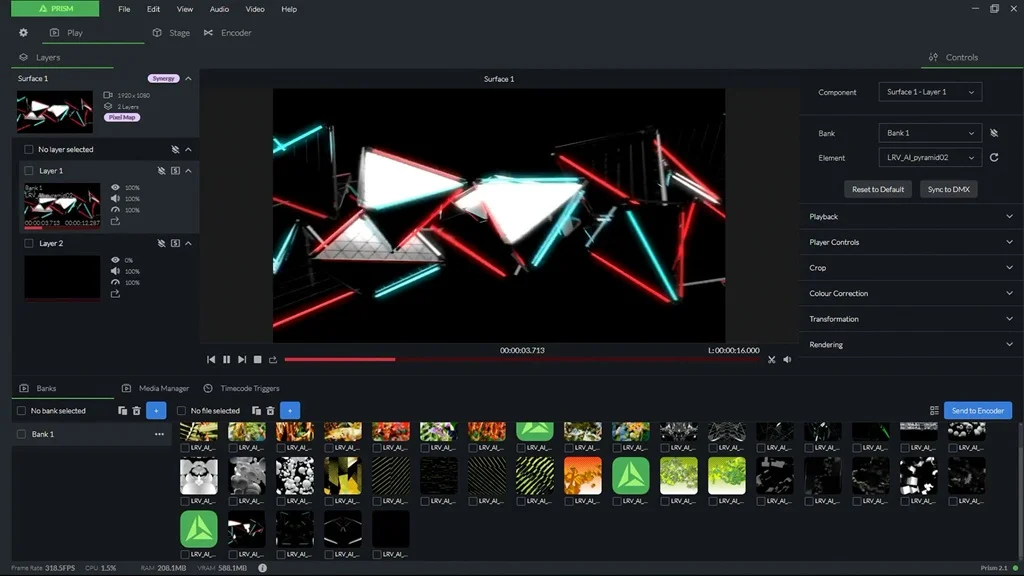
The global entertainment technology sector has reached a significant milestone with the official introduction of Prism, a new media control interface developed by the London-based lighting control specialist Avolites. Designed to address the increasingly blurred lines between lighting design and video content management, Prism represents a strategic shift toward democratizing high-end visual workflows. By providing an intuitive platform that does not require the extensive programming background typically associated with complex media servers, Avolites aims to empower a broader range of designers and operators to manage dynamic visual environments. This launch comes at a time when live productions, from international concert tours to immersive museum installations, are demanding a more unified approach to pixel-based storytelling.
The Convergence of Light and Motion: The Philosophy Behind Prism
For over four decades, Avolites has been at the forefront of the lighting industry, but the last 15 years have seen the company pivot toward a more integrated vision of show control. The development of Prism is a direct response to a specific market pain point: the "skills gap" in media server operation. As LED technology becomes more affordable and accessible, even smaller productions are incorporating high-resolution screens and pixel-mapped fixtures. However, the budget for a dedicated media team is often non-existent in these scenarios.
Jon Hole, Product and Marketing Manager at Avolites, emphasizes that the software was built to lower the barrier to entry without stripping away professional-grade capabilities. The goal was to create a tool where lighting professionals, who are already comfortable with DMX-based workflows and timeline programming, can step into the world of video without feeling overwhelmed by the technical overhead of traditional media servers. This "accessible power" philosophy is intended to reduce the time spent on troubleshooting and technical setup, allowing more room for creative experimentation.
Technical Specifications and the Synergy Ecosystem
At the heart of Prism’s value proposition is its deep integration with the existing Avolites ecosystem. When paired with the company’s flagship Titan lighting control software via the proprietary Synergy networking solution, Prism ceases to be a standalone video player and becomes an extension of the lighting console. This integration allows for a "single-pane-of-glass" experience where the operator can manipulate video layers, adjust colors, and trigger clips directly from the lighting desk.
The technical architecture of Prism is built to handle the rigors of modern high-resolution playback. The software supports a wide array of professional codecs, including HAP, NotchLC, and DXV, ensuring compatibility with the industry’s most popular content creation tools. Furthermore, the inclusion of AiM encoding provides a specialized pipeline for high-resolution video, ensuring smooth playback even when dealing with 4K or 8K canvases.
Key technical features of the Prism platform include:
- 10-Bit Color Support: Ensuring high dynamic range (HDR) fidelity and smooth gradients, which is essential for modern LED wall technology.
- Comprehensive Output Options: Beyond physical display outputs, Prism supports NDI (Network Device Interface) and RTSP (Real-Time Streaming Protocol), facilitating flexible signal routing over standard IP networks.
- Advanced Blending: With 17 different blend modes, designers have granular control over how layers interact, mirroring the creative flexibility found in professional post-production software.
- Timecode Triggering: Essential for synchronized touring shows, Prism allows for frame-accurate playback synced to external timecode sources.
- Pixel-Map Adjustments: The software allows users to bridge the gap between video content and lighting fixtures, mapping video data onto DMX-controlled lights with minimal latency.
A Chronology of Innovation: Avolites’ 15-Year Media Journey
The release of Prism is not an isolated event but the culmination of a decade and a half of research and development in live media integration. To understand the significance of Prism, one must look at the timeline of Avolites’ evolution in this space.
In the late 2000s, Avolites began exploring the integration of video into its lighting consoles, recognizing that the future of show design would rely on "pixels" rather than just "beams." This led to the development of the Ai media server range, which quickly gained a reputation for handling massive data loads. The Ai platform was famously utilized during the Opening and Closing Ceremonies of the 2012 London Olympic Games, where it managed complex projections and LED mappings on a scale rarely seen before.
Since then, Avolites has refined its media offerings through high-profile collaborations. The technology has been a staple in the touring rigs of global superstars like Coldplay and Maluma, and has been implemented in permanent installations ranging from the Rio Hotel in Las Vegas to the intricate stage setups of the band The Script. Each of these projects provided data and feedback that informed the development of Synergy—the protocol that allows Titan and Ai (and now Prism) to "speak" the same language. Prism represents the next step in this chronology: taking the power of the Ai engine and repackaging it into a more streamlined, user-friendly interface for the modern era.
Licensing Models and Hardware Integration: The AvoKey and Travel Collections
Avolites has introduced a tiered licensing structure for Prism, designed to scale with the needs of the user. The software is tied to two distinct product lines: the AvoKey Collection and the Travel Collection. This approach allows users to invest in the level of performance required for their specific projects while maintaining the ability to upgrade as their needs grow.
The AvoKey Collection is aimed at permanent installations and high-end touring. It is divided into three tiers:
- A1+: Unlocks one primary display output, suitable for simple single-screen setups or small-scale pixel mapping.
- A2+: Unlocks two display outputs, providing the flexibility for dual-screen environments or main-and-backup configurations.
- A3+: Unlocks three display outputs, catering to complex multi-screen stages or high-resolution panoramic displays.
The Travel Collection is optimized for the mobile professional, offering the same tiered output structure (T1+, T2+, and T3 Bundle) in a more portable format. This ensures that designers can carry their media control capabilities in a laptop bag, making it an ideal solution for fly-dates, festival guest slots, and corporate events where space and weight are at a premium.
Market Analysis: Implications for the Global Live Events Industry
The introduction of Prism is likely to have a ripple effect across several sectors of the live entertainment industry. In the venue and club market, where dedicated video technicians are a luxury, Prism allows the house lighting designer to take control of the visual atmosphere in its entirety. This creates a more cohesive experience for the audience, as the lighting and video can be perfectly synchronized in terms of color palette and rhythm.

In the world of museums and galleries, the software’s support for NDI and RTSP makes it a powerful tool for networked installations. As these institutions move toward more interactive and digitally-driven exhibits, the need for a stable, professional-grade media player that can be managed by non-specialists becomes paramount.
Industry analysts also point to the "efficiency factor." By reducing the time required for media programming, production companies can lower their labor costs and speed up their load-in and rehearsal schedules. In an era where production timelines are becoming increasingly compressed, the ability to rapidly deploy high-quality visual content is a significant competitive advantage.
Official Reactions and Future Outlook
Early feedback from industry professionals suggests a positive reception for the software’s "visual workflow" approach. Production managers have noted that the ability to see a real-time preview of the media canvas within the control interface significantly reduces the cognitive load on the operator.
While Avolites has a strong foothold in the European and North American markets, the launch of Prism is also seen as a move to capture a larger share of the emerging markets in Asia and South America. In these regions, the demand for high-quality production values is soaring, but the pool of specialized media server operators is still growing. Prism provides a "fast track" for these regions to achieve world-class visual results.
Looking ahead, Avolites has confirmed that Prism will be a centerpiece of their upcoming exhibition schedule. The industry will have its first opportunity for a hands-on demonstration of the software at LEATCON 26, held in Hamburg from October 6th to 8th. Avolites will be stationed in Hall A1, Stand D07, where they are expected to showcase the full range of Prism’s capabilities, including its seamless integration with the latest Titan hardware.
As the entertainment landscape continues to evolve, the arrival of Prism signals a shift toward a more holistic view of show control. No longer are lighting and video separate entities; they are now two sides of the same creative coin. With Prism, Avolites has provided the toolset to ensure that this convergence is accessible to all, regardless of their technical background. The software stands as a testament to the company’s 15-year legacy in media integration and its commitment to the future of visual storytelling.
