

The landscape of professional music production has long grappled with the friction between modern digital convenience and the tactile, sonic richness of vintage hardware. In a significant move to bridge this gap, Coffeeshopped has officially announced the release of Patch Base 4 for Mac. This latest iteration of the acclaimed synthesizer editor and librarian software arrives as a comprehensive update designed to provide a more stable, polished, and feature-rich environment for sound designers and electronic musicians. By offering a unified interface for over 85 different hardware synthesizers, Patch Base 4 seeks to eliminate the technical hurdles associated with legacy equipment, allowing artists to focus on the creative process rather than the complexities of MIDI System Exclusive (SysEx) communication.
Addressing the Modern Challenges of Vintage Hardware
The primary obstacle facing owners of vintage synthesizers from the 1980s and 1990s is the interface. Instruments such as the Yamaha DX7, the Roland D-50, or the Korg Wavestation were revolutionary for their time, yet their physical interfaces often relied on small, non-backlit LCD screens and a limited number of buttons. This led to the dreaded phenomenon known as "menu diving," where users had to navigate through layers of sub-menus to change a single parameter. In a modern studio environment where speed and intuition are paramount, these legacy interfaces can stifle creativity.
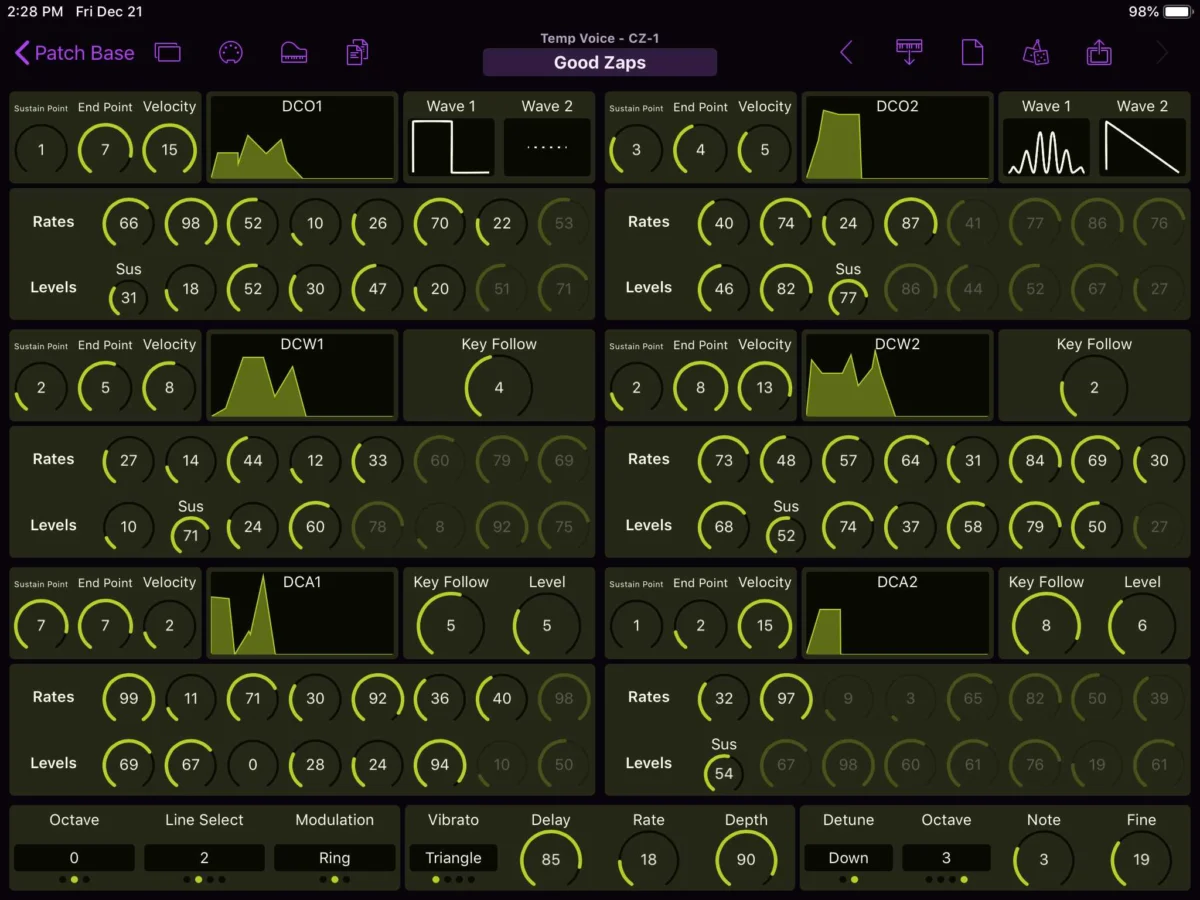
Patch Base 4 addresses this by providing a high-resolution, graphical representation of every parameter within a supported synthesizer. Instead of squinting at a two-line display on a rack-mounted module, users can now manipulate sliders, knobs, and envelopes on their Mac screen. Changes are transmitted in real-time to the hardware, providing immediate auditory feedback. This level of integration transforms a thirty-year-old synthesizer into a device that feels as accessible and responsive as a modern software plugin.
Evolution of the Patch Base Ecosystem
Developed by Chadwick Wood under the Coffeeshopped brand, Patch Base originally found its footing on the iPad. The touch-screen interface of the tablet was a natural fit for the faders and toggles of a synth editor. However, as the user base grew, the demand for a dedicated desktop version became undeniable. Professional producers often centralize their operations within a Digital Audio Workstation (DAW) on a Mac, and having a native application that sits alongside Logic Pro, Ableton Live, or Cubase provides a more streamlined workflow.
The transition from Version 3 to Version 4 represents a significant technical milestone. While previous versions focused on expanding the library of supported synths, Patch Base 4 prioritizes the "under-the-hood" architecture. The developer has emphasized that this version is built for increased stability, ensuring that the software can handle the heavy MIDI data loads required when performing bulk dumps of patch libraries or real-time parameter automation.
Key Features and Technical Enhancements in Version 4
Patch Base 4 is not merely a cosmetic update; it introduces several functional improvements that enhance the utility of the software for power users. While the core mission remains the editing and organization of sounds, the refined engine provides smoother performance on the latest macOS versions, including full optimization for Apple Silicon (M1, M2, and M3 chips). This ensures that users on the newest hardware experience low-latency communication with their external gear.
One of the standout features of the Patch Base ecosystem is its "Librarian" functionality. In addition to editing a single sound (a "patch"), the software allows users to manage entire banks of sounds. This is critical for performers who need to organize specific sets of sounds for live shows or studio projects. Patch Base 4 improves the ease with which users can fetch banks from their hardware, reorganize them via drag-and-drop, and save them to their Mac for permanent backup. This effectively serves as an insurance policy against the internal battery failures that often plague vintage gear, leading to the loss of precious custom sounds.
A Comprehensive Library of Supported Instruments
The true strength of Patch Base 4 lies in its sheer breadth of support. Supporting over 85 different synthesizers, the software covers a vast spectrum of synthesis types, including Frequency Modulation (FM), Linear Arithmetic (LA), Wavetable, and traditional Analog.
Yamaha FM Synthesis Support
The Yamaha DX and TX series are notorious for being difficult to program. Patch Base 4 provides comprehensive editors for the DX7, DX7II, TX81Z, and the modern Reface DX. By visualizing the complex operator relationships and envelope generators of FM synthesis, the software demystifies a form of sound design that many musicians previously found impenetrable.
Roland Legacy Support
Roland’s "Super JV" and "Super JD" series, along with the legendary D-50, are staples of film scoring and pop production. Patch Base 4 offers deep-level access to the multi-timbral setups of the JV-1080 and JV-2080, as well as the JD-990. These units often have hundreds of parameters per patch, all of which are mapped out clearly in the Patch Base interface.
Korg and Other Manufacturers
From the Korg M1 and Wavestation to the Oberheim Matrix series and the Waldorf Blofeld, the software acts as a "universal remote" for the studio. Recent additions to the library also include modern classics like the Korg Minilogue and the Monologue, showing that the software is as relevant for new hardware as it is for the old.
Technical Data and Communication Standards
Patch Base 4 operates primarily through the MIDI protocol, specifically utilizing System Exclusive (SysEx) messages. Unlike standard MIDI CC (Continuous Controller) messages, which are typically limited to 128 values, SysEx allows for much higher resolution and the transmission of manufacturer-specific data. This is what enables Patch Base to change hidden parameters that are not normally accessible via standard MIDI controllers.
The software also supports MIDI over USB and traditional 5-pin MIDI DIN connections (via an interface). For the Mac version, this means compatibility with any Core MIDI-compliant interface. The stability improvements in Version 4 are particularly relevant here, as SysEx data can be "heavy" and prone to errors if the timing of the MIDI clock is not handled precisely. The updated engine in Patch Base 4 ensures that data packets are delivered reliably, preventing the "MIDI buffer overflow" errors that can sometimes cause older synths to freeze.
The Shift Toward Unified Studio Management
In the current industry climate, there is a visible trend toward "hybrid" studios. Producers are moving away from purely "in-the-box" (software-only) workflows and reintegrating hardware for its unique sonic character. However, they expect the software-like ease of use they have grown accustomed to.
Patch Base 4 fits perfectly into this paradigm. By providing a consistent UI across dozens of different brands, it reduces the cognitive load on the producer. Instead of learning the quirks of five different editor programs from five different manufacturers—many of which are no longer updated or supported on modern operating systems—the user only needs to learn one interface. This unification is a significant value proposition for professional environments where time is money.
Pricing Structures and Accessibility
Coffeeshopped has maintained a flexible pricing model for Patch Base 4 to accommodate different types of users. For those who only own one or two specific synthesizers, individual editors can be purchased. The base application is available for $49.99, which includes one editor of the user’s choice. Additional editors can be added to the collection for $24.99 each.
For professional studios or "gear-heads" with extensive collections, Coffeeshopped offers an "All-Access" subscription. This model provides immediate access to the entire library of 85+ editors, as well as any new editors released in the future. This subscription-based approach ensures that the developer can continue to provide long-term support and updates as macOS evolves, which is a common challenge for niche music software.
Future Implications for Electronic Music Production
The release of Patch Base 4 is more than just a software update; it is a commitment to the longevity of hardware instruments. As hardware becomes older, the risk of it becoming "e-waste" increases if it cannot be easily integrated into modern workflows. By providing a stable, modern bridge, Coffeeshopped is helping to preserve the usability of these instruments for a new generation of musicians.
Furthermore, the democratization of sound design offered by Patch Base 4 cannot be overstated. When the barrier to entry for complex synthesis (like FM or Wavetable) is lowered through intuitive visual design, it leads to a broader diversity of sounds in the musical landscape. Musicians who might have previously relied on factory presets are now empowered to craft their own unique textures, contributing to the ongoing evolution of electronic music.
As the industry moves forward, the success of tools like Patch Base 4 suggests that the future of music production is not a choice between hardware and software, but rather a seamless integration of both. Coffeeshopped’s latest release stands as a testament to the enduring value of classic synthesis and the power of modern software to unlock its full potential. With its improved stability, polished interface, and expansive library, Patch Base 4 is poised to remain an essential tool for the modern studio for years to come.
