

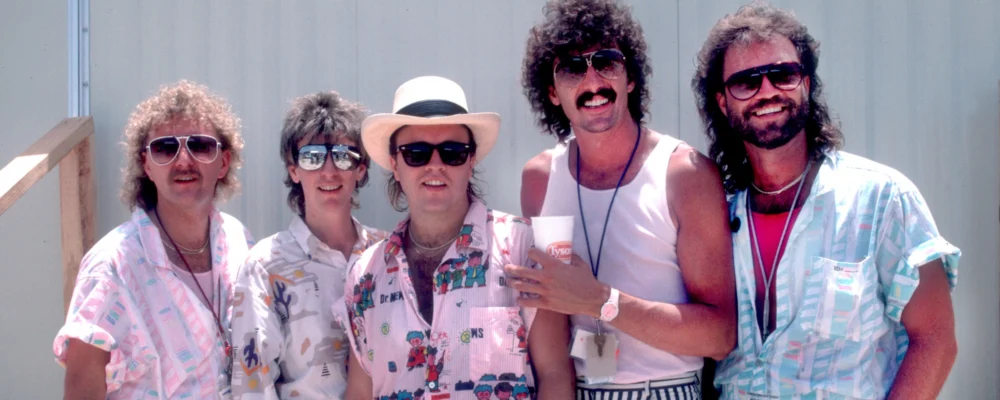
The decade of the 1980s represented a transformative period for country music, characterized by a tension between the slick, crossover-friendly "Urban Cowboy" sound and the burgeoning neo-traditionalist movement. During this era, the Nashville songwriting machine produced a vast array of chart-topping hits that followed the genre’s traditional storytelling roots. However, a subset of successful tracks defied the standard narrative conventions of the time. While most country songs achieved popularity through clear, relatable stories of heartbreak or rural life, certain hits resonated with the public despite—or perhaps because of—messages that were metaphorical, abstract, or linguistically unconventional. Songs like Sawyer Brown’s high-energy rendition of "The Race Is On," The Oak Ridge Boys’ infectious "Elvira," and Barbara Mandrell’s intellectualized "Crossword Puzzle" stand as prime examples of 1980s hits where the core message required a deeper level of interpretation or accepted a degree of lyrical ambiguity.
The Reimagining of a Classic: Sawyer Brown and The Race Is On
In 1989, the country-rock group Sawyer Brown released a high-octane cover of "The Race Is On," a track that would ultimately become one of the defining hits of their career. While the song was already a recognized standard within the genre, Sawyer Brown’s late-decade revival brought the track’s complex metaphorical structure back to the forefront of the Billboard charts. The song was originally written by Don Rollins and first became a major hit for George Jones in 1964. By the time Sawyer Brown included it on their album The Boys Are Back, the landscape of country music had shifted, yet the song’s intricate comparison of romantic failure to a professional horse race remained a unique lyrical feat.
The central conceit of "The Race Is On" is an extended metaphor that likens the dissolution of a relationship to the chaotic environment of a racetrack. Unlike traditional breakup songs that focus on dialogue or specific events, Rollins’ lyrics use the terminology of the turf to describe internal emotional states. The lyrics state: "Now the race is on / And here comes pride in the backstretch / Heartaches goin’ to the inside / My tears are holdin’ back there and / I’m tryin’ not to fall / My heart’s out of the runnin’ / True love’s scratched for another’s sake / The race is on and it looks like heartaches / And the winner loses all."
For the casual listener, the rapid-fire delivery—especially in Sawyer Brown’s upbeat, percussion-heavy version—can obscure the inherent tragedy of the message. The phrase "the winner loses all" presents a philosophical paradox. In the context of the song, the "winner" of the race is the person who successfully exits the relationship or moves on, yet the "loss" refers to the total destruction of the shared life and the "scratching" (withdrawal) of true love from the competition. Sawyer Brown’s ability to turn a song about devastating emotional loss into a stadium-ready anthem highlighted the 1980s trend of masking complex or somber messages with high-production energy.
The Linguistic Mystery of The Oak Ridge Boys’ Elvira
If any song epitomizes the power of a catchy hook over a clear narrative, it is The Oak Ridge Boys’ 1981 smash hit, "Elvira." Released as part of the Fancy Free album, the song was a monumental success, peaking at number one on the Billboard Hot Country Singles chart and reaching number five on the Billboard Hot 100. Despite its ubiquity, the song’s lyrical content remains a point of curiosity for music historians and fans alike. Written by Dallas Frazier in the mid-1960s, the song was inspired not by a woman, but by a street sign in East Nashville.
The song’s narrative describes a man’s intense infatuation with a woman named Elvira, but the lyrical focus quickly shifts from descriptive storytelling to rhythmic, non-lexical vocables. The chorus is famous for its deep-voiced "oom-pa-pa-oom-pa-pa-mow-mow" refrain, delivered by the group’s bass singer, Richard Sterban. The lyrics continue: "Elvira / Elvira / My heart’s on fire for Elvira / Giddy up, um-poppa-um-poppa, mow, mow / Giddy up, um-poppa-um-poppa, mow, mow / High-ho silver, away."
The inclusion of "High-ho silver, away"—a catchphrase synonymous with The Lone Ranger—alongside the "giddy up" horse imagery and the nonsense syllables of the bass line, creates a message that is more atmospheric than literal. The Oak Ridge Boys recognized the song’s potential for mass appeal precisely because of its playful ambiguity. In a retrospective interview with NPR, Joe Bonsall recalled the recording session as a moment of pure spontaneity. He noted that the band and the session musicians were smiling and having fun through only a few takes, realizing that the "feeling" of the song superseded the need for a traditional narrative. The song’s success proved that in the early 1980s, a "message" could simply be a feeling of exuberance, conveyed through vocal textures rather than strictly coherent storytelling.
Barbara Mandrell and the Complexity of Crossword Puzzle
While "Elvira" leaned into nonsense syllables, Barbara Mandrell’s 1984 single "Crossword Puzzle" took the opposite approach, utilizing a highly structured but intellectually demanding metaphor. Written by Frank J. Myers and Steve Dean, the song appeared on Mandrell’s Clean Cut album during a period when she was one of the most dominant forces in entertainment, bolstered by her NBC variety show, Barbara Mandrell and the Mandrell Sisters.
"Crossword Puzzle" attempted to map the intricacies of a failing marriage onto the grid of a crossword game. The lyrics are dense with wordplay: "What we’ve become is one across and also rhymes with rules / Two down is what we tell that’s opposite the truth / Three across is what we do to each other’s feelings / Four across begins with ‘A’ and means disagreeing / We’re living out a crossword puzzle / Filling in the spaces day by day / We’re living out a crossword puzzle / Now love’s the only word without a space."
The song requires the listener to mentally solve the puzzle to fully grasp the emotional weight of the scene. "One across" (rhyming with rules) implies "fools"; "two down" (opposite the truth) implies "lies"; "three across" (hurting feelings) implies "bruising" or "harming"; and "four across" (beginning with ‘A’) implies "arguing." By the time the listener deciphers the clues, the song has moved on to the next verse. This intellectual barrier may have contributed to the song’s chart performance; while it was a Top 15 hit, it failed to reach the summit like Mandrell’s more straightforward classics such as "I Was Country When Country Wasn’t Cool."
The song’s lack of a clear, immediate emotional payoff made it an outlier in 1984. It represented a gamble on the part of the songwriters and Mandrell, suggesting that the country audience was ready for "high-concept" lyrical structures. However, the song’s legacy is that of a "quirky" hit—a testament to a time when artists were willing to experiment with how a message was delivered, even if it risked alienating the casual listener.
Historical Context: The 1980s Songwriting Landscape
To understand why these songs with unclear or complex messages became hits, one must look at the broader context of the 1980s music industry. The decade began with the "Urban Cowboy" movement, which brought a pop-oriented, polished sound to Nashville. This era prioritized "hooks" and crossover appeal, often favoring catchy choruses over the gritty realism of 1970s Outlaw Country.
By the mid-80s, the "New Traditionalist" movement, led by George Strait, Reba McEntire, and Randy Travis, began to pull the genre back toward its roots. However, this left a middle ground where artists like Sawyer Brown and The Oak Ridge Boys could thrive by blending traditional country themes with experimental production and unconventional lyrics. The rise of CMT (Country Music Television) in 1983 also played a significant role. Visual storytelling in music videos allowed artists to provide a narrative framework for songs that might have been lyrically ambiguous, helping audiences connect with the "vibe" of a track like "Elvira" or the energy of "The Race Is On."
Chronology of Releases and Chart Performance
The trajectory of these three songs illustrates the evolving tastes of the 1980s country audience:
- 1981: "Elvira" (The Oak Ridge Boys) – Released at the height of the crossover era. It spent 15 weeks on the country charts and became a platinum-certified single. It remains the group’s signature song and a staple of American pop culture.
- 1984: "Crossword Puzzle" (Barbara Mandrell) – Released during a transitional year for Mandrell. Despite its cleverness, it peaked at #11 on the Billboard Hot Country Songs chart. This period marked the beginning of a shift in Mandrell’s career, exacerbated by a serious automobile accident later that year.
- 1989: "The Race Is On" (Sawyer Brown) – Released as the lead single from The Boys Are Back. It peaked at #5 on the country charts. Its success signaled a revival for Sawyer Brown, who had struggled to maintain their initial Star Search momentum in the mid-80s.
Broader Impact and Lyrical Implications
The success of these tracks demonstrated that the "message" of a country song does not always have to be a linear story about a truck, a dog, or a neon light. "The Race Is On" proved that sophisticated metaphors could be revitalized for a new generation. "Elvira" showed that phonetic playfulness could create a lasting cultural bond. "Crossword Puzzle" explored the limits of conceptual songwriting in a genre typically known for its plain-spokenness.
In the decades following the 1980s, country music would continue to oscillate between simplicity and complexity. However, these three songs remain vital case studies in how Nashville artists successfully navigated the charts by challenging their listeners to think, solve puzzles, or simply "giddy-up" along with the rhythm. They paved the way for the more diverse lyrical landscape of the 1990s, where artists like Garth Brooks and Mary Chapin Carpenter would further expand the boundaries of what a country song could communicate. Ultimately, the legacy of these 1980s hits lies in their ability to remain favorites even when their meanings were not immediately on the surface, proving that sometimes, the music itself is the most powerful message of all.
