

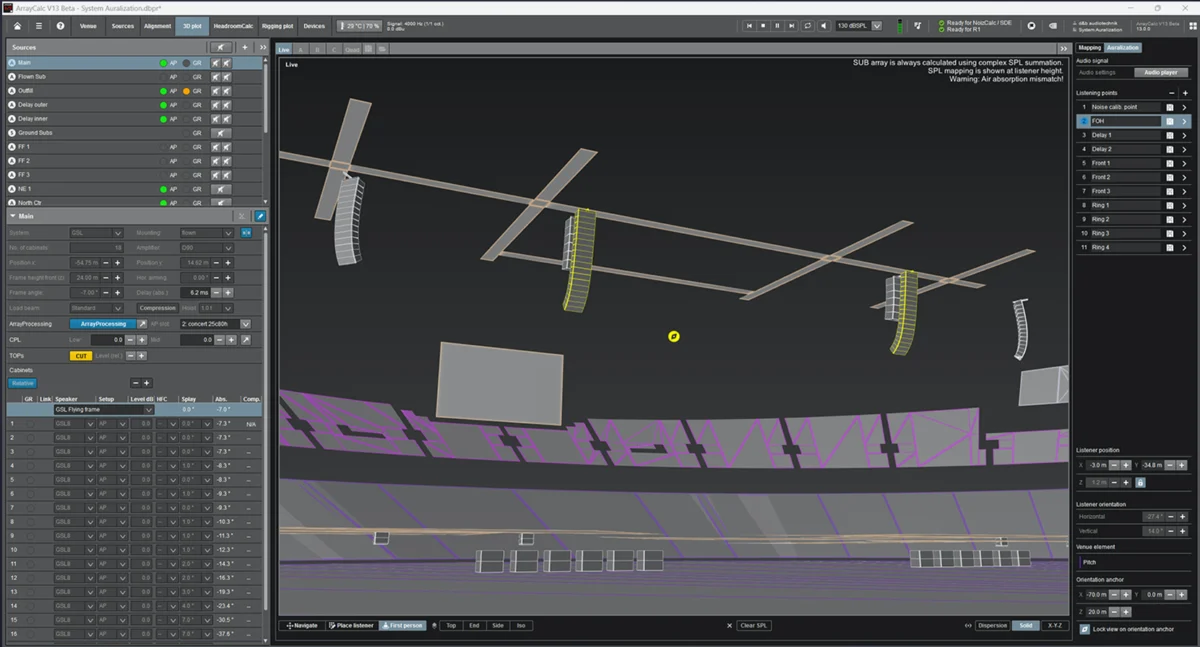
The German pro-audio manufacturer d&b audiotechnik has officially launched System Auralization, a sophisticated software extension for its flagship ArrayCalc simulation environment, marking a significant evolution in how sound reinforcement systems are designed and validated. Announced on September 23, 2026, this new feature allows acoustic engineers and system designers to experience a realistic auditory preview of their loudspeaker configurations long before a single piece of hardware is rigged. By transitioning from purely visual data representations—such as heat maps and pressure plots—to an immersive, real-time binaural listening experience, d&b audiotechnik aims to bridge the gap between theoretical system design and the actual auditory experience of the audience. The beta version of ArrayCalc containing this feature is now available for immediate download, inviting the global user community to participate in the final stages of its refinement.
A Paradigm Shift in Sound Reinforcement Design
For nearly two decades, the industry standard for planning large-scale sound systems has relied heavily on predictive modeling. Software tools like ArrayCalc have traditionally provided technical data, showing sound pressure levels (SPL) distributed across a 3D venue model. While these visual aids are indispensable for ensuring even coverage and avoiding acoustic "hot spots," they have historically lacked a way to communicate the qualitative nature of the sound. System Auralization changes this by providing a high-fidelity, binaural rendering of the system’s direct sound.
This advancement means that a system technician can now "walk" through a virtual venue in a first-person perspective. As they move from the front row to the back of the balcony, the software calculates the precise acoustic signature at each coordinate, accounting for distance, arrival times, and frequency response. This allows for the immediate assessment of critical design elements, such as the transition between main hangs and side hangs, or the effectiveness of front-fill speakers in the near-field. By hearing these transitions in real-time, designers can identify potential phase issues or tonal inconsistencies that might not be immediately obvious when looking at a static 2D SPL map.
Technical Architecture and Real-Time Processing
At the heart of System Auralization is a powerful rendering engine capable of processing complex acoustic data in real-time. The software utilizes binaural technology to simulate how human ears perceive sound within a space. This involves the application of Head-Related Transfer Functions (HRTFs) to the simulated audio signal, creating a 360-degree spatial audio experience through standard headphones.
The integration with ArrayCalc’s existing toolset is seamless. When a user modifies the geometry of a line array, adjusts the splay angles between cabinets, or tweaks the DSP settings in the virtual amplifiers, the auralization engine updates the audio output instantly. This includes the implementation of d&b’s proprietary ArrayProcessing technology. ArrayProcessing is an advanced optimization tool that applies specific filters to each cabinet in an array to achieve a target frequency response across the entire audience area. Previously, the benefits of ArrayProcessing were visualized through improved consistency in SPL maps; now, engineers can hear the exact difference the processing makes by toggling it on and off within the auralized environment.
Furthermore, the introduction of a new "Snapshot Recall" function within ArrayCalc enhances the comparative analysis of different designs. An engineer can create multiple "snapshots" of different system configurations—for example, comparing a traditional line array setup against one using d&b’s Soundscape object-based audio—and switch between them instantly. Because the audio playback remains continuous during these transitions, the engineer can perform a direct A/B comparison of the tonal balance and spatial clarity of each design.
The Evolution of d&b Simulation Tools: A Brief Chronology
The release of System Auralization is the latest milestone in a long history of software innovation at d&b audiotechnik. To understand the significance of this update, one must look at the trajectory of the company’s digital ecosystem:
- 2000s: Introduction of the original ArrayCalc, focusing on basic mechanical calculations and 2D SPL mapping for line arrays.
- 2010: The launch of the d&b Workflow, integrating ArrayCalc with the R1 Remote control software, allowing data to be transferred directly from simulation to physical amplifiers.
- 2014: The debut of ArrayProcessing, which revolutionized how frequency and level distribution were managed across large venues.
- 2018: The introduction of d&b Soundscape, shifting the focus from channel-based to object-based mixing and spatial reinforcement.
- 2021-2024: Continued refinement of the d&b Cloud and interoperability with third-party CAD and BIM (Building Information Modeling) software.
- 2026: The launch of System Auralization, moving beyond visual simulation into the realm of immersive auditory prediction.
This timeline demonstrates a clear move toward making the planning phase as accurate and intuitive as possible. By adding the "listening" component, d&b is addressing one of the final frontiers in acoustic simulation: the human element of subjective perception.
Professional Impact and Expert Perspectives
The implications of this technology extend beyond simple convenience. In the high-stakes world of international touring and large-scale installations, time is the most valuable commodity. Florian Hahn, Product Manager for Applied Software at d&b audiotechnik, emphasizes that the primary goal of the new feature is to empower engineers to make more informed decisions during the pre-production phase.
"With System Auralization, sound engineers can make well-founded decisions and take many important design aspects into account during the planning phase," Hahn stated. "It saves an enormous amount of time, which is particularly valuable in the run-up to a show. Although it was developed to support professional users in their work, it also contributes to a better understanding of system behavior and thus represents a useful tool for the next generation of system technicians."
Industry reactions suggest that the software will be particularly impactful for client presentations. Traditionally, explaining to a venue owner or a concert promoter why a specific (and perhaps more expensive) system design is necessary required interpreting complex technical charts. Now, an engineer can simply provide the client with a pair of headphones and let them hear the difference between a standard setup and a premium, optimized configuration. This "proof of concept" through hearing is expected to streamline the approval process for major projects.

Broader Implications for the Audio Industry
The introduction of System Auralization by d&b audiotechnik is likely to trigger a new wave of competition among pro-audio manufacturers. While other companies have offered various forms of auralization in the past—often for architectural acoustics or through third-party software like EASE—the integration of high-fidelity, real-time auralization directly into a manufacturer’s proprietary workflow is a significant step forward.
From an educational standpoint, the tool serves as a powerful simulator for training new engineers. Acoustic principles such as the inverse square law, comb filtering, and the effects of humidity and temperature on high-frequency absorption can now be demonstrated audibly in a controlled virtual environment. This pedagogical value ensures that the next generation of technicians will have a more intuitive grasp of how sound behaves in complex spaces.
Furthermore, the data generated by System Auralization could eventually be integrated into Virtual Reality (VR) and Augmented Reality (AR) workflows. As the industry moves toward more immersive production environments, the ability to pair a 3D visual render of a stage with a spatially accurate acoustic render is becoming increasingly desirable. d&b’s current beta release lays the groundwork for these future integrations.
Future Outlook and Beta Phase
As the software is currently in its beta phase, d&b audiotechnik is actively seeking feedback from its global user base. This period of collaborative development is crucial for fine-tuning the binaural algorithms and ensuring the software remains stable across various hardware configurations. The company has indicated that the feedback received will directly influence the features and user interface of the general release version.
The current version of ArrayCalc with System Auralization allows users to import their own audio files, ranging from high-resolution music tracks to pink noise, to test the system’s response across the full frequency spectrum. This flexibility ensures that the simulation is relevant to a wide variety of applications, from classical orchestral reinforcements to high-SPL electronic dance music events.
In conclusion, System Auralization represents a maturing of the digital twin concept in the audio industry. By creating an accurate acoustic digital twin of a venue and sound system, d&b audiotechnik is providing professionals with a level of certainty that was previously unattainable. As the software moves toward a full release, it is poised to become an essential component of the modern sound engineer’s toolkit, ensuring that the final "real-world" result is as close to the intended design as possible, while simultaneously reducing the time and labor required to achieve acoustic perfection.
