

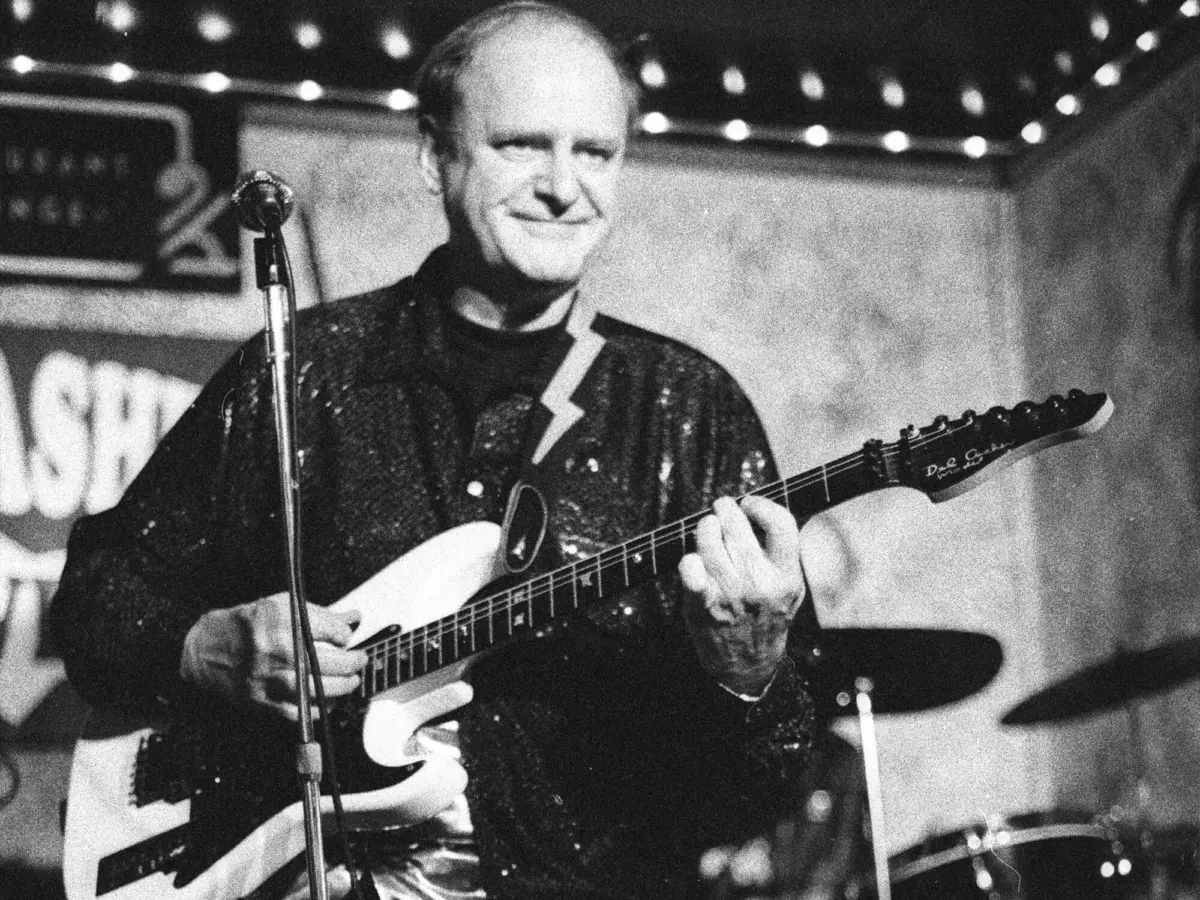
Del Casher, the pioneering guitarist and ingenious inventor credited with the development of the iconic wah-wah pedal, passed away on October 1, 2026, at the age of 88, following a battle with cancer. The announcement of his death, made public recently, marks the end of an era for a musician whose contributions transcended performance, fundamentally reshaping the sonic landscape of modern music. Casher’s dual legacy as a sought-after studio session player for legends like Elvis Presley and Cher, and as a prolific innovator whose creations became indispensable tools for countless artists, cements his place as one of the most significant, yet often unsung, figures in contemporary music technology.
The Genesis of an Iconic Sound: The Wah-Wah Pedal’s Birth
Casher’s most celebrated invention, the wah-wah pedal, emerged from a confluence of practical necessity, engineering ingenuity, and artistic vision in the mid-1960s. The story begins during his tenure as a guitarist and consultant for the Vox company, specifically after its acquisition by the American Thomas Organ Company. At this juncture, Thomas Organ was keen on adapting Vox’s popular British amplifier designs for the burgeoning American market, a process that often involved slight modifications to component sourcing and circuit design to reduce manufacturing costs while maintaining sound quality.
A critical component in this narrative was the Mid-Range Resonator (MRB) circuit found in certain UK Vox amplifiers, such as the AC100. This circuit was designed to mimic the tonal characteristics of brass instruments, particularly the "cupped mute" effect of a trumpet or trombone. Thomas Organ engineers, led by chief engineer Joe Banaron, tasked their team with exploring ways to adapt this circuit into a standalone effect. It was during this period that Brad Plunkett, a junior engineer at Thomas Organ, was assigned the task of reverse-engineering the AC100’s MRB circuit.
Plunkett, working under the guidance and insight of Casher, constructed a prototype using a potentiometer to sweep the frequency of the filter. Casher, with his extensive experience as a studio musician, immediately recognized the profound potential of this device not for brass instruments, as Vox initially envisioned, but for the electric guitar. He likened the sweeping filter effect to the vocal-like articulation produced by a harmonica player cupping their instrument around a microphone, hence the onomatopoeic "wah-wah" designation. Casher’s insight was revolutionary; while the initial application considered by Vox was for electric trumpets, Casher saw an entirely new expressive dimension for the guitar, transforming its voice from a static instrument to one capable of vocalizations and dynamic, emotive swells.
Despite Casher’s fervent belief in its guitar application, Vox executives remained skeptical. They perceived the market for guitar effects as niche and preferred to target band instruments. This led to the initial commercial release of a similar device, the Clyde McCoy Wah-Wah pedal, marketed primarily to horn players in 1966. The "Clyde McCoy" version, named after a jazz trumpeter, capitalized on the brass instrument connection. However, Casher’s relentless advocacy and personal demonstrations eventually swayed opinion, culminating in his ability to record and release his own compositions utilizing the wah-wah pedal by 1967. These early recordings served as critical proof of concept, showcasing the pedal’s versatility and expressive power in a way no marketing campaign could. Crucially, despite his instrumental role in its development and popularization, Casher was not eligible for manufacturing royalties, a common plight for many uncredited innovators in the music industry’s early days of rapid technological expansion. This omission would resonate with him throughout his life, highlighting the often-complex relationship between invention, commercialization, and recognition.
Beyond the Wah: A Prolific Inventor’s Toolkit
While the wah-wah pedal stands as his most famous contribution, Del Casher’s inventive spirit was far from limited. His innate curiosity and a musician’s practical need for new sounds and tools led to several other significant innovations. Among these was the Ecco-Fonic, a portable tape echo device he developed. In an era where echo effects were largely confined to bulky studio units or less reliable spring reverbs, the Ecco-Fonic offered musicians unprecedented portability and control over their sound. This device allowed guitarists and other instrumentalists to take studio-quality tape delay effects to live performances, liberating them from the limitations of the existing sound reinforcement infrastructure. The Ecco-Fonic, much like the wah-wah, demonstrated Casher’s forward-thinking approach to musical technology, always seeking to empower musicians with greater expressive capabilities. His work extended to other Vox accessories, contributing to the development of early fuzz pedals and other modulation effects, underscoring his deep engagement with the burgeoning field of electronic musical instruments.
A Pillar of the Studio Scene: The Session Guitarist’s Craft
Parallel to his inventive pursuits, Casher maintained a vibrant and highly respected career as a studio session guitarist. The 1960s and 70s were the golden age of studio recording, particularly in Los Angeles, where anonymous yet incredibly talented musicians formed the backbone of countless hit records. Casher was a prominent member of this elite group, often referred to collectively as "The Wrecking Crew," though he wasn’t exclusively part of that specific cohort. His reputation stemmed from his exceptional versatility, sight-reading prowess, and uncanny ability to adapt to diverse musical styles, from rock and pop to jazz and country.
His credits read like a who’s who of music legends. He lent his guitar work to sessions for Elvis Presley, providing nuanced accompaniment that often went uncredited but was integral to the final sound. He worked with Cher, contributing to her distinct vocal tracks with his tasteful guitar lines. Perhaps most notably, his collaboration with Frank Zappa and The Mothers of Invention showcased his adventurous side, as Zappa was known for pushing musical boundaries and demanding high levels of improvisation and technical skill from his musicians. Casher’s ability to seamlessly transition between the structured demands of pop production and the experimental frontiers of avant-garde rock made him an invaluable asset in the highly competitive studio environment. This extensive session work not only provided him with a livelihood but also served as a fertile ground for identifying sonic needs and inspiring his inventive solutions, directly linking his practical experience to his technological breakthroughs.
The Wah-Wah’s Enduring Global Impact
The initial skepticism surrounding the wah-wah pedal quickly dissolved as musicians worldwide discovered its transformative power. By the late 1960s, it had become an indispensable tool, forever altering the sound of rock, funk, R&B, and jazz. Its vocal-like sweep and expressive capabilities offered guitarists a new dimension of articulation, allowing them to make their instruments "speak."
Jimi Hendrix, arguably the most influential guitarist of his generation, wielded the wah-wah with unparalleled artistry. Tracks like "Voodoo Child (Slight Return)," "Burning of the Midnight Lamp," and his iconic performance at Woodstock on "The Star-Spangled Banner" showcased the pedal’s ability to create screaming, soaring, and almost human-like vocalizations from the guitar. Eric Clapton, during his tenure with Cream, employed the wah-wah on classics such as "White Room" and "Tales of Brave Ulysses," giving his blues-rock solos a distinctly psychedelic edge.
Beyond these pioneers, the wah-wah’s influence proliferated across genres and generations. In funk, artists like Isaac Hayes and Curtis Mayfield used it to create rhythmic, percussive textures, particularly on tracks like Hayes’s "Theme from Shaft," where the wah-wah-laden guitar line became instantly recognizable. Jazz fusion guitarists, including John McLaughlin and George Benson, adopted it for its expressive potential in improvisational contexts.
In subsequent decades, the pedal remained a staple. Kirk Hammett of Metallica became known as the "wah king," his aggressive, melodic solos often defined by the pedal’s distinct sweep. Slash, with Guns N’ Roses, frequently incorporated the wah-wah into his blues-infused rock solos, adding grit and vocal qualities. John Frusciante of the Red Hot Chili Peppers utilized it for both rhythmic texture and lead lines, blending funk and rock sensibilities. Legendary guitarists like Jeff Beck and Joe Walsh have also incorporated the wah-wah into their extensive repertoires, demonstrating its enduring versatility and appeal. The sheer ubiquity of the wah-wah pedal in recorded music and live performances across countless genres attests to Casher’s profound and lasting impact on musical expression. Its operation, fundamentally a variable band-pass filter, allows a musician to sweep through frequencies, emphasizing certain harmonics and creating the signature "wah" sound, effectively making the guitar "talk."
A Legacy of Underserved Recognition and Later Struggles
Despite the global ubiquity of his most famous invention, Del Casher often found himself on the periphery of the financial rewards and widespread public recognition enjoyed by the companies and artists who benefited from his ingenuity. In a poignant 2011 interview with the New York Times, Casher reflected on Vox’s initial dismissal of the wah-wah’s potential for guitar, stating, "No one at Vox saw a future for the device." His sentiments regarding his legacy were deeply personal and moving: "I feel gratified that I was there at the beginning," he said. "I would just like guitar players to think of me once in a while. The only thing I ask is: remember me." This plea for remembrance underscores the often-unacknowledged contributions of inventors in the fast-paced music technology industry.
Casher’s later years were not without hardship. The global COVID-19 pandemic, which brought live music and studio sessions to a grinding halt, significantly impacted his financial stability. Like many musicians whose livelihoods depend on active engagement with the industry, Casher faced severe economic challenges. This led him, reluctantly, to begin selling off parts of his cherished collection of instruments, a testament to the profound financial strain he endured. The necessity of parting with instruments that were not merely tools but extensions of his creative life highlighted the vulnerability even of legendary figures in the face of unforeseen global crises.
Del Casher is survived by his devoted 89-year-old wife, Eiko. In light of his passing and the financial difficulties they faced, a GoFundMe campaign has been launched by the community to support Eiko, aiming to ensure she receives safe care and stability during this challenging time. This community effort serves as a testament to the respect and affection held for Casher and his family, a final, collective acknowledgment of his immense contributions to music.
Reflections on an Innovator’s Path
Del Casher’s story is a compelling narrative of innovation, artistic dedication, and the often-complex realities of intellectual property and recognition in the music industry. His ability to bridge the gap between technical engineering and musical artistry allowed him to envision and create tools that expanded the expressive palette of musicians worldwide. His legacy is not merely in the circuits and mechanics of a pedal but in the countless iconic guitar solos, rhythmic grooves, and sonic textures that have shaped popular music for over half a century.
His passing marks a moment of reflection for the music community, a reminder of the unsung heroes whose behind-the-scenes work enables the sounds that define generations. While Casher may not have received the same public adulation as the rock stars who wielded his invention, his impact is undeniably etched into the very fabric of modern music. Every time a guitarist stomps on a wah pedal, they are, in essence, remembering Del Casher, the visionary who taught the electric guitar how to speak. His contributions will continue to inspire new generations of musicians and inventors, ensuring that his request to "remember me" resonates for decades to come through the enduring power of his inventions.
