

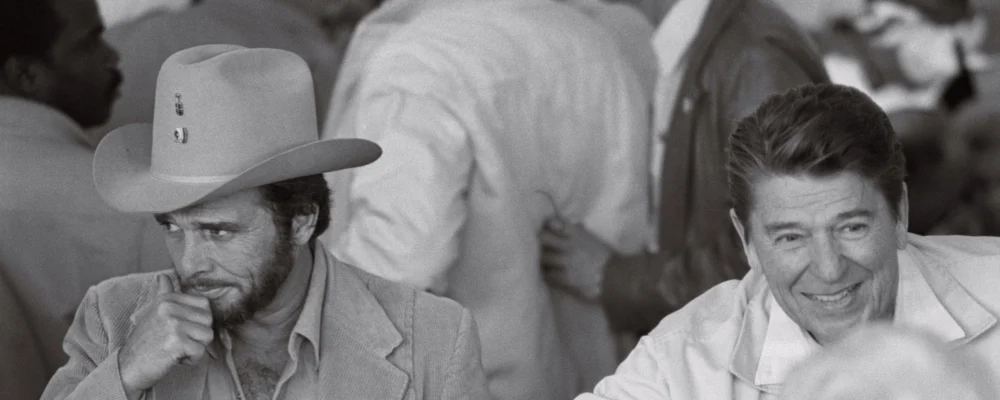
On March 14, 1972, a significant chapter in the history of American music and judicial clemency was written when Ronald Reagan, then the Governor of California, granted a full and unconditional pardon to country music superstar Merle Haggard. The executive action effectively erased the legal stigma of a criminal past that had haunted Haggard for over a decade, despite his meteoric rise to fame as a pioneer of the Bakersfield Sound and a leading figure in the outlaw country movement. The pardon served as a formal acknowledgment of Haggard’s total rehabilitation and underscored a rare intersection of conservative political leadership and the counter-cultural nuances of the country music industry.
The Path to San Quentin: A Youth Defined by Rebellion
To understand the weight of the 1972 pardon, one must examine the turbulent early life of Merle Haggard. Born in 1937 in Oildale, California, Haggard’s childhood was marked by stability until the death of his father, James Haggard, in 1946. The loss of his father when Merle was only nine years old is frequently cited by biographers and by Haggard himself as the catalyst for a decade of delinquency. Without a paternal figure, Haggard became increasingly incorrigible, engaging in truancy, petty theft, and repeated escapes from juvenile detention centers.
By his late teens, Haggard’s criminal record had escalated. In 1957, while attempting to provide for his young family, a 19-year-old Haggard and a friend attempted to burglarize a local Bakersfield restaurant. The attempt was amateurish and poorly timed; the pair tried to break into the establishment while it was still open for business. Haggard was arrested, and after a subsequent attempt to escape from the local jail, he was sentenced to serve time in San Quentin State Prison, one of the most notorious maximum-security facilities in the United States.
Haggard arrived at San Quentin in 1958 as inmate number A-45200. His time in prison was initially volatile, including a stint in solitary confinement for his involvement in a gambling ring and a brewing scheme. However, two specific events during his incarceration would alter the trajectory of his life. The first was the execution of fellow inmate Caryl Chessman, which profoundly affected Haggard’s view of the finality of the law. The second was the 1958 New Year’s Day performance at San Quentin by Johnny Cash. Witnessing Cash’s connection with the prisoners inspired Haggard to take his musical aspirations seriously, leading him to join the prison country band and focus on his rehabilitation.
Re-entry and the Invisible Chains of a Felony Record
Merle Haggard was released from San Quentin on parole on November 3, 1960. While he was physically free, he entered a society that offered limited grace to convicted felons. Haggard returned to Bakersfield and began working in manual labor during the day while performing in local clubs at night. His talent was undeniable, and by the mid-1960s, he had secured a recording contract and began producing hits like "Sing Me Back Home" and "The Bottle Let Me Down."
By 1972, Haggard was no longer a struggling ex-convict; he was an international superstar. He had earned multiple number-one hits and was a celebrated figure in the Nashville and Bakersfield scenes. Despite this success, the legal limitations of his felony conviction remained a constant professional and personal hurdle. Under California law at the time, a convicted felon faced significant restrictions regarding the restoration of civil rights, including the right to vote and the ability to own firearms.
Furthermore, Haggard’s career required frequent international travel. Each time he crossed a border for a world tour, he was required to disclose his criminal history to customs and immigration officials. This process was not only humiliating for a man of his stature but also posed a constant risk of visa denials in more conservative nations. The "tail" of his criminal record, as Haggard described it, remained a heavy burden that professional success alone could not lift.
The Political Context of the 1972 Pardon
The movement to secure a pardon for Haggard was orchestrated quietly by his close associates and family members. They recognized that Haggard’s public image—largely defined by his 1969 hit "Okie From Muskogee"—had made him a darling of the "Silent Majority" and a symbol of traditional American values during the social upheavals of the Vietnam War era. This cultural alignment made him a viable candidate for clemency from a governor like Ronald Reagan, who campaigned on a platform of law and order but also believed in the possibility of individual redemption through hard work and personal responsibility.
On March 14, 1972, Governor Reagan reviewed Haggard’s case. The application for a pardon was supported by evidence of Haggard’s exemplary behavior since his 1960 release, his contributions to the arts, and his status as a law-abiding taxpayer. Reagan’s decision to grant the pardon was not merely a celebrity favor; it was a formal recognition that Haggard had "led an honest and upright life, exhibited good moral character, and conducted himself as a law-abiding citizen."
The pardon granted Haggard a "full and unconditional" restoration of his civil rights. For Haggard, the news was life-changing. He later recalled that the pardon removed a psychological weight he had carried for fifteen years. In his own words, the act by Reagan meant he no longer had to preface legal transactions or international travel with an admission of his ex-convict status. It was the final step in his transition from a social outcast to a respected member of the American establishment.
Chronology of Key Events
- April 6, 1937: Merle Haggard is born in Oildale, California.
- 1946: James Haggard dies, precipitating Merle’s downward spiral into delinquency.
- 1957: Haggard is arrested for a botched burglary of a Bakersfield restaurant.
- 1958: Haggard is sent to San Quentin State Prison (Inmate A-45200).
- January 1, 1958: Haggard watches Johnny Cash perform at San Quentin.
- November 3, 1960: Haggard is released from prison on parole.
- 1966-1971: Haggard achieves massive commercial success with hits like "I’m a Lonesome Fugitive" and "Okie From Muskogee."
- March 14, 1972: Governor Ronald Reagan officially pardons Merle Haggard.
- March 1982: Haggard performs for President Reagan at the Sierra Grande Ranch.
From the Governor’s Mansion to the White House: A Lasting Bond
The relationship between the politician and the musician did not end with the 1972 pardon. Ten years later, the roles had shifted: Reagan was now the President of the United States, and Haggard was a living legend of country music. In March 1982, Haggard was invited to perform at a fundraiser held at Reagan’s Sierra Grande Ranch in California.
The performance was a symbolic full circle. Haggard, the man Reagan had officially forgiven a decade prior, stood before the President and the First Lady to perform songs that captured the essence of the American experience. Before beginning his set, which included "Are the Good Times Really Over?", Haggard addressed the President directly, expressing his hope that Reagan would be as pleased with the music as Haggard had been with the pardon.
The event was more than a musical performance; it was a demonstration of the American ideal of the "second chance." Reagan, often criticized by his detractors for a rigid stance on crime, used his relationship with Haggard to illustrate a belief in the transformative power of rehabilitation. For Haggard, the performance at the ranch was a public validation that he had finally and completely outrun the shadows of his youth.
Analysis of Implications and Legacy
The pardon of Merle Haggard remains a landmark case in the study of executive clemency. It serves as a data point for several broader sociopolitical themes:
- Rehabilitation vs. Retribution: Haggard’s case is frequently cited as a success story for the rehabilitative model of justice. His transition from a repeat offender to a cultural icon suggests that incarceration, when paired with a genuine personal epiphany and societal re-entry support, can produce productive citizens.
- The Power of Cultural Alignment: It is difficult to ignore the role that Haggard’s music played in his pardon. His songs often resonated with the demographic that supported Reagan—working-class Americans who valued patriotism and tradition. This cultural synergy likely smoothed the political path for Reagan to exercise his clemency powers without fear of a "soft on crime" backlash.
- The Stigma of Felony Convictions: Haggard’s struggle to navigate life as a felon, even while being a millionaire and a public figure, highlights the long-term "collateral consequences" of criminal convictions. His story has been used by advocates for sentencing reform to illustrate how legal barriers can hinder even the most successful individuals long after their debt to society has been paid.
Merle Haggard passed away on April 6, 2016, on his 79th birthday. He left behind a legacy of 38 number-one country hits and a reputation as the "poet of the common man." While his music earned him a place in the Country Music Hall of Fame, it was the 1972 pardon that allowed him to occupy that place as a fully restored citizen. The act by Ronald Reagan remains a defining moment in the narrative of a man who lived the lyrics of his own songs—a story of pride, rebellion, and, ultimately, redemption.
