

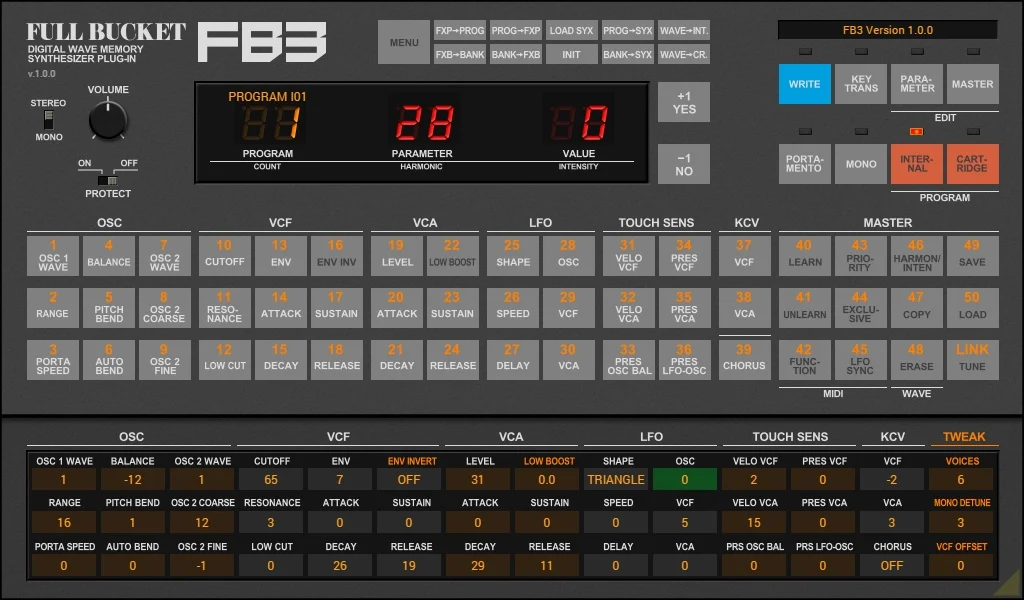
Full Bucket Music, a developer renowned for high-fidelity emulations of vintage hardware, has officially announced the release of FB3, a virtual instrument designed to simulate the Kawai K3 and K3m synthesizers. Originally released in 1986, the Kawai K3 represented a pivotal moment in music technology, bridging the gap between the burgeoning digital synthesis movement and the established warmth of analog circuitry. The FB3 software arrives as a comprehensive recreation of this hybrid architecture, offering modern music producers access to a unique sonic palette that has remained relatively niche compared to its contemporaries from Yamaha and Roland. The plugin is available across multiple formats, including VST2, VST3, CLAP, AAX, and AU, ensuring compatibility with a wide array of Digital Audio Workstations (DAWs) on both Microsoft Windows and Apple macOS platforms.
The Historical Context of the Kawai K3
To understand the significance of the FB3 release, one must look back at the landscape of the mid-1980s. The synthesizer market was undergoing a radical transformation following the 1983 release of the Yamaha DX7, which introduced the world to Frequency Modulation (FM) synthesis. While the DX7 offered bright, complex, and realistic sounds, it was notoriously difficult to program and lacked the familiar resonance of analog filters. In response, other Japanese manufacturers sought to find a middle ground.
Kawai, a company primarily known for its world-class pianos, entered the fray with the K3 in 1986. Unlike the DX7’s FM approach, the K3 utilized "Digital Wave" synthesis, a form of additive synthesis where users could select from 32 preset waveforms or create their own by adjusting the levels of 32 harmonics. What truly set the K3 apart, however, was its inclusion of genuine analog filters. Specifically, it utilized the SSM2044 voltage-controlled filter (VCF) chips, the same components found in legendary instruments like the Korg Polysix and the Octave Plateau Voyetra-8. This hybrid combination of digital oscillators and analog filters gave the K3 a "darker," more organic character that many found more musical than the clinical precision of pure digital synths.
The FB3 by Full Bucket Music seeks to capture this specific "lo-fi digital meets hi-fi analog" aesthetic. By meticulously modeling the behavior of the original hardware, the developer provides a tool that resonates with the current industry trend toward "retro-digital" sounds, often heard in synthwave, ambient, and experimental electronic music.
Technical Specifications and Architecture of FB3
The FB3 is not merely a sample-based recreation but a high-performance simulation written in native C++ code. This approach ensures low CPU consumption while maintaining high audio fidelity. The architecture of the FB3 mirrors the original Kawai K3, featuring two oscillators per voice. Users can choose from the original 32 internal waveforms, which include various acoustic simulations and abstract digital cycles.
A standout feature of the FB3 is its implementation of the user-definable additive synthesis section. In the original hardware, users could build a waveform from 32 harmonics via a somewhat tedious menu-diving process. The FB3 streamlines this, allowing for a more intuitive exploration of additive synthesis. Once the digital signal leaves the oscillators, it passes through a modeled version of the SSM2044 low-pass filter. This filter is known for its smooth resonance and ability to "fatten" digital signals, a characteristic that Full Bucket Music has prioritized in the FB3’s development.
Additional technical features of the FB3 include:
- Polyphony and Voice Management: While the original K3 was a six-voice instrument, the FB3 allows for expanded polyphonic capabilities typical of modern software instruments.
- Micro-tuning Support: The plugin supports the MTS-ESP by ODDSound, a system for dynamic micro-tuning. This is a critical feature for composers working outside the Western equal temperament system.
- Resizable User Interface: Recognizing the needs of modern high-resolution displays, the FB3 features a fully resizable UI, maintaining clarity and usability across different screen sizes.
- MIDI Learn: All parameters within the FB3 can be mapped to external MIDI controllers, facilitating hands-on performance and automation within a DAW.
The Developer: Björn Arlt and the Full Bucket Philosophy
The FB3 is the latest addition to the extensive catalog of Full Bucket Music, a project led by developer Björn Arlt. For over a decade, Arlt has established a reputation for creating some of the most accurate and efficient freeware synthesizers in the industry. His portfolio includes emulations of the Korg PS-3100, the Trident, and the Poly-800, among others.
What distinguishes Full Bucket Music from many other software developers is the commitment to the "donationware" model. Despite the professional quality of the instruments—often rivaling paid products from major corporations—they are offered for free. This philosophy has garnered a loyal following among musicians who value accessibility and high-quality DSP (Digital Signal Processing) without the barrier of high entry costs or invasive copy-protection schemes.

The release of the FB3 follows a period of rigorous testing and refinement. Arlt’s approach to coding in C++ allows the plugins to run efficiently on both legacy systems and the latest hardware, including Apple Silicon (M1/M2/M3) chips. This cross-platform stability is a hallmark of the Full Bucket brand, making the FB3 a reliable choice for both studio production and live performance.
Industry Impact and the Resurgence of Hybrid Synthesis
The release of the FB3 comes at a time when the music technology industry is experiencing a renewed interest in "early digital" aesthetics. While the early 2010s were dominated by a quest for pure analog gear, the current decade has seen a shift toward the "crunchy" and "gritty" textures of 8th and 12th-bit digital synthesizers from the mid-to-late 1980s.
The Kawai K3, and by extension the FB3, fits perfectly into this niche. The SSM filter provides a level of warmth that prevents the digital oscillators from sounding overly harsh, creating a sound that is often described as "glassy" yet "heavy." In a market saturated with emulations of the Minimoog and the Roland Juno-106, the FB3 offers a refreshing alternative. It provides a specific timbre that is difficult to achieve with standard subtractive software synthesizers.
Furthermore, the inclusion of the CLAP (CLever Audio Plug-in) format is a significant nod to the future of the industry. CLAP is an open-source plug-in standard developed by Bitwig and u-he, designed to offer better performance and more modern features than the aging VST2 and VST3 standards. By supporting CLAP, Full Bucket Music ensures that the FB3 is positioned at the forefront of plug-in technology.
Comparative Analysis: Hardware vs. Software
For many purists, the question remains: can a software simulation truly replace the hardware? In the case of the Kawai K3, the hardware is becoming increasingly rare and difficult to maintain. The SSM2044 chips are no longer in production, and the membrane buttons on the original K3 unit are prone to failure over time.
The FB3 addresses these reliability issues while offering several advantages over the original 1986 unit. Beyond the obvious benefits of DAW integration and total recall of settings, the FB3 eliminates the noise floor issues associated with 1980s-era digital-to-analog converters (DACs). While some users prefer the "lo-fi" noise of the original, the FB3 allows for a cleaner signal path while still retaining the essential character of the digital waveforms and analog filter curves.
Initial reactions from the synthesizer community have been overwhelmingly positive. Beta testers and early adopters have noted that the FB3 captures the "weight" of the K3’s low end—a trait often lost in digital recreations. The ability to import original Sysex data (if supported in future updates or via manual parameter matching) also makes the FB3 a valuable tool for owners of the original hardware who wish to bring their favorite patches into the digital domain.
Conclusion and Availability
The FB3 by Full Bucket Music represents more than just a free download; it is a preservation of musical history. By bringing the unique architecture of the Kawai K3 to a modern audience, Björn Arlt has provided a versatile tool that honors the innovation of the 1980s while utilizing the power of 21st-century computing.
As music production continues to move toward a "hybrid" workflow—where the lines between analog, digital, and software are increasingly blurred—the FB3 stands as a testament to the enduring appeal of unique synthesis methods. Whether used for lush pads, metallic percussive sounds, or aggressive basslines, the FB3 offers a distinctive voice in a crowded software market.
The FB3 is available for immediate download on the Full Bucket Music website. It supports Windows (32-bit and 64-bit) and macOS (64-bit, Intel, and Apple Silicon). While the plugin is free, the developer accepts donations to support the ongoing maintenance and development of his software catalog. As the industry continues to evolve, the FB3 serves as a reminder that some of the most inspiring sounds are found not in the pursuit of perfection, but in the unique character of the past.
