

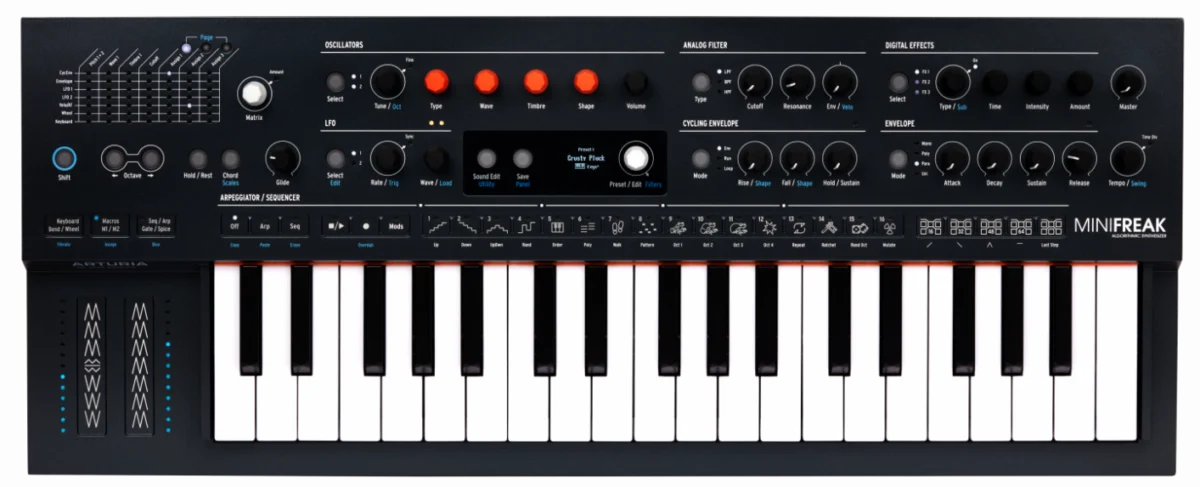
Arturia, the Grenoble-based pioneer in music technology, has officially released Firmware Version 5.0 for the MiniFreak, marking a significant milestone in the evolution of the polyphonic hybrid synthesizer. This major update introduces highly anticipated features, most notably the ability for users to import their own samples and wavetables, alongside a fresh bank of factory presets designed to showcase these new sonic possibilities. By bridging the gap between factory-standard digital oscillators and custom-designed sound sources, Arturia has effectively transformed the MiniFreak from a fixed-architecture instrument into a versatile platform for sound designers and performers alike. The release underscores a growing industry trend where hardware instruments receive substantial post-launch functional expansions, ensuring longevity and relevance in a rapidly changing market.
Evolution of the Freak Series: A Contextual Background
The MiniFreak, launched in late 2022, was the natural successor to the MicroFreak, an experimental paraphonic synthesizer that gained a cult following for its touch-plate keyboard and diverse digital oscillator types. While the MicroFreak introduced the world to Arturia’s "Freak" philosophy—combining eccentric digital sound engines with a classic analog filter—the MiniFreak expanded this concept into a six-voice polyphonic powerhouse. It featured two engines, an integrated keyboard, and a robust effects section, positioning it as a mid-tier competitor against established poly-synths.
Since its inception, the "Freak" line has been defined by its adaptability. Arturia has historically used firmware updates not just for bug fixes, but to introduce entirely new synthesis methods. The Version 5.0 update for the MiniFreak follows this lineage, bringing features that were previously requested by the user community to bring the hardware closer to the flexibility of software-based workstations. This update specifically targets the "hybrid" nature of the machine, allowing the warmth of its analog filters to process user-generated digital content.
Technical Analysis of New Features
The centerpiece of the Version 5.0 update is the dual-pronged approach to custom content: user sample import and wavetable import. These features represent a fundamental shift in how the MiniFreak’s two engines can be utilized.
User Sample Import
Previously, the MiniFreak relied on a selection of pre-loaded samples for its "Sample" and "Granular" engines. With Version 5.0, users can now upload their own audio files into the hardware’s internal memory. This allows for the inclusion of vocal snippets, field recordings, or custom percussion sounds. Once imported, these samples can be manipulated through the MiniFreak’s various synthesis parameters, including the granular engine, which can slice and rearrange the audio into complex textures. This capability effectively turns the MiniFreak into a polyphonic sampler-synthesizer hybrid, allowing for a level of personalization that was previously impossible.
Custom Wavetable Import
Wavetable synthesis has long been a staple of the MiniFreak’s sound palette, but it was limited to the factory-provided tables. The V5.0 update unlocks the ability to import custom wavetables (typically in standard formats like those used by popular software synths). This is a critical addition for modern electronic music producers who rely on specific wavetable signatures to define their sound. By importing custom tables, users can leverage the MiniFreak’s modulation matrix—featuring an LFO, a cycling envelope, and a sequencer—to scan through these tables in ways that feel organic and tactile.
Factory Bank v5.0
To demonstrate the practical application of these new features, Arturia has included a new Factory Bank containing 23 presets. these presets are meticulously crafted to highlight the synergy between user-imported data and the MiniFreak’s internal processing. They range from atmospheric pads that utilize the new granular capabilities to aggressive, evolving leads that showcase the custom wavetable scanning. This bank serves as both a creative tool for immediate use and an educational resource for users looking to understand how to best implement their own samples.
Chronology of MiniFreak Development
To understand the impact of Version 5.0, it is helpful to look at the timeline of the MiniFreak’s lifecycle:
- October 2022: The MiniFreak is officially launched, featuring 22 oscillator modes, two engines, and a 37-note velocity-sensitive keyboard with aftertouch. It is released alongside "MiniFreak V," a software plugin version of the hardware.
- Early 2023: Firmware updates focus on stability and minor workflow enhancements, such as improved MIDI clock synchronization and minor adjustments to the modulation matrix behavior.
- Late 2023: The release of Firmware V2.0 and subsequent iterations introduced new effects and oscillator types, including the "Shaper" and "Vocoder" modes, mirroring updates seen in the MicroFreak.
- June 2024: The announcement and release of Version 5.0. This update is viewed as the most significant "expansion" of the instrument’s core architecture to date, moving away from "more of the same" content toward "user-driven" content.
The Role of MiniFreak V in the Ecosystem
A unique aspect of the MiniFreak ecosystem is the "MiniFreak V" plugin, which provides a bit-perfect software emulation of the hardware. The Version 5.0 update is applied to both the hardware and the software, ensuring a seamless workflow between the two.
The software component is essential for the new import features. Users utilize the MiniFreak V librarian to manage their custom samples and wavetables, which are then synced to the hardware via USB. This integration highlights Arturia’s commitment to a "hybrid" workflow, where the computer handles the heavy lifting of file management and complex editing, while the hardware provides the tactile interface for performance and sound shaping.
Market Implications and Industry Reaction
The release of MiniFreak V5.0 places Arturia in a strong position within the compact poly-synth market. Competitors such as the Korg Minilogue XD, the ASM Hydrasynth Explorer, and the Novation Peak offer various forms of digital-analog hybrid synthesis, but Arturia’s aggressive update schedule provides a distinct value proposition.
Industry analysts note that by providing these updates free of charge, Arturia is fostering high brand loyalty. In a market where consumers often feel that hardware becomes "obsolete" within a few years, Arturia’s strategy of continuous improvement extends the product’s lifecycle and resale value. While there have been no official statements from competitors, the industry trend is clearly shifting toward "software-defined hardware," where the physical controls remain constant but the internal engine evolves.
From a user perspective, the reaction has been overwhelmingly positive. Sound designers have noted that the ability to import samples into a polyphonic instrument with analog filters at this price point is relatively rare. The "Freak" community, known for its experimental leanings, is expected to produce a wealth of third-party sample packs and wavetable libraries in the coming months, further enriching the instrument’s ecosystem.
Technical Specifications and Requirements
The MiniFreak v5 firmware update is available as a free download for all registered users through the Arturia Software Center or the Arturia website. To successfully implement the update and utilize the new features, users should adhere to the following technical parameters:
- Hardware Requirements: Arturia MiniFreak connected via USB 2.0 or 3.0.
- Software Requirements: The latest version of MiniFreak V must be installed to facilitate sample and wavetable transfers.
- File Compatibility: While Arturia’s system is designed to be user-friendly, samples generally perform best when formatted as 16-bit or 24-bit WAV files. Wavetables should follow standard 2048-sample cycle lengths for optimal compatibility with the digital oscillators.
- Storage: The hardware has a dedicated portion of flash memory reserved for user content, allowing for a significant number of custom slots without overwriting the original factory sounds.
Broader Impact on Hybrid Synthesis
The move toward user-loadable content in hardware synthesizers reflects a broader democratization of sound design. Traditionally, the ability to load custom samples into a hardware synth was reserved for high-end workstations or dedicated samplers. By bringing this functionality to the MiniFreak, Arturia is making complex, bespoke sound design accessible to a wider audience of musicians and producers.
Furthermore, the update emphasizes the importance of the "Granular" synthesis engine. Granular synthesis, which involves breaking audio into tiny "grains" and reassembling them, is a computationally intensive process. The MiniFreak’s ability to perform this polyphonically on user-supplied audio, and then pass that audio through a genuine analog poly-filter, creates a sonic character that is difficult to replicate in a purely digital environment.
Conclusion
Arturia MiniFreak v5 is more than a simple patch update; it is a significant retooling of the instrument’s identity. By allowing user sample and wavetable import, Arturia has removed the final barriers between the user’s imagination and the hardware’s output. The addition of the Factory Bank v5.0 ensures that even those who do not wish to create their own content will find immediate value in the update.
As the music industry continues to blur the lines between hardware and software, the MiniFreak stands as a prime example of how a modern synthesizer can grow and adapt. For current owners, the update is a substantial "gift" of functionality; for prospective buyers, it makes the MiniFreak one of the most compelling and flexible options in its class. The update is available now for download, reinforcing Arturia’s reputation for excellence in post-purchase support and innovative instrument design.
