

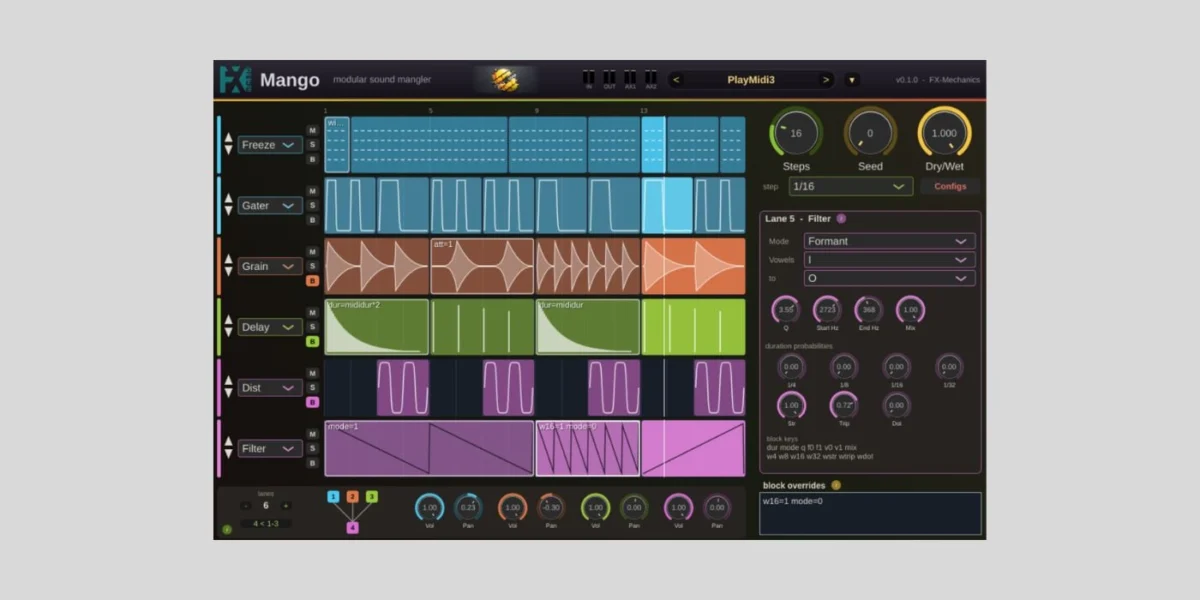
FX-Mechanics has officially released Mango, a comprehensive and entirely free, open-source modular glitch effect plugin designed to empower music producers across macOS, Windows, and Linux operating systems. This sophisticated new tool, available in VST3, AU, and standalone formats, offers a deep dive into rhythmic manipulation and sonic deconstruction, providing a powerful platform for crafting tempo-synced stutters, transformative transitions, and intricately mangled audio loops. The plugin’s arrival marks a significant addition to the landscape of creative audio processing tools, particularly for those seeking advanced control over glitch and rhythmic effects without financial barriers.
The Enduring Legacy of Glitch Effects in Music Production
The concept of "glitch" in music production has evolved from accidental digital artifacts and system errors into a deliberate and highly valued aesthetic. Originating in the experimental electronic music scenes of the 1990s, particularly within genres like IDM (Intelligent Dance Music) and microsound, producers began intentionally incorporating sounds that mimicked skips, clicks, digital distortion, and data corruption. What was once considered an imperfection became a source of unique rhythmic and textural possibility, challenging traditional notions of musicality and sonic purity.
Early pioneers in glitch music often achieved these effects through unconventional means, such as circuit bending, physically manipulating audio cables, or deliberately corrupting digital files before importing them into samplers and sequencers. As digital audio workstations (DAWs) and plugin architectures matured, software developers began creating dedicated tools to emulate and expand upon these techniques. These plugins offered unprecedented control, allowing musicians to apply glitch effects in a structured, tempo-synced manner, transforming random chaos into controlled, musical artistry. This paradigm shift democratized the glitch aesthetic, making it accessible to a broader spectrum of producers beyond the experimental fringes.
Kieran Foster’s Glitch: A Defining Moment in Software Development
The release of Mango inevitably draws comparisons to seminal plugins in the genre, most notably "Glitch" by Kieran Foster, known professionally as illformed and dblue. Foster’s original dblue Glitch plugin, first introduced in the early 2000s, was nothing short of revolutionary. It established a new benchmark for tempo-synced glitch effects, offering an intuitive yet powerful interface that allowed producers to easily slice, reverse, gate, repeat, and otherwise mangle audio loops with rhythmic precision. Its impact was profound, helping to define the entire tempo-synced glitch effect format for an entire generation of producers and influencing countless subsequent designs.
Foster’s contributions to the VST plugin community extended beyond Glitch. His work was characterized by innovation, efficiency, and a deep understanding of what producers needed for creative sound design. His recent and untimely passing cast a somber shadow over the audio production community. In a heartfelt tribute to his enduring legacy, his final major work, Glitch2, was subsequently made available for free, ensuring that his groundbreaking contributions would continue to inspire and facilitate creative expression for years to come. The decision to release Glitch2 freely was met with widespread appreciation, underscoring the deep respect and admiration the community held for Foster’s pioneering spirit.
Mango’s Modular Architecture: A New Interpretation of a Classic Concept
Mango arrives as one of the latest free variations on the foundational ideas laid out by plugins like Glitch. At its core, Mango is presented as a modular sound glitcher and mangler. Much like its spiritual predecessors, it employs a sophisticated step sequencer interface, capable of accommodating up to eight distinct lanes. Each of these lanes is dedicated to controlling a single effect, offering a clear and organized approach to complex audio manipulation.
The operational mechanic is elegantly straightforward: users "draw" blocks onto a specific lane within the sequencer grid. The chosen effect for that lane processes the audio exclusively when the playhead traverses inside one of these defined blocks. Outside the boundaries of a block, the lane remains transparent, allowing the original audio to pass through unaffected or for other active lanes to take precedence. This block-based activation system provides granular control over when and where effects are applied, enabling precise rhythmic and textural transformations.
Crucially, the lanes in Mango stack vertically, from top to bottom, effectively creating a sequenced effect chain. This design means that the output of an upper lane can feed directly into the input of a lower lane, facilitating intricate multi-stage processing. Producers can reorder these lanes at will, allowing for dynamic experimentation with the signal flow. Furthermore, individual lanes can be muted or soloed, aiding in sound design and mixing, and the number of active lanes can be adjusted from one to all eight, offering scalability from simple rhythmic gates to densely layered sonic tapestries. This modularity is key to Mango’s flexibility, allowing users to build bespoke effect chains tailored to specific creative demands.
The Innovation of Seeded Randomness
While many glitch effects rely on fixed rhythmic rates or purely chaotic randomness, Mango introduces a compelling innovation: seeded randomness for note lengths. Instead of mandating a single, static rhythmic rate for every effect instance, Mango allows users to assign weighted probabilities to various common note lengths, including 1/4, 1/8, 1/16, 1/32, and 1/64. Based on these user-defined weights, Mango then algorithmically draws the actual rhythmic value for each individual block.
This approach offers a powerful balance between unpredictable creativity and musical coherence. The "seeded" aspect is particularly significant: the resulting rhythmic pattern is intrinsically tied to a specific seed value, along with the particular lane and block it affects. This ensures that the generated pattern plays back identically, whether in real-time playback within the DAW or during offline bounces. This reproducibility is invaluable for professional production workflows, guaranteeing consistency across different stages of a project. For moments when a fresh burst of inspiration is needed, the entire pattern can be instantly re-rolled simply by turning the dedicated "Seed" knob, generating new, yet consistently repeatable, variations. This feature distinguishes Mango from purely random generators, providing controlled serendipity that can be both creative and reliable.
A Comprehensive Suite of Effect Modules
Mango’s modularity is underpinned by a robust selection of eleven distinct effect modules, each designed to contribute to the rich palette of glitch and mangling possibilities. This comprehensive array covers the typical "glitch ingredients" and extends into more experimental territories:
- Gater: Essential for rhythmic chopping and stutter effects, allowing for precise control over the amplitude envelope to create sharp, percussive cuts.
- Grain: A granular synthesis module that can stretch, freeze, or fragment audio into microscopic particles, ideal for creating shimmering textures, micro-loops, or dense, evolving soundscapes.
- Delay: A versatile tempo-synced delay unit, capable of creating rhythmic echoes, dub-style repeats, or complex feedback loops, all synchronized to the host tempo.
- Distortion: From subtle saturation to aggressive digital clipping, this module adds harmonic content and grit, transforming clean signals into grungier textures.
- Filter: A classic sound sculpting tool, offering various filter types (low-pass, high-pass, band-pass) to shape the spectral content of the audio, useful for sweeps, drop-outs, or isolating frequency ranges.
- Quantizer: This module snaps audio events or parameters to a defined grid, ensuring rhythmic precision and creating a "choppy" or "stepped" quality, especially effective when combined with other time-based effects.
- Ring Modulator: A classic effect that multiplies the input signal by a carrier wave, producing metallic, dissonant, or alien timbres, excellent for experimental sound design.
- Reverser: Creates classic reverse slice effects, flipping audio segments backwards to generate unique rhythmic motifs and atmospheric textures.
- Spectral Freeze: This module captures and sustains a snapshot of the audio’s spectral content, creating infinite sustains, drones, or ambient pads from transient sounds.
- Aux Send: Allows for routing audio to an auxiliary bus within Mango, facilitating internal parallel processing or creating feedback loops between different lanes.
- Pan: Provides dynamic control over the stereo position of the audio, enabling rhythmic panning movements, spatialization effects, or extreme left-right bounces.
This diverse selection ensures that Mango is capable of handling a wide array of glitch, stutter, and sound design tasks, from subtle rhythmic embellishments to radical sonic transformations.
MIDI Integration for Dynamic Control
Beyond its internal sequencing capabilities, Mango also features robust MIDI integration, expanding its expressive potential. While the plugin does not generate sound directly from MIDI notes, it can receive MIDI input and use these notes to dynamically drive certain block parameters. This opens up avenues for real-time, performative control over the glitch effects.
For instance, specific "PlayMidi" presets demonstrate how a delay module within Mango can tune itself or alter its characteristics based on the MIDI notes being played by the user. This allows for musically intelligent effects where the timing or pitch-related parameters of a glitch effect respond directly to melodic or harmonic input. This feature elevates Mango beyond a static sequencer, transforming it into a more interactive and musically responsive instrument, suitable for live performance or expressive automation.
Technical Specifications and Accessibility Considerations
Mango is designed for broad compatibility, available across the three major operating systems: macOS, Windows, and Linux. It supports the widely used VST3 and AU plugin formats, ensuring integration with nearly all modern DAWs, and also offers a standalone application for direct use without a host.
For macOS users, the build is universal, meaning it runs natively on both Apple Silicon (M1/M2/M3) and Intel-based Macs. It requires macOS 10.13 (High Sierra) or later. However, a specific technical consideration for macOS users is that the application is currently unsigned. This means that macOS’s Gatekeeper security feature may flag the plugin upon download, potentially preventing it from appearing in a DAW until the user manually clears the quarantine flag. This is a common procedure for unsigned software and typically involves a simple command-line instruction or adjusting security preferences. Documentation or community forums usually provide clear instructions for this workaround, ensuring smooth integration for all users.
Implications and The Future of Free Glitch Tools
The release of Mango by FX-Mechanics carries several significant implications for the audio production community. Firstly, its status as a free and open-source plugin democratizes access to advanced glitch processing. In an industry where professional-grade effects can often be costly, Mango provides a powerful, no-barrier entry point for producers of all skill levels, from aspiring bedroom musicians to seasoned professionals looking for new tools.
Secondly, its open-source nature fosters community engagement and potential future development. Developers can inspect, learn from, and even contribute to Mango’s codebase, potentially leading to bug fixes, feature enhancements, or even entirely new modules from the community. This collaborative model has historically driven innovation in various software sectors, and its application to audio plugins promises a dynamic future for Mango.
Thirdly, Mango’s advanced, modular design caters to a growing segment of producers who desire deeper control over their sound. While "one-button" glitch effects exist for instant gratification, Mango positions itself as a more technical, exploratory tool. It appeals to those who enjoy building complex signal chains, experimenting with intricate rhythmic patterns, and meticulously crafting unique soundscapes for genres ranging from IDM, techno, and experimental electronic music to hip-hop and film scoring.
In a market saturated with both commercial and freeware plugins, Mango carves out a niche by offering a feature set that rivals some paid alternatives, combined with the transparency and collaborative potential of open-source development. It stands as a testament to the continued innovation within the audio software community and honors the legacy of pioneers like Kieran Foster by advancing the art of digital audio manipulation.
For producers seeking a robust, free, and deeply customizable tool for building tempo-synced stutters, transformative transitions, and intricately mangled loop variations, Mango represents a highly compelling and interesting download. Its comprehensive feature set, innovative seeded randomness, and modular design position it as a significant contribution to the evolving landscape of creative audio effects.
Availability
FX-Mechanics Mango is available for immediate download via its GitHub repository.
Download: FX-Mechanics Mango (FREE)
Last Updated on August 15, 2026 by Tomislav Zlatic.
