

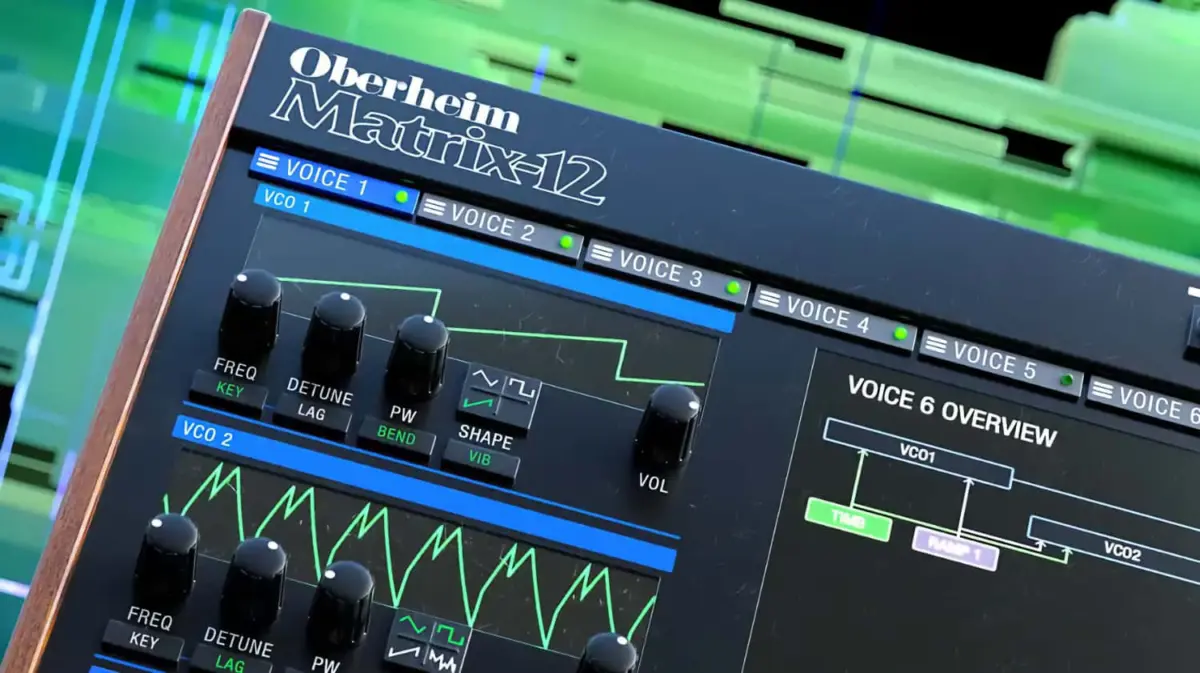
GForce Software has officially announced the release of the Oberheim Matrix-12, a high-fidelity software recreation of one of the most sophisticated analog synthesizers ever produced. Developed in direct collaboration with Oberheim and Marcus Ryle—one of the original designers of the 1985 hardware—this virtual instrument aims to bring the complex modulation and rich sonic character of the legendary flagship synthesizer to modern digital audio workstations. The release marks a significant milestone in the ongoing partnership between GForce and Oberheim, following the successful digital revivals of the OB-E, SEM, and OB-X instruments.
The original Matrix-12, released in 1985, is widely regarded as a pinnacle of analog synthesis technology. By combining twelve independent voices with an unprecedented modulation matrix and a versatile 15-mode filter, the hardware established a new standard for sound design that remains influential nearly four decades later. GForce’s software iteration seeks to preserve this legacy while addressing the historical workflow challenges associated with the original unit’s complex programming interface.
Historical Context and the Evolution of the Matrix Series
To understand the significance of the GForce Oberheim Matrix-12, one must look at the climate of the music industry in the mid-1980s. During this period, the synthesis market was undergoing a radical shift from analog to digital, spearheaded by the success of the Yamaha DX7. In response, Oberheim Electronics sought to push the boundaries of what analog technology could achieve, focusing on deep programmability and voice flexibility.
The lineage of the Matrix-12 began with the Oberheim Xpander, released in 1984. The Xpander was a six-voice synthesizer module that introduced the "Matrix Modulation" system, which allowed users to route almost any modulation source to any destination, mimicking the flexibility of a modular synthesizer without the need for physical patch cables. Recognizing the demand for a keyboard-based version with increased polyphony, Oberheim released the Matrix-12 a year later.
The Matrix-12 was essentially two Xpanders housed in a single chassis with a five-octave velocity and aftertouch-sensitive keyboard. It utilized Curtis Electromusic Specialties (CEM) integrated circuits, specifically the CEM 3374 dual voltage-controlled oscillators (VCOs) and the CEM 3372 filter/VCA chips. This hardware configuration gave the instrument a distinctively lush, precise, and expansive sound that became a staple for film composers and electronic musicians alike.
Technical Specifications and Software Architecture
The GForce Oberheim Matrix-12 is not a mere sample library; it is a component-modeled emulation designed to replicate the nuances of the original hardware’s signal path. The software features twelve independent voices, each equipped with two oscillators, a dedicated noise generator, and the signature 15-mode filter.
The 15-Mode Filter System
One of the most defining characteristics of the Matrix-12 is its multi-mode filter. Unlike many synthesizers of its era that offered only a standard 4-pole low-pass filter, the Matrix-12 provided 15 different filter types. These include:
- Low-pass (1, 2, 3, and 4-pole variations)
- High-pass (1, 2, and 3-pole variations)
- Band-pass (2 and 4-pole variations)
- Notch filters
- Phase-shift modes
GForce has meticulously modeled these filter responses, ensuring that the resonance and frequency interactions behave with the same unpredictability and warmth as the original analog circuits.
Advanced Modulation Matrix
The "Matrix" in the instrument’s name refers to its sophisticated modulation system. In the software version, users have access to five envelopes, five low-frequency oscillators (LFOs), and four ramp generators per voice. The software recreates the original’s ability to assign these sources to a vast array of destinations.
To improve upon the original hardware—which required navigating small vacuum fluorescent displays (VFDs) and numerous sub-menus—GForce has implemented a redesigned user interface. This modern "Editor" view allows users to see the entire modulation architecture at a glance, facilitating a more intuitive sound design process that was previously impossible on the 1985 hardware.
Collaboration with Marcus Ryle and Oberheim
A critical factor in the development of this software was the involvement of Marcus Ryle. As a former design engineer at Oberheim, Ryle played a pivotal role in the creation of the original Matrix-12 and Xpander. His participation ensures that the software’s behavior, particularly regarding the timing of envelopes and the scaling of modulation amounts, is historically accurate.
"The Matrix-12 was a landmark instrument," noted industry analysts following the announcement. "Having the original designer involved in the software recreation provides a level of authenticity that third-party emulations often lack. It ensures that the ‘soul’ of the instrument—the way the circuits breathe and react—is translated correctly into the digital realm."
Tom Oberheim, the founder of Oberheim Electronics, has also officially licensed the product, signaling that it meets the brand’s rigorous standards for sound quality. This collaboration continues a trend of vintage hardware manufacturers embracing digital formats to ensure their legacies remain accessible to a new generation of producers who may never have the opportunity to own or maintain the increasingly rare and expensive original units.
Modern Enhancements and Integration
While the GForce Oberheim Matrix-12 remains faithful to the original’s core architecture, it incorporates several contemporary features to enhance its utility in a modern production environment.
- Expanded Sound Library: The software includes over 1,000 patches, featuring sounds from the original Matrix-12 and Xpander factory libraries, as well as new presets created by world-class sound designers.
- Integrated Effects: To provide a complete production-ready sound, GForce has added a dedicated effects section, including high-quality delay and reverb, which were absent from the original 1985 hardware.
- Preset Management: A robust patch browser allows users to categorize, search, and tag sounds, making it easier to navigate the vast sonic possibilities of the instrument.
- Polyphonic Aftertouch and MPE: Recognizing the shift toward more expressive controllers, the software supports Polyphonic Aftertouch and MIDI Polyphonic Expression (MPE), allowing for a level of performance nuance that exceeds the capabilities of the original keyboard.
Market Impact and Industry Implications
The release of the GForce Oberheim Matrix-12 comes at a time when the demand for high-end virtual analog synthesis is at an all-time high. For years, the Matrix-12 was considered the "holy grail" of synthesizers, often fetching prices upwards of $15,000 on the second-hand market. By providing an officially licensed, stable, and affordable software alternative, GForce is democratizing access to these legendary tones.
Industry experts suggest that this release will likely impact how film composers and electronic producers approach sound design. The Matrix-12’s ability to create evolving, complex textures makes it particularly suited for cinematic scoring and ambient music. Furthermore, the inclusion of the original factory presets ensures that the classic sounds of the 80s—heard on countless hit records—are preserved for historical and creative use.
The software’s compatibility with both macOS and Windows, and its availability in AU, AAX, VST, and VST3 formats, ensures that it can be integrated into virtually any professional studio setup. The standalone version also offers an option for live performers who wish to use the instrument without the overhead of a host DAW.
Pricing and Availability
GForce Software has positioned the Oberheim Matrix-12 as a premium but accessible tool. The instrument is available immediately through the GForce Software website.
- Standard Price: $119.99
- Introductory Offer: $83.99 (Available through December 5, 2026)
- Trial Version: A 14-day fully functional trial is available for users to evaluate the instrument before purchase.
This aggressive introductory pricing, spanning an unusually long period, suggests that GForce and Oberheim are committed to establishing the Matrix-12 as a staple in the digital instrument market.
Final Summary of Features
The GForce Oberheim Matrix-12 represents a fusion of vintage character and modern convenience. Its key features include:
- Authentic Modeling: Twelve-voice polyphony with accurate VCO and filter emulation.
- 15 Filter Modes: Full recreation of the original multi-mode filter architecture.
- Modern UI: A redesigned interface that simplifies the complex Matrix Modulation system.
- Extensive Modulation: 5 LFOs, 5 Envelopes, and 4 Ramp generators per voice.
- Official Collaboration: Developed with Marcus Ryle and officially licensed by Oberheim.
- Contemporary Effects: Integrated delay and reverb for polished sound output.
- Expressive Control: Support for MPE and Polyphonic Aftertouch.
As the music technology industry continues to evolve, the GForce Oberheim Matrix-12 stands as a testament to the enduring appeal of analog synthesis and the possibilities afforded by collaborative software development. By bridging the gap between 1985 and the present day, GForce has ensured that the complex, lush, and powerful voice of the Matrix-12 will continue to be heard in the music of the future.
