

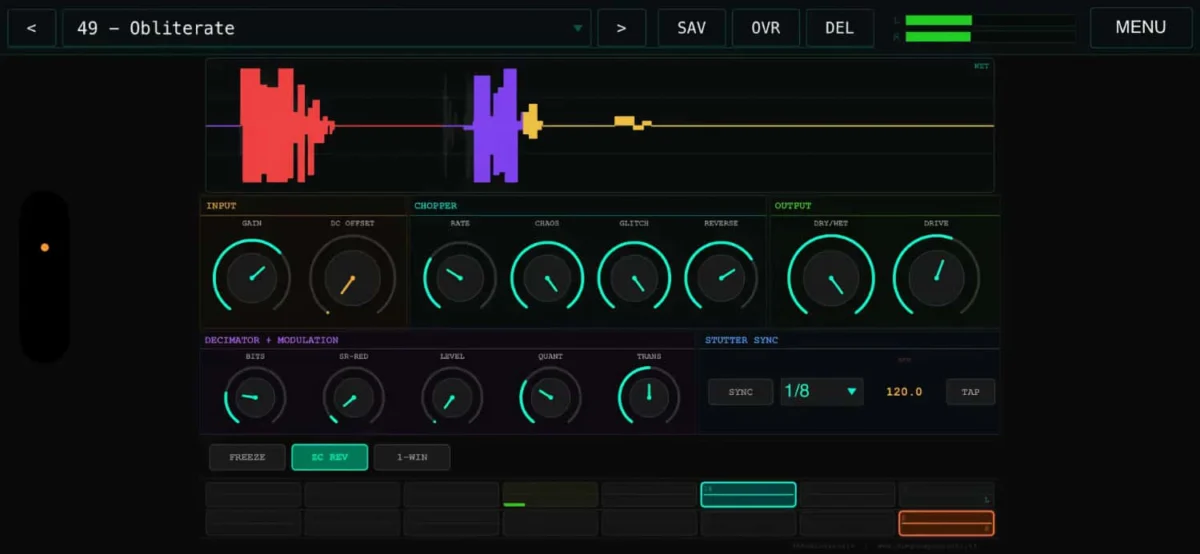
The landscape of mobile music production has witnessed a significant expansion with the release of GlitchShredder, a dedicated audio effect application designed specifically for the iPhone and iPad ecosystems. This new utility enters the market as a specialized tool for sound designers, electronic musicians, and live performers, offering a sophisticated suite of features for capturing, repeating, reversing, and recombining incoming audio fragments in real time. As the boundaries between desktop-class digital audio workstations (DAWs) and mobile platforms continue to blur, GlitchShredder represents a growing trend toward high-fidelity, low-latency signal processing on portable devices.
At its core, GlitchShredder functions by intercepting an incoming audio signal and subjecting it to a non-linear buffering process. This process allows the user to deconstruct live audio into manageable segments, which can then be manipulated through various probabilistic and rhythmic algorithms. The application is designed to operate both as a standalone utility for immediate experimentation and as an AUv3 (Audio Unit version 3) plugin. The latter capability is particularly critical for modern mobile workflows, as it enables the effect to be hosted within industry-standard environments such as Apple’s Logic Pro for iPad, GarageBand, AUM, and Cubasis.
Technical Architecture and the Chopper Engine
The primary engine behind GlitchShredder’s sonic capabilities is its "Chopper" module. Unlike traditional delay or reverb effects that apply a uniform transformation to a signal, the Chopper utilizes independent left and right channel processing. This dual-mono approach allows for the creation of complex, wide stereo images and polyrhythmic textures that would be difficult to achieve with a single-channel processor.
Each channel within the Chopper is equipped with 16 individual segment slots. These slots serve as the memory banks for captured audio fragments. By distributing audio across these slots, the software can jump between different points in time, creating the "stutter" or "glitch" aesthetic popularized in genres such as IDM (Intelligent Dance Music), glitch-hop, and experimental ambient music.
To manage these segments, the application employs several advanced control parameters:
- Glitch Probability: A randomized engine that determines the likelihood of a segment being repeated or skipped, introducing an element of controlled chaos into the performance.
- Reverse Probability: This parameter dictates how often the captured audio fragments are played backward. When combined with the Glitch Probability, it creates a shifting, kaleidoscopic audio output.
- Quantized Jumps: This ensures that when the playhead moves between different segment slots, it does so in a way that maintains rhythmic integrity, preventing the audio from drifting out of sync with the underlying beat.
- Transient Detection: One of the most technologically advanced features of the app, transient detection allows the software to identify the "hits" or peaks in an audio signal—such as a drum snare or a sharp vocal consonant—and trigger the shredding process specifically at those moments. This results in a more musical and responsive effect compared to simple time-based triggering.
Integration and Workflow Compatibility
The transition of the iOS platform from a consumption-based medium to a professional production environment has been accelerated by the adoption of the AUv3 standard. GlitchShredder’s full support for this standard ensures that it can be integrated into complex signal chains. In a typical production scenario using a host like AUM, a user might route a synthesizer through GlitchShredder, follow it with a resonant filter, and then send the output to a global reverb. Because AUv3 supports state saving, all parameters of the GlitchShredder effect are preserved within the host project, allowing for seamless session recall.
Furthermore, the application addresses the necessity of rhythmic precision through its "Stutter Sync" functionality. Producers can choose to have the effect follow the host tempo automatically—essential for synchronized performances in Logic Pro or Cubasis—or they can opt for manual control. Manual control includes the ability to set a specific BPM (beats per minute) or use a Tap Tempo interface, making the app versatile enough for use with external hardware instruments that may not be sending a MIDI clock signal.
The Evolution of Mobile DSP and Market Context
The release of GlitchShredder comes at a time when the mobile music software market is experiencing a period of robust diversification. According to industry data, the mobile music production sector has seen a compound annual growth rate (CAGR) of over 12% in the last five years. This growth is driven by the increasing processing power of Apple’s M-series and A-series chips, which allow developers to implement complex digital signal processing (DSP) algorithms that were previously reserved for high-end desktop hardware.
Historically, glitch and stutter effects were achieved through labor-intensive manual editing—literally cutting and pasting tape or digital audio regions. In the early 2000s, VST plugins like Illformed’s Glitch or Sugar Bytes’ Effectrix automated this process for desktop users. GlitchShredder brings this level of granular control to the iPad, but at a significantly lower price point and with a touch-first interface. At $4.99 USD, the application is positioned as an accessible entry point for beginners while providing the depth required by professional sound designers.
Chronology of Development and Release
The development of GlitchShredder follows a timeline of increasing sophistication in the iOS audio community. While basic "looper" apps have existed since the inception of the App Store, the demand for "intelligent" effects—those that use probability and transient detection—has surged in the last 24 months.
- Phase One: The Standalone Era: Early iOS effects were limited by the "Inter-App Audio" (IAA) protocol, which was often unstable and difficult to route.
- Phase Two: The AUv3 Revolution: With the introduction of AUv3, developers began porting more complex DSP code to iOS, leading to a "gold rush" of professional-grade plugins.
- Phase Three: Logic Pro for iPad: The launch of Logic Pro for iPad in 2023 served as a catalyst for developers to optimize their apps for a "pro" user base. GlitchShredder’s release is part of this third wave, focusing on high-performance integration and stability.
The application’s availability on the Apple App Store marks the culmination of an intensive design period focused on balancing a minimalist user interface with a complex internal engine. The developer has prioritized a "no-talking" demonstration strategy, allowing the sonic results of the software to speak for itself through high-quality video previews showcasing the app’s behavior within the AUM environment.
Industry Impact and Professional Implications
Industry analysts suggest that tools like GlitchShredder are crucial for the "democratization" of music production. By providing high-end granular synthesis and stutter effects for under five dollars, the barrier to entry for experimental music production is lowered. However, the implications go beyond mere cost. The portability of the iPad, combined with GlitchShredder’s low-latency performance, makes it a formidable tool for live performance.
In a live setting, a performer can manipulate the "Glitch Probability" slider in real time using a touch screen, providing a level of gestural expression that is often missing from mouse-and-keyboard setups. This tactile feedback is a primary reason why many professional electronic musicians are incorporating iPads into their stage rigs as dedicated "effect processors."
Initial reactions from the mobile music production community have highlighted the app’s efficiency. Early adopters have noted that the CPU overhead is remarkably low, allowing multiple instances of the plugin to run simultaneously even on older iPad models. This efficiency is a hallmark of modern DSP optimization, where developers must account for the thermal constraints of mobile devices.
Future Outlook
As GlitchShredder gains traction, the potential for future updates remains high. Potential paths for development include the integration of MIDI CC (Continuous Controller) support for external hardware mapping and the possibility of "Snapshot" morphing, where users can glide between different probability settings.
The launch of GlitchShredder is more than just the release of a new app; it is a testament to the maturity of the iOS music ecosystem. It provides a specialized solution to a specific creative problem: how to introduce controlled, rhythmic instability into a digital signal. By leveraging the AUv3 framework and focusing on independent channel processing, GlitchShredder offers a professional-grade solution for the modern, mobile-centric musician.
In conclusion, GlitchShredder represents a significant value proposition in the current audio software market. Its combination of real-time audio fragmentation, probability-based triggering, and seamless host integration positions it as an essential tool for those looking to push the boundaries of conventional sound design on the iOS platform. As mobile devices continue to evolve into central hubs for creative expression, applications like GlitchShredder will play a pivotal role in defining the sound of the next generation of electronic music.
