

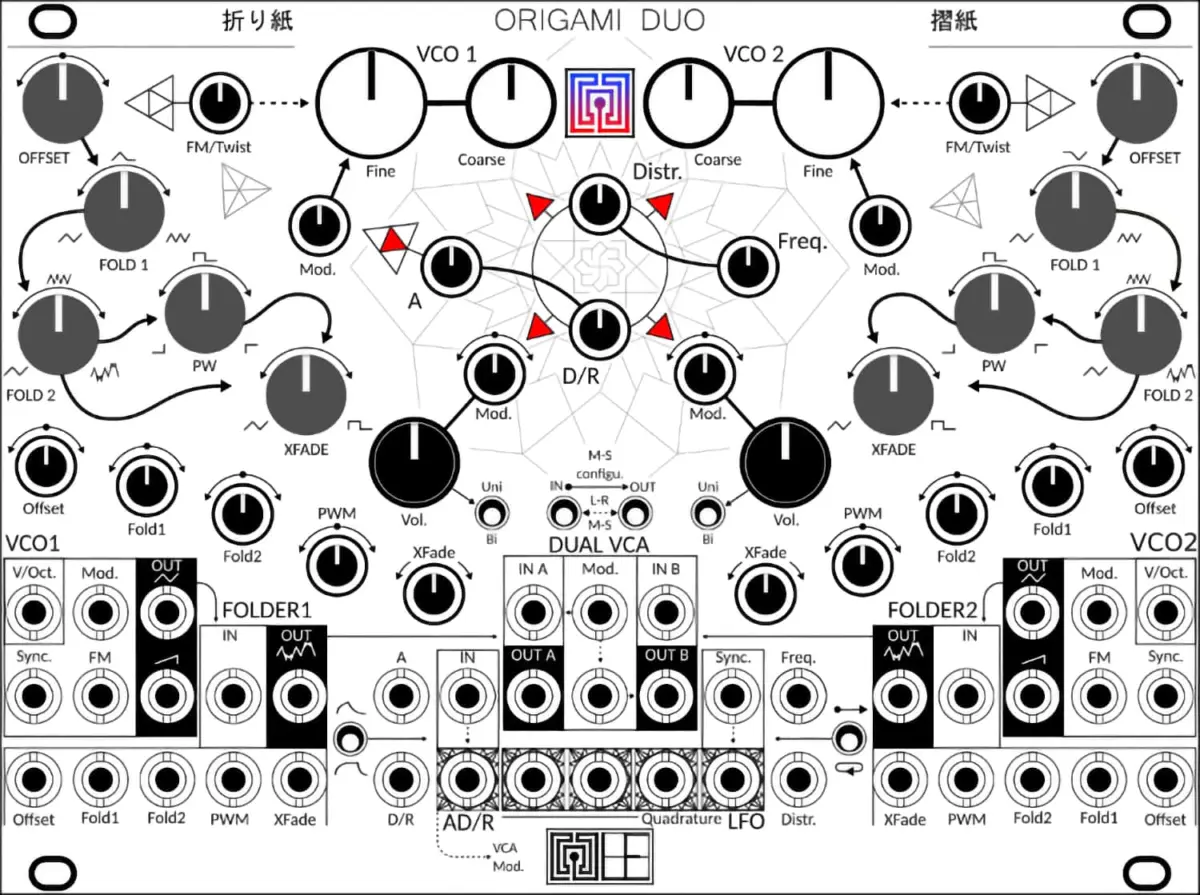
Larix Elektro, a developer specialized in high-end analog synthesis components, has officially announced the release of the Origami Duo, a comprehensive Eurorack module designed to serve as a versatile cornerstone for modular synthesis systems. The unit integrates two independent analog oscillators, multi-stage wavefolders, voltage-controlled amplifiers (VCAs), an envelope generator, and a multi-output low-frequency oscillator (LFO). By combining these elements with a sophisticated Mid-Side (M/S) processing matrix, the Origami Duo positions itself as a singular solution for complex sound design, capable of functioning as a complete synthesizer voice, a dual complex oscillator, or a dedicated stereo signal processor.
Technical Architecture and Oscillator Design
At the core of the Origami Duo are two AS3340-based oscillator circuits. The AS3340 is a modern high-fidelity recreation of the classic CEM3340 integrated circuit, which famously powered legendary synthesizers such as the Prophet-5, the Roland SH-101, and the Oberheim OB-Xa. By utilizing this architecture, Larix Elektro ensures that the Origami Duo provides the stable pitch tracking and rich harmonic profile associated with vintage analog hardware while maintaining the reliability required for modern modular setups.
Each oscillator is followed by a dedicated processing chain that includes a multi-stage wavefolder. Unlike traditional subtractive synthesis, which removes harmonics from a complex waveform using a filter, wavefolding is a "West Coast" synthesis technique that increases harmonic density by "folding" the peaks of a waveform back onto itself when they exceed a certain threshold. The Origami Duo enhances this process with additional waveshaping circuitry and comparators. These comparators allow the primary waveforms to transition toward square waves, providing a broad palette of timbres ranging from smooth, metallic textures to aggressive, harmonically saturated tones. Pulse-width modulation (PWM) is also available for both oscillators, offering further movement and timbral flexibility.
The Mid-Side Processing Matrix
One of the most distinctive features of the Origami Duo is its internal Mid-Side (M/S) routing architecture. In professional audio engineering, Mid-Side processing is a technique typically reserved for mixing and mastering, where a stereo signal is split into its center (Mid) and spatial (Side) components. By integrating a configurable M/S matrix directly into an oscillator module, Larix Elektro allows users to manipulate the spatial image of their sounds at the source.
The module can be configured to output a standard stereo signal or an encoded M/S signal. This allows for advanced stereo imaging where the wavefolding or modulation can be applied differently to the center of the sound versus the edges. When used as a stereo processor, external signals can be fed into the Origami Duo to take advantage of this matrix, turning the module into a powerful tool for spatializing mono sources or re-processing existing stereo loops. This level of integrated signal routing is rare in the Eurorack format, where such functionality usually requires multiple dedicated utility modules.
Integrated Modulation and Control
To support its complex signal path, the Origami Duo includes a suite of integrated modulation sources. A four-output LFO provides a variety of rhythmic and cyclic modulation options, allowing users to animate wavefolder depth, oscillator pitch, or PWM without exhausting external modulation modules. Complementing the LFO is a dedicated envelope generator, which is essential for shaping the amplitude and timbral evolution of the sound when the module is used as a standalone synthesizer voice.
The module features internal normalizations that allow the two oscillators to interact. This enables complex frequency modulation (FM) and cross-modulation, which are hallmarks of "complex oscillators." The inclusion of onboard VCAs ensures that the signal level can be controlled dynamically, making the Origami Duo a truly "all-in-one" voice. For performers, this reduces the need for extensive patching, though the module remains fully "modular" with numerous patch points for external control voltages (CV).
Chronology and Development Context
The development of the Origami Duo reflects a growing trend in the Eurorack industry toward "super-modules"—units that consolidate the functionality of several traditional modules into a single, cohesive interface. Larix Elektro’s entry into this space follows a period of intensive research into analog signal paths that minimize noise while maximizing harmonic flexibility.
The announcement comes at a time when the modular community is increasingly moving away from purely subtractive synthesis toward hybrid workflows that incorporate West Coast folding and advanced stereo techniques. The Origami Duo was designed to bridge these two worlds, offering the stability of classic analog oscillators with the experimental potential of modern wavefolding and M/S processing.
Market Positioning and Pricing
The Origami Duo is priced at €680, including VAT. While this places the module in the premium segment of the Eurorack market, industry analysts point out that the cost is competitive when considering the cumulative price of the individual components it replaces. A typical setup involving two 3340-based oscillators, two wavefolders, an M/S matrix, a quad LFO, an envelope generator, and two VCAs would likely exceed the €1,000 mark and occupy significantly more rack space (HP).
The module is currently available through the official Larix Elektro website and select boutique modular retailers. Its release is expected to appeal to both studio-based sound designers looking for a "Swiss Army knife" oscillator and live performers who require a compact but powerful stereo voice that minimizes the risk of patch cable failure during a set.
Comparison with Industry Standards
When compared to other complex oscillators on the market, such as the Make Noise DPO or the Frap Tools Brenso, the Origami Duo distinguishes itself through its specific focus on stereo field manipulation. While the DPO is renowned for its raw FM capabilities and the Brenso for its sophisticated folding algorithms, the Origami Duo’s inclusion of a dedicated M/S matrix offers a unique utility for producers who prioritize spatial depth in their patches.
Furthermore, the use of the AS3340 chip provides a specific "flavor" of analog sound that is highly sought after. Many modern oscillators use discrete circuits or digital wavetables; the Origami Duo’s adherence to the 3340 architecture provides a link to the classic poly-synth era, albeit in a format that encourages radical experimentation.
Broader Implications for Sound Design
The introduction of the Origami Duo suggests a shift in how modular manufacturers are approaching the "stereo" nature of modern electronic music. For years, Eurorack was predominantly a mono-focused format, with stereo processing often treated as an afterthought at the end of the signal chain. By placing stereo and M/S processing at the heart of the oscillator section, Larix Elektro is encouraging a workflow where spatiality is an intrinsic part of the synthesis process rather than a post-processing effect.
For educators and newcomers to modular synthesis, the Origami Duo also serves as a pedagogical tool. It clearly illustrates the relationship between waveshaping, modulation, and spatial imaging. The module’s layout, while dense, is designed to provide a logical flow from the initial waveform generation to the final output stage, making it an effective centerpiece for a small "skiff" or travel rig.
Official Response and Future Outlook
Early reactions from the modular synthesizer community have been positive, with particular praise directed at the module’s ability to handle both traditional and experimental duties. Larix Elektro has stated that the Origami Duo is the result of listening to user feedback regarding the need for more integrated stereo solutions within the Eurorack ecosystem.
As the modular market continues to mature, the Origami Duo represents a sophisticated evolution of the analog oscillator. It honors the history of electronic music through its choice of components while pushing the boundaries of what is possible within a single module. With its robust build quality and deep feature set, the Origami Duo is poised to become a staple for artists seeking to expand their sonic horizons through the intricate "folding" of sound and space.
