

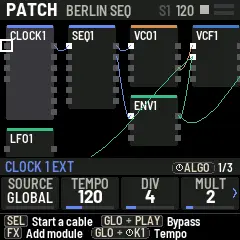
Matt Kuebrich has officially released Patchwerk, a comprehensive firmware overhaul designed to repurpose the M-Vave FM-1 hardware into a sophisticated, patchable modular synthesizer environment. This project represents a significant shift in the utility of budget-tier music hardware, providing users with a library of 85 distinct modules that facilitate complex sound generation, signal processing, and algorithmic sequencing. By replacing the factory firmware of the M-Vave FM-1—a device originally marketed as a portable FM synthesizer and MIDI controller—Patchwerk unlocks a level of flexibility typically reserved for high-end Eurorack systems or dedicated software environments like VCV Rack.
The Patchwerk ecosystem is built upon a virtual patch-cable architecture, allowing for the routing of control voltages and audio signals between diverse modules. This methodology mirrors the workflow of physical modular synthesis, where the user defines the instrument’s internal logic rather than adhering to a fixed signal path. The version 1.0.3 update introduces a robust suite of tools, including oscillators, filters, envelopes, Low-Frequency Oscillators (LFOs), and specialized synthesis engines modeled after vintage hardware.
Technical Architecture and Module Diversity
At the core of Patchwerk is its expansive module library, which covers the full spectrum of electronic sound design. The project incorporates 85 modules, categorized into synthesis, modulation, utility, and effects. Notably, the firmware includes dedicated engines for Casio CZ-style Phase Distortion synthesis and Yamaha TX81Z-style 4-operator FM synthesis. These inclusions allow users to recreate the distinct timbres of the 1980s digital era within a modern, modular framework.
The synthesis capabilities are further augmented by granular instruments and samplers, enabling the manipulation of external audio or pre-loaded waveforms. For rhythmic applications, Patchwerk provides drum machines and sequencing modules that can drive complex percussive patterns. The modulation section is equally dense, featuring multi-stage envelopes and LFOs that can be mapped to any parameter within the patch, facilitating evolving textures and generative compositions.
The processing suite includes a variety of filters—ranging from classic low-pass ladders to more exotic resonant types—and a selection of time-based effects. These modules allow for the spatial and spectral shaping of sounds directly on the hardware, eliminating the immediate need for external processing units in a portable setup.
The Hybrid Interface: Hardware Tactility and Browser-Based Control
One of the most innovative aspects of the Patchwerk project is its dual-interface system. While patches can be constructed and modified using the physical encoders and buttons on the M-Vave FM-1, the developer has also provided a browser-based emulator. This emulator serves two primary functions: it provides a visual representation of the patch bay for easier configuration and allows users to experiment with the system without owning the hardware.
When the M-Vave FM-1 is connected to a computer via USB, the browser-based interface synchronizes in real-time with the hardware. Changes made in the digital environment are immediately reflected on the physical device, and conversely, adjustments to the hardware knobs update the virtual patch. This bidirectional communication is facilitated via WebMIDI, a technology that allows web applications to interact directly with MIDI-enabled hardware through a desktop browser such as Google Chrome or Microsoft Edge.
This hybrid approach addresses one of the primary limitations of compact hardware: the "menu-diving" often required to manage complex parameters on small screens. By offloading the visual patching to a larger display while retaining the tactile feel of the FM-1’s physical controls, Patchwerk offers a workflow that bridges the gap between hardware and software synthesis.
Chronology of Development and the Rise of "Hacker" Firmware
The development of Patchwerk follows a growing trend in the music technology community where independent developers "unlock" the potential of affordable hardware through custom firmware. The M-Vave FM-1, priced significantly lower than its competitors in the boutique synth market, was identified by Kuebrich as a viable platform for such a project due to its internal processing capabilities and USB-MIDI integration.
The release of version 1.0.3 marks a milestone in the project’s maturity, moving from a proof-of-concept to a stable, feature-rich production tool. The timeline of the project reflects a broader movement toward open-source music tools, where the value of a device is no longer dictated solely by its manufacturer-provided features but by the community-driven software it can run.
Historically, this trend gained momentum with devices like the Korg Volca series and the Monologue, which saw various hardware and software modifications. However, Patchwerk represents a more total transformation, replacing the entire operating logic of the device rather than simply adding features.
Open Source Licensing and Community Impact
Patchwerk is distributed as a free, open-source project under the GNU General Public License v3.0 (GPL-3.0). This licensing choice ensures that the code remains accessible to the public for study, modification, and distribution. By making the project open-source, Kuebrich has invited the global community of developer-musicians to contribute to the module library and refine the system’s performance.
From an industry perspective, the availability of high-quality modular firmware for budget hardware democratizes access to complex synthesis. Modular synthesis has traditionally been a high-barrier-to-entry field, characterized by expensive individual modules and complex power requirements. Patchwerk effectively lowers this barrier, allowing anyone with a $50–$70 hardware investment to explore the principles of modular routing and sound design.
Installation and Operational Security
The installation of Patchwerk is conducted through the project’s official website. The process utilizes a web-based installer that requires a USB connection to the FM-1 and a compatible browser. To safeguard users, the installer includes a built-in option to revert the device to its original factory M-VAVE firmware.
Despite the accessibility of the installation process, the developer has issued standard advisories regarding data management. Users are urged to back up all existing projects and samples before initiating the firmware flash, as the process overwrites the internal memory of the device. This "non-destructive" approach to hardware modification—where the original state can be restored—is a key factor in the project’s appeal, as it mitigates the risk of "bricking" the device.
Market Implications and Future Outlook
The introduction of Patchwerk into the synthesis market highlights a shift in consumer expectations. As hardware becomes more standardized in terms of internal ARM processors and digital-to-analog converters (DACs), the software layer becomes the primary differentiator. The ability for a single piece of hardware to act as a polyphonic FM synth one day and a granular modular rig the next increases the longevity and value of the physical asset.
Industry analysts suggest that projects like Patchwerk may influence how manufacturers design future entry-level instruments. By providing more open architectures or official support for third-party developers, companies could foster a more loyal user base. Conversely, the success of Patchwerk demonstrates that the DIY community is capable of delivering professional-grade features that often surpass the original specifications of the hardware.
As Patchwerk continues to evolve, the potential for further module development is vast. The current library of 85 modules already places it in competition with established software suites, and the portability of the M-Vave FM-1 makes it a unique proposition for live performers who require a modular setup that can fit in a backpack.
Conclusion: The Democratization of the Modular Synthesis Landscape
Patchwerk v1.0.3 is more than just a firmware update; it is a recontextualization of what budget music hardware can achieve. By leveraging open-source principles and modern web technologies, Matt Kuebrich has provided a platform that is both educational for synthesis newcomers and powerful for seasoned sound designers.
The project stands as a testament to the ingenuity of the independent developer community. In an era where music technology is often categorized by high price points and proprietary ecosystems, Patchwerk offers a transparent, flexible, and cost-effective alternative. As the project matures and the user base grows, it is likely to remain a focal point for those interested in the intersection of hardware hacking and electronic music production. The modular synthesis landscape is no longer confined to expensive racks and patch cables; it has successfully transitioned into the palm of the hand, powered by a community-driven vision of what a digital instrument should be.
