

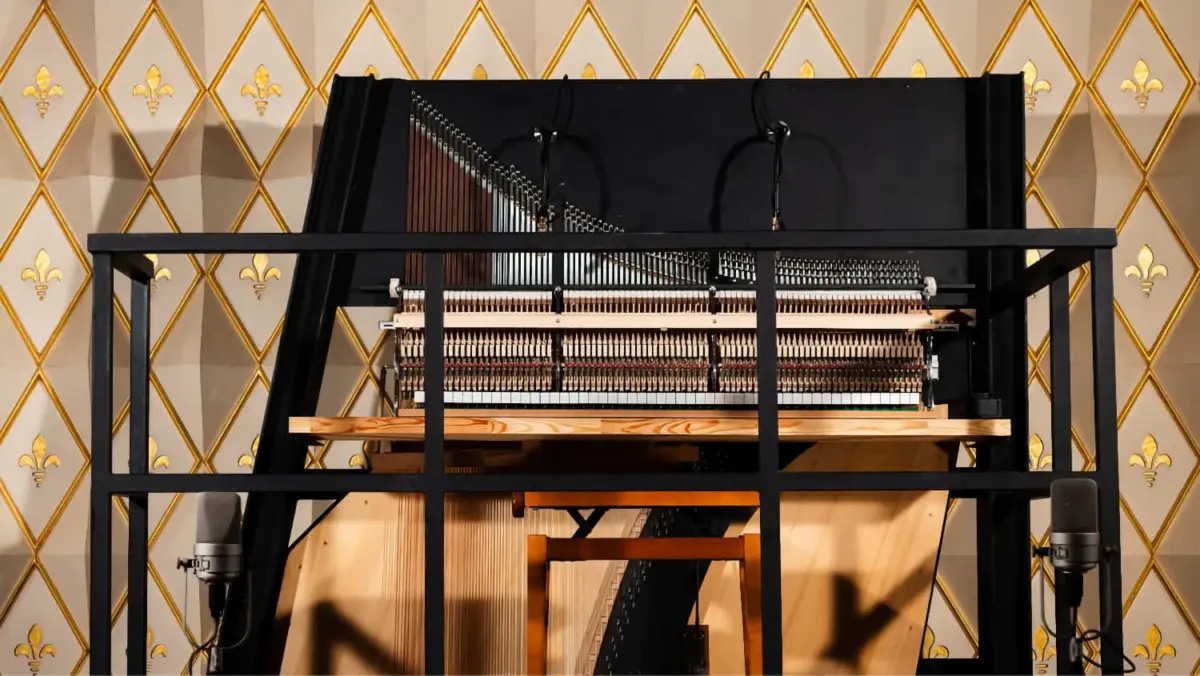
Native Instruments has officially announced the release of Vertikal, a new virtual instrument developed in close partnership with the renowned German composer and producer Nils Frahm. The library, designed for the Kontakt platform, represents a significant technical achievement in the realm of acoustic sampling, capturing the unique sonic profile of a bespoke, 4.5-meter-tall vertical piano housed in Frahm’s Berlin studio. By integrating high-fidelity acoustic recordings with a sophisticated generative sound engine, Vertikal aims to provide composers and electronic musicians with a tool that bridges the gap between traditional piano performance and avant-garde sound design.
The Engineering Behind the Instrument
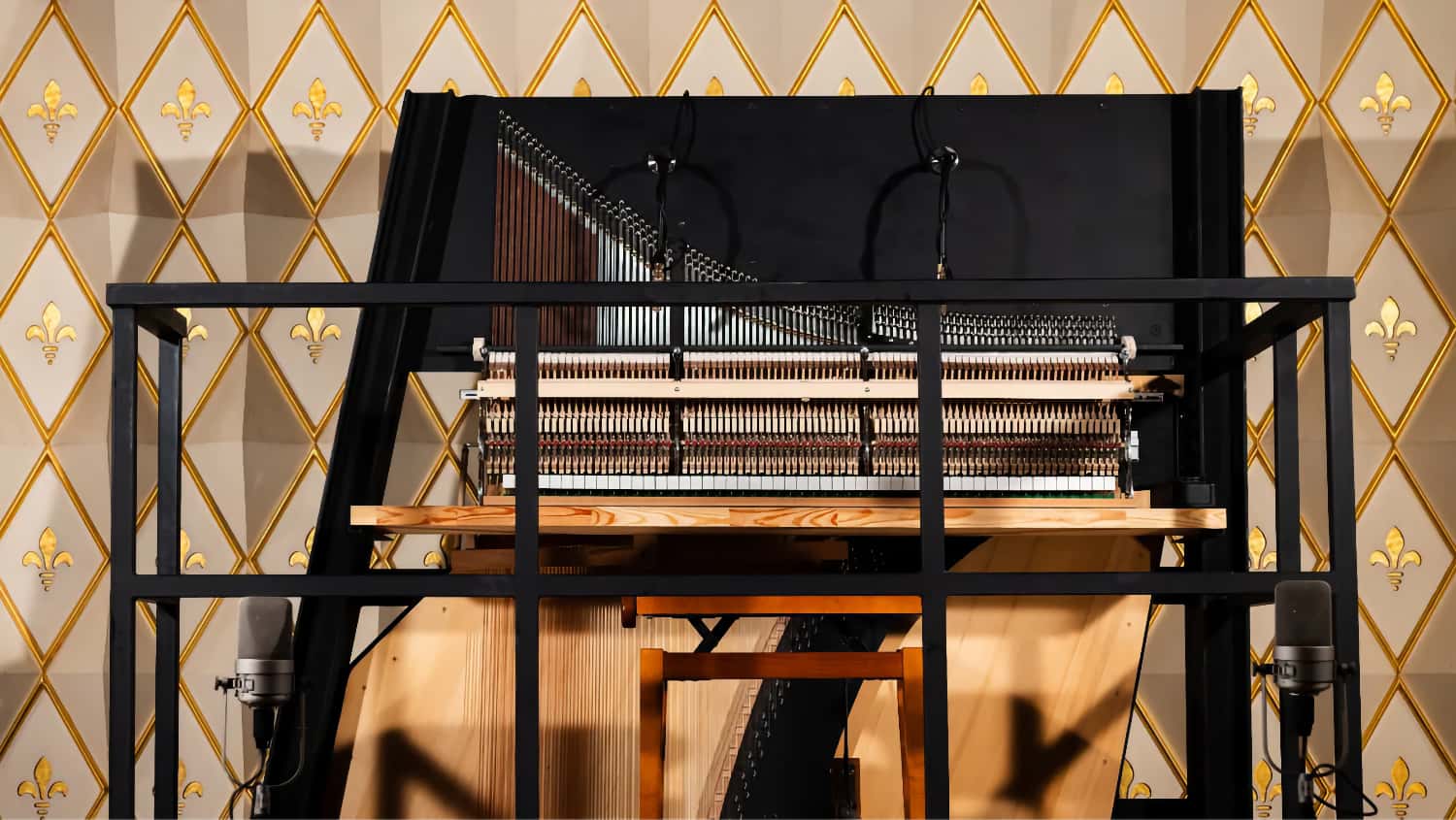
At the core of Vertikal is a physical instrument that defies standard piano dimensions. The source of the library is the Klavins M450, a monumental vertical piano designed and built by specialist David Klavins. Standing at 4.5 meters (approximately 14.7 feet) tall, the piano is a permanent fixture in Saal 3 of the historic Funkhaus Berlin complex. Due to its immense height, the pianist must sit on a balcony near the ceiling of the studio to access the keyboard.
The primary advantage of such a massive vertical design lies in the length of the strings. The M450 features bass strings measuring approximately 3.9 meters (12.7 feet). In acoustic physics, longer strings allow for a lower degree of inharmonicity—the phenomenon where the overtones of a string depart from perfect mathematical harmonics. This results in a bass response that is exceptionally clear, deep, and resonant, providing a fundamental frequency strength that standard grand pianos cannot easily replicate.
Despite its imposing physical presence, Native Instruments and Nils Frahm focused on the instrument’s capacity for intimacy. During the sampling process, the team prioritized the "soft" end of the dynamic range. The result is a sound that remains detailed and breathy even at low velocities, making it particularly suitable for ambient, neo-classical, and cinematic scoring.
Recording Environment: Saal 3, Funkhaus Berlin
The acoustic identity of Vertikal is inextricably linked to Saal 3, the recording space within Nils Frahm’s studio. Funkhaus Berlin, formerly the headquarters of the German Democratic Republic’s state radio, is world-renowned for its architectural acoustics. Saal 3 was specifically chosen for its natural reverberation and "controlled" airiness, which allows the piano’s sound to bloom without becoming muddy.
The sampling sessions involved capturing not only the direct sound of the strings but also the mechanical noises of the piano—the movement of the hammers, the creak of the dampers, and the subtle vibrations of the massive wooden frame. This "room-inclusive" approach ensures that the virtual instrument feels grounded in a physical space, providing a level of realism that isolated studio recordings often lack.
Dual Interpretations: Pure and Felt
Vertikal is delivered as two distinct Kontakt instruments, each offering a different tonal perspective on the M450.
- Vertikal Pure: This version captures the instrument in its natural state. It highlights the clarity of the long strings and the expansive resonance of the soundboard. It is designed for users who require the full harmonic spectrum of the piano, from its crystalline highs to its subterranean lows.
- Vertikal Felt: Following a technique popularized by Frahm in his previous collaborations with Native Instruments, this version involves a layer of felt placed between the hammers and the strings. This dampens the attack and filters out high-frequency transients, resulting in a warm, muted, and highly percussive sound that has become a staple of contemporary ambient music.
Both versions include more than 150 "snapshots"—pre-configured settings that allow users to quickly toggle between various microphone mixes, mechanical noise levels, and effect chains.
Advancements in Generative Sound: Particles 2.0
A defining feature of Vertikal is the inclusion of Particles 2.0, an updated version of the generative engine first introduced in the Native Instruments Noire library. Particles 2.0 acts as a real-time performance enhancer, generating a "cloud" of additional notes based on the user’s input.
The engine functions by analyzing the pitch, timing, and velocity of the notes played by the musician. It then triggers secondary sound sources that can be tuned, delayed, or modulated to create evolving textures. The 2.0 update introduces several new operational modes:
- Pulse: Creates rhythmic, percussive repetitions that can be synced to a project’s tempo.
- Echo: Generates cascading melodic lines that function like a sophisticated, pitch-aware delay system.
- Texture: Focuses on granular, atmospheric layers that move independently of the piano’s rhythm.
- Loop: Allows for the creation of cyclical patterns that evolve over time.
The engine also incorporates a "Motion" system, which utilizes LFOs (Low-Frequency Oscillators) and envelope followers to automate parameters. For users with MIDI controllers supporting polyphonic aftertouch or high-resolution mod wheels, Vertikal offers deep real-time expressive control, allowing the generative layers to swell or recede based on physical performance data.
Chronology of Collaboration
Vertikal marks the third major collaboration between Native Instruments and Nils Frahm. The partnership began in 2015 with the release of Una Corda, an instrument based on a custom-made piano with only one string per key. This was followed in 2019 by Noire, which sampled Frahm’s customized Yamaha CFX concert grand in the same Saal 3 environment.
This timeline reflects a broader trend in the music software industry toward "character pianos." While the early 2000s were dominated by attempts to create the "perfect" concert grand library, the last decade has seen a shift toward instruments with unique flaws, specific historical contexts, or unconventional physical builds. Vertikal represents the culmination of this trend, moving away from the standard 9-foot grand toward a 15-foot vertical anomaly.
Market Positioning and Industry Implications
Priced at $149, Vertikal enters a competitive market for boutique piano libraries. It is positioned as a "premium creative tool," targeting film composers who need unique textures for soundtracks, as well as electronic producers looking for organic sounds that can be easily manipulated.
Industry analysts suggest that the release of Vertikal highlights Native Instruments’ continued reliance on the Kontakt ecosystem as a industry-standard host for high-end libraries. By bundling generative synthesis with traditional sampling, NI is also addressing the growing demand for "instant inspiration" tools—software that helps composers overcome "blank page" syndrome by providing evolving rhythmic and melodic foundations.
The integration of polyphonic aftertouch support in Vertikal also signals a move toward supporting the latest generation of MIDI hardware, such as the Native Instruments Kontrol S-Series MK3 keyboards. As MPE (MIDI Polyphonic Expression) becomes more common, virtual instruments are being redesigned to offer more than just static snapshots of acoustic sounds.
Technical Specifications and Availability
Vertikal requires the latest version of Kontakt 7 or the free Kontakt Player. The library is NKS (Native Kontrol Standard) compatible, ensuring seamless integration with Native Instruments hardware.
Key Features Summary:
- Instrument Type: Sample-based virtual vertical piano with generative engine.
- Source: Klavins M450 (4.5 meters tall).
- Total Presets: Over 100 Particles presets and 150 snapshots.
- Engine: Particles 2.0 with four assignable effects slots.
- Modulation: Motion system with LFO and polyphonic aftertouch support.
- Price: $149 USD / €149 EUR.
Conclusion
The release of Vertikal underscores the ongoing evolution of the virtual piano. By focusing on a physical instrument that most musicians would never have the opportunity to play in person, Native Instruments and Nils Frahm have provided a unique sonic palette that emphasizes the physical reality of sound. Through the combination of the M450’s massive low-end resonance and the intricate generative capabilities of the Particles 2.0 engine, Vertikal stands as a versatile tool for modern composition, blending the boundaries between the acoustic past and the digital future.
