

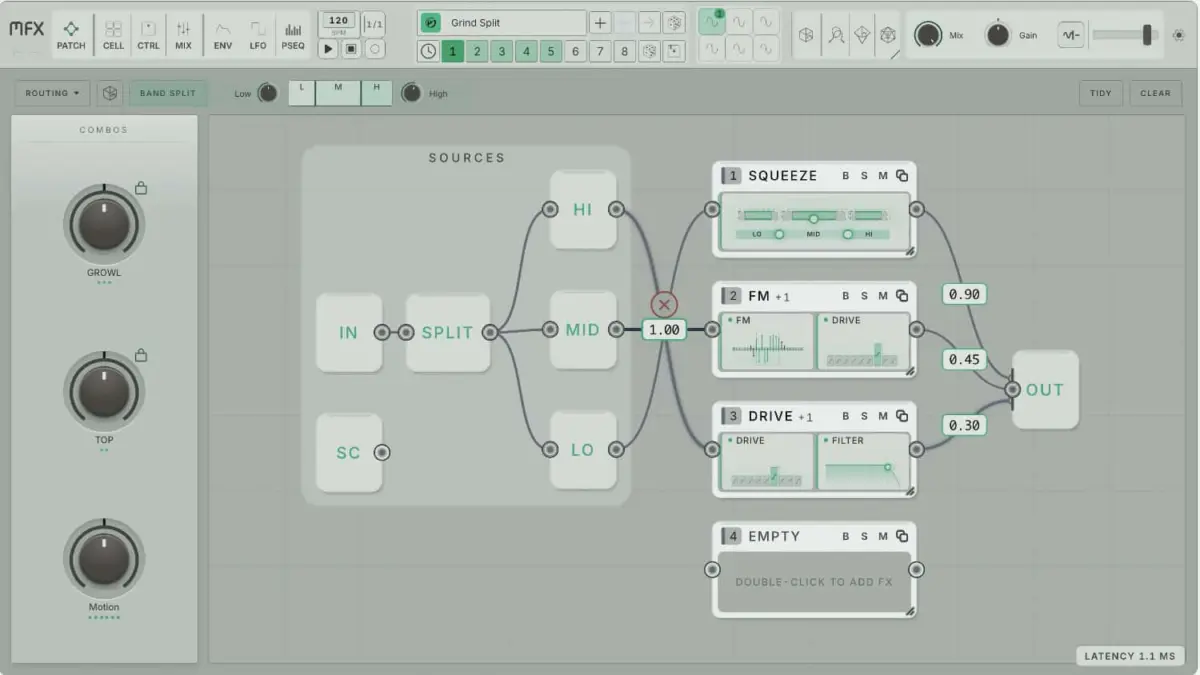
MAP Audio has officially released MFX, a comprehensive modular multi-effects processor designed to streamline complex signal chains within a single VST and AU plugin interface. By integrating 34 distinct audio processors and a flexible, cable-based routing system, the software aims to provide music producers and sound designers with a versatile environment for sonic manipulation. The plugin features four discrete processing cells that can be interconnected using virtual patch cables, allowing for series, parallel, and feedback configurations. This architecture is intended to replace long chains of individual plugins, reducing CPU overhead and simplifying the workflow for creative audio processing.
The Architecture of Modular Signal Processing
The core of the MFX philosophy lies in its modularity. Unlike traditional multi-effects units that follow a fixed signal path—usually moving from left to right or top to bottom—MFX utilizes a non-linear approach. The interface centers on four processing cells, each capable of hosting any of the 34 available effects modules. These cells act as independent hubs that can be patched together in nearly any order.
The inclusion of virtual patch cables provides a visual representation of the signal flow, a design choice that draws inspiration from Eurorack modular synthesis. Users can click and drag to connect the output of one cell to the input of another. A critical feature of this routing system is the ability to control signal levels directly on the cables themselves. This allows for precise gain staging between different stages of the effect chain, ensuring that high-gain distortions or resonant filters do not clip the subsequent modules in the network.
Beyond standard serial routing, MFX supports parallel processing and complex feedback loops. Parallel routing allows a dry signal to be split and processed by different effects simultaneously before being summed at the output, preserving the clarity of the original source. The feedback capability is particularly notable for sound designers, as it allows the output of a processing cell to be fed back into an earlier stage of the chain. When applied to delays, pitch shifters, or filters, this can create self-oscillating textures, evolving pads, and rhythmic artifacts that are difficult to achieve with static plugin chains.
A Comprehensive Library of 34 Processors
The versatility of MFX is derived from its internal library of 34 processors. While the developer has optimized these modules for low-latency performance, they cover a wide spectrum of audio utility and creative transformation. The processors can be broadly categorized into four main groups:
Time-Based and Reverb Effects
This category includes various delays—ranging from clean digital lines to emulated analog tape delays—and several reverb algorithms. These modules are essential for creating spatial depth and rhythmic echoes. By placing these within the modular grid, users can, for example, apply a bitcrusher only to the feedback path of a delay, creating a degrading echo effect that does not affect the initial transient of the sound.
Spectral and Filter Modules
MFX provides a suite of filtering tools, including high-pass, low-pass, band-pass, and notch filters with adjustable resonance. More advanced spectral tools allow for frequency-dependent manipulation, enabling producers to carve out specific niches in the frequency spectrum or create sweeping phaser and flanger movements.
Dynamics and Distortion
To add character and grit, the plugin includes multiple distortion models, saturation units, and bitcrushers. These are complemented by dynamics processors such as compressors and expanders. The modular nature of MFX allows these dynamics tools to be used as "sidechain" triggers within the plugin itself, where the volume of one cell can modulate the parameters of another.
Modulation and Utility
Rounding out the 34 processors are various modulation tools like choruses, tremolos, and vibratos, along with utility modules for gain staging, stereo widening, and phase inversion. The "extensive modulation tools" mentioned by MAP Audio refer to internal LFOs and envelope followers that can be mapped to almost any parameter within the 34 processors, allowing for movement that is synced to the host DAW’s tempo.
Chronology and Development Context
The release of MFX comes at a time when the "in-the-box" production landscape is shifting toward consolidated modular environments. Over the last decade, the industry has seen a transition from standalone plugins to "super-plugins" or "ecosystems."
- The Rise of Modular Software (2015–2018): Early adopters in the modular software space, such as VCV Rack and various Reaktor ensembles, proved that there was a significant market for cable-based routing in a digital environment.
- The Integration Era (2019–2022): Major developers began releasing multi-effect shells where users could load various modules. However, many of these remained linear in their routing capabilities.
- The Launch of MFX (Current): MAP Audio’s entry into this market focuses on the specific niche of high-flexibility routing with a relatively low barrier to entry. By limiting the system to four cells but allowing complex feedback, the developer has prioritized a balance between infinite possibility and user-friendly constraints.
The development of MFX appears to be a response to the "plugin fatigue" reported by many modern producers. Rather than navigating thirty separate windows to adjust a complex vocal chain, MFX centralizes the process, providing a single macro-view of the entire signal transformation.
Technical Specifications and Licensing
MAP Audio has positioned MFX as a professional-grade tool with a licensing model designed for the modern multi-studio producer. The plugin is available for $80 USD, a price point that sits in the mid-range of the effects market.
Key technical details include:
- Format: VST and AU (Audio Units), ensuring compatibility with major Digital Audio Workstations (DAWs) such as Ableton Live, Logic Pro, FL Studio, Cubase, and Reaper.
- Licensing: Each purchase includes a license that covers up to three separate machines. This is a significant detail for professionals who move between a primary studio desktop, a mobile laptop rig, and a secondary production suite.
- Interface: A high-definition graphical user interface (GUI) that supports resizing, which is becoming a standard requirement for users working on 4K or ultra-wide monitors.
Market Analysis and Professional Implications
The introduction of MFX into the software market carries several implications for the future of digital audio production. From a technical standpoint, the "feedback" capability is a highlight. In many DAWs, creating a feedback loop between two tracks is either prohibited by the software’s architecture to prevent infinite gain loops or requires complex "dummy" busing. By handling the feedback internally, MFX allows for safe, controlled experimentation with recursive audio processing.
Industry analysts suggest that tools like MFX are particularly valuable in the realms of cinematic sound design and electronic music. In film scoring, the ability to take a simple organic recording—such as a cello note or a foley hit—and run it through a modular network of 34 processors can result in unique, unidentifiable textures that form the basis of a modern soundtrack.
Furthermore, the "four-cell" limitation is viewed by some experts as a creative strength. While some modular environments offer infinite slots, they can often lead to "choice paralysis" or excessive CPU consumption. By constraining the user to four primary processing hubs, MAP Audio encourages more intentional decision-making. Producers must think critically about which effects are most essential to the sound they are crafting.
Official Response and User Reception
While formal reviews are still emerging, early feedback from the sound design community has highlighted the plugin’s "patch-cord" aesthetics as a major draw. Users have noted that the visual feedback—seeing the signal level pulse through the virtual cables—provides a more intuitive connection to the sound than traditional knobs and faders alone.
MAP Audio has indicated that MFX is intended to be an evolving platform. While it launches with 34 processors, the modular architecture allows for the potential of future updates where new modules, inspired by classic hardware or modern DSP breakthroughs, can be added to the library.
In conclusion, MAP Audio’s MFX represents a significant step toward making complex, modular signal routing accessible to a broader range of producers. By combining a vast library of processors with a flexible, feedback-capable routing system, it offers a powerful alternative to traditional serial plugin chains. As the boundaries between synthesis and effects processing continue to blur, MFX stands as a versatile tool for those looking to push the limits of digital sound manipulation.
