

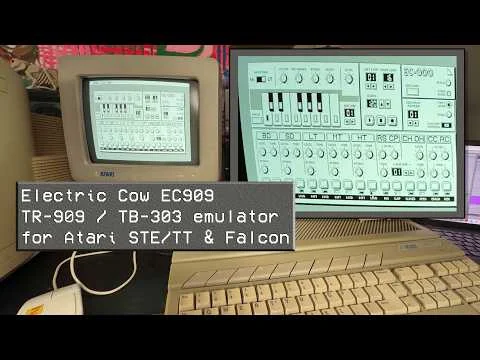
The EC909 was designed during the twilight years of the Atari home computer line’s dominance in the professional music industry. While the Atari ST had long been the industry standard for MIDI sequencing due to its built-in MIDI ports and rock-solid timing, the later Falcon 030, TT, and enhanced STE models provided the additional processing power necessary for digital signal processing (DSP) and software-based synthesis. The EC909 leveraged these advancements, offering users a localized, "in-the-box" solution for acid house and techno production at a time when hardware units were becoming increasingly expensive and difficult to maintain.
Technical Specifications and Hardware Requirements
The Electric Cow EC909 was engineered to maximize the capabilities of the Motorola 68000 series processors found in the Atari range. While the software is compatible with the Atari STE and the high-end TT, it was specifically optimized for the Atari Falcon 030. The Falcon’s inclusion of a Motorola 56001 DSP chip allowed for real-time manipulation of audio that was simply not possible on earlier 16-bit machines.
On the Falcon, the EC909 allows for real-time pattern creation and playback, providing a tactile experience similar to the original Roland hardware. However, when running on the Atari STE, the software faces significant performance hurdles. Due to the limited 8 MHz clock speed of the STE’s 68000 CPU, users often experience noticeable lag during playback and editing. Despite these limitations, the software remains functional on the STE, serving as a valuable tool for sound design and pattern generation, even if the real-time performance is compromised.
The software utilizes Pulse Code Modulation (PCM) samples to recreate the percussive elements of the TR-909. These samples are not static; the EC909 provides users with the ability to edit the pitch and attack of each drum sound, allowing for a degree of customization that exceeded the capabilities of many basic samplers of the era. This flexibility ensured that producers could tailor their drum sounds to fit the specific needs of a track, whether they required the punchy, high-tuned kicks of hardcore techno or the deeper, more atmospheric tones of house music.
Functional Architecture and User Interface
The EC909 architecture is divided between its drum machine and synthesizer components. The drum section utilizes a step-sequencing interface familiar to users of the original Roland hardware. Users can program patterns, adjust velocities, and modify sample parameters within a unified workspace. The TB-303 emulation provides the signature "squelch" and resonance associated with the silver bass box, utilizing software synthesis to replicate the analog filter sweeps that defined the acid genre.
One of the most robust features of the EC909 is its export capability. The program supports the export of single-bar patterns into high-fidelity audio formats. Users can choose between AIFF and AVR formats, with support for both 8-bit and 16-bit resolution in mono or stereo. This was a critical feature for the 1990s producer, as it allowed for the integration of EC909-generated loops into larger arrangements within professional Digital Audio Workstations (DAWs) or hardware samplers like the Akai S-series.
Furthermore, the EC909 bridges the gap between software synthesis and MIDI control. The program can generate MIDI files from user-created patterns, enabling the transfer of complex sequences to other synthesizers or software. It also supports MIDI triggering for its internal drum sounds, allowing the Atari to function as a sound module controlled by an external sequencer or keyboard.
The CandiKit Utility and Sample Customization
A standout feature highlighted in the original documentation and the recent demonstration by ako is the inclusion of the CandiKit program. This utility allows users to bypass the stock TR-909 samples and load their own custom audio data into the EC909 engine. By replacing the default PCM samples, producers could effectively transform the EC909 into a versatile sample-based drum machine, utilizing sounds from other classic hardware like the TR-808, LinnDrum, or even found-sound recordings.
The process of loading custom samples via CandiKit on an Atari STE is reportedly slow, as the hardware struggles with the data-intensive task of processing and reallocating memory for audio samples. Nevertheless, the successful implementation of this feature in a 1998 software package demonstrates a forward-thinking approach to user-end customization that remains a hallmark of modern plugin design.
Historical Context: The Atari Music Legacy
To understand the impact of the EC909, one must consider the broader context of the Atari computer’s role in music history. Throughout the late 1980s and early 1990s, the Atari ST was the centerpiece of countless professional studios. Its integrated MIDI ports provided a level of timing accuracy that contemporary PCs and Macintoshes struggled to match. Iconic software such as C-Lab Notator (the precursor to Logic Pro) and Steinberg Cubase were born on the Atari platform.
By 1998, however, the industry was shifting toward the PowerPC and Pentium architectures, which offered the raw power necessary for full-scale digital audio recording and sophisticated virtual instruments. Electric Cow’s release of the EC909 was part of a "late-stage" flowering of Atari development. Developers were pushing the aging hardware to its absolute limits, finding creative ways to implement synthesis and sampling techniques that were becoming standard on more modern systems. The EC909 represents this era of "extreme coding," where efficiency and optimization were paramount.
Modern Availability and Digital Preservation
The resurgence of interest in the EC909 is largely due to the efforts of the retro-computing community and the Electric Cow Archive. As original Atari hardware becomes a niche collector’s item, the preservation of its software library has become a priority for digital historians. The EC909 is currently available for download through the Electric Cow Archive, hosted on the Exxos Forum, a hub for Atari hardware and software enthusiasts.
Recognizing that many modern producers do not have access to functioning Atari hardware, the user ako has released a dedicated EC909 sample pack. This pack captures the output of the software, including its unique "lo-fi" character derived from the Atari’s internal digital-to-analog converters (DACs). The 8-bit and 16-bit samples offer a specific grit and warmth that is highly sought after in modern electronic music production, particularly in genres such as lo-fi hip hop, synthwave, and industrial techno.
Impact and Implications for Modern Production
The EC909 serves as a reminder of the transition from hardware-centric studios to software-based "bedroom" production. By emulating the 909 and 303, Electric Cow democratized access to sounds that were, even in 1998, becoming prohibitively expensive. Today, the software stands as a testament to the longevity of the Atari platform and the enduring appeal of the Roland sound palette.
From a technical standpoint, the EC909’s ability to handle MIDI, PCM samples, and synthesis within a single environment on 1990s hardware is an impressive feat of engineering. Its legacy is seen in the countless "groovebox" style applications and plugins that dominate the market today. For the modern producer, the EC909 sample pack provides a bridge to the past, offering a palette of sounds that carry the distinct DNA of the Atari era—a period where technical limitations often spurred the greatest creative innovations.
In conclusion, the Electric Cow EC909 is more than just a historical curiosity; it is a functional piece of music history that continues to provide value to the contemporary creative community. Whether utilized through original hardware for its unique workflow or via sample packs for its vintage sonic character, the EC909 remains a vibrant example of the intersection between computing history and electronic music evolution. The work of archivists like ako ensures that these digital artifacts are not lost to time but continue to inspire new generations of musicians.
