

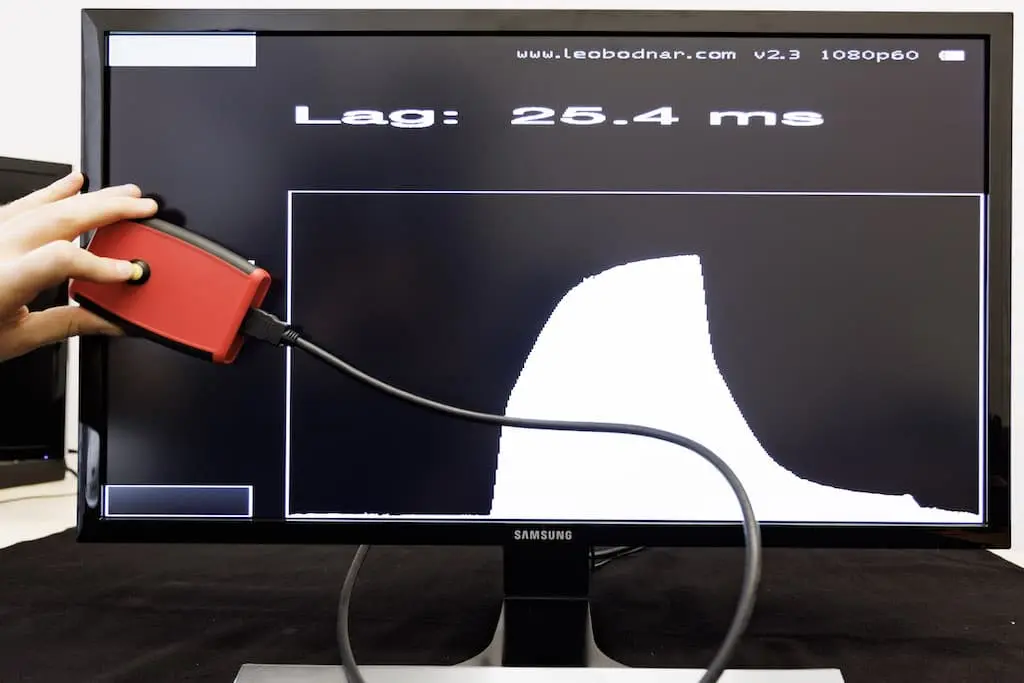
The pursuit of zero-latency signal transmission remains one of the most significant challenges in the professional audiovisual (AV) industry, particularly as resolutions climb and signal chains become increasingly complex. In a landscape where live broadcasts, competitive gaming, and synchronized multi-screen installations demand absolute precision, the ability to quantify delay is no longer a luxury but a necessity. The Leo Bodnar HDMI Video Signal Lag Tester has emerged as a cornerstone tool for technicians, providing a compact, hardware-based solution for measuring the exact time elapsed between a signal’s output and its appearance on a display. This device, characterized by its distinctive red chassis and tactile yellow button, offers a millisecond-accurate diagnosis of latency, effectively demystifying the performance of monitors, projectors, and complex distribution networks.
The Technical Evolution of Latency Measurement
Historically, measuring input lag was a cumbersome process that often required high-speed cameras and manual frame counting. This method was not only time-consuming but also prone to human error. The transition from Cathode Ray Tube (CRT) displays to digital Liquid Crystal Displays (LCD) and Organic Light Emitting Diodes (OLED) introduced significant processing overhead. Unlike CRTs, which scanned an electron beam across the screen in real-time, digital displays must buffer incoming data, perform scaling, apply color corrections, and often execute motion-smoothing algorithms before a single pixel is illuminated.
The Leo Bodnar device simplifies this by integrating a signal generator and a light sensor into a single handheld unit. When the user activates the device via the prominent yellow button, it generates a specific HDMI signal containing three white rectangles on a black background. These rectangles are positioned at the top, middle, and bottom of the screen. A high-speed photodiode located on the underside of the device detects the exact moment the light from these rectangles hits the screen. By comparing the internal timestamp of the signal generation with the detection of light by the sensor, the device calculates the total latency and displays the result directly on the screen in milliseconds.
Hardware Specifications and Operational Modes
The device is offered in multiple configurations to suit different professional requirements. The standard versions provide signals at 720p and 1080p resolutions, both operating at a 60 Hz refresh rate. For high-end applications involving Ultra-High Definition (UHD) workflows, a 4K-capable version is available, supporting resolutions up to 3840 × 2160 at 60p. This is particularly relevant given that 4K processing often introduces higher latency due to the increased data volume managed by the display’s internal Scaler and System-on-a-Chip (SoC).
Power is supplied by two AA batteries, ensuring that the tool remains portable and independent of external power sources—a critical feature for field technicians working on-site at venues or in server rooms. The operational logic is straightforward: the measurement cycle begins the moment the button is pressed and continues until it is released. This allows for real-time monitoring of fluctuations in latency, which can occur in networked AV environments or when displays are subject to thermal throttling.
The Significance of 60 Hz and Frame Timing
In the context of latency, the 60 Hz refresh rate is a standard benchmark. At 60 frames per second (fps), each frame persists for approximately 16.67 milliseconds. When the Leo Bodnar tester reports a lag of 16.7 ms, it indicates a delay of exactly one frame. In professional environments, such as live sports broadcasting or eSports tournaments, a delay exceeding two frames (approx. 33 ms) is often considered unacceptable, as it disrupts the "feel" of the interaction and can lead to lip-sync issues between audio and video.
By providing measurements for the top, middle, and bottom of the screen, the device also reveals how a display handles its "scan-out." Most digital displays update from top to bottom. A measurement at the top might show 2 ms, while the bottom shows 18 ms, reflecting the time the display takes to draw the image from the first line to the last. For comparative analysis and standardized reporting, the manufacturer recommends using the middle rectangle as the primary data point.
Identifying Bottlenecks in the Signal Chain
One of the most practical applications of the Leo Bodnar tester is the identification of "slow" inputs. In many modern professional displays and consumer televisions, different HDMI ports may be routed through different internal processing paths. A common finding among technicians is that an "HDMI 1" port might be optimized for low-latency gaming, while "HDMI 2" might be routed through a heavy image-processing chip intended for cinematic viewing, resulting in vastly different lag profiles.
The original report by Alexander Heber highlighted a scenario where a single monitor exhibited a difference of 18 ms between two different inputs. In a professional setting, such a discrepancy can be catastrophic if not accounted for, especially in "Video Wall" configurations where multiple screens must act as a single cohesive canvas. Furthermore, the tool is invaluable when testing Software Defined Video over Ethernet (SDVoE) modes. SDVoE technology promises "zero-latency" transmission over 10Gb networks, but actual performance can vary based on the compression mode used (e.g., genlock vs. fast-switch). The Leo Bodnar tester provides the empirical data required to verify manufacturer claims and optimize network settings.
Challenges with Conversion and Signal Processing
While the device is highly accurate, its effectiveness can be influenced by the signal chain’s architecture. Active conversion—such as converting HDMI to SDI and back to HDMI—can sometimes interfere with the tester’s ability to read the return signal, particularly if the converter introduces significant jitter or alters the frame rate. The manufacturer notes that signal processing between the sender and receiver can occasionally lead to failed measurements if the integrity of the specific test pattern is compromised. However, for direct display testing and standard switching environments, the results remain consistently verifiable through secondary methods, such as high-speed photographic tests.
Economic Considerations and Market Availability
For European professionals, acquiring the Leo Bodnar tester involves navigating international trade logistics following the United Kingdom’s departure from the European Union. The base 1080p model is priced at just over €100 in the UK-based webshop, while the 4K version represents a more significant investment at over €400. Once import duties and taxes are factored in, the cost increases, yet the device remains highly competitive. There are few alternatives on the market that offer this level of precision in a dedicated, handheld form factor without requiring a laptop or specialized software suites.
Broader Industry Implications and Professional Adoption
The adoption of the Leo Bodnar HDMI Lag Tester reflects a broader trend toward transparency and data-driven optimization in AV integration. As the industry moves toward AV-over-IP, where video signals share bandwidth with data and control signals, the potential for "latency creep" is high. Technicians are now expected to provide documented proof of system performance, including latency figures, as part of the commissioning process for high-stakes installations.
Furthermore, the gaming industry has driven a massive surge in demand for low-latency displays. With the rise of "Game Modes" in professional-grade monitors, the Leo Bodnar tool has become the gold standard for independent reviewers and quality assurance engineers. It allows them to strip away marketing jargon and provide consumers and professionals with hard data.
Conclusion: A Staple for the Modern Tool-Case
As digital signal processing becomes more sophisticated, the "invisible" delay introduced by hardware will continue to be a focal point for AV professionals. The Leo Bodnar HDMI Video Signal Lag Tester addresses this need by providing a simple, reliable, and highly accurate means of measurement. Whether it is used to calibrate a projector for a live concert, synchronize a multi-screen art installation, or ensure that a competitive gaming arena is fair for all participants, this "small red box" has proven its worth.
The ability to detect an 18 ms difference between inputs or to verify the performance of an SDVoE network ensures that the technician is never working in the dark. Despite the added costs of international shipping and customs, the device’s utility makes it an essential component of any modern AV tool-case. As we look toward the future of 8K video and beyond, the fundamental need to measure the speed of light—or at least the speed of the pixels—remains unchanged. The Leo Bodnar tester stands as a testament to the fact that in the world of professional video, every millisecond counts.
