

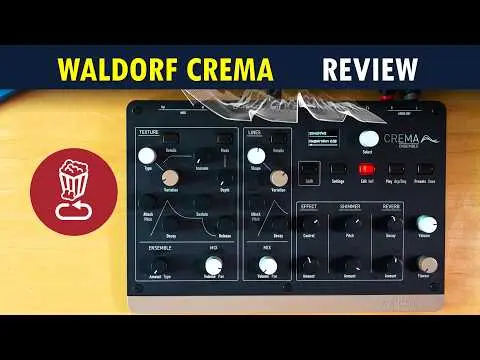
The Evolution of Waldorf’s Compact Desktop Series
The Waldorf Crema arrives as a spiritual and technical successor to the Streichfett, a dedicated string synthesizer released by the company in 2014. While the Streichfett gained a cult following for its faithful recreation of the "string machine" sounds of the 1970s and 80s—reminiscent of the Solina String Ensemble or the ARP Omni—the Crema seeks to transcend these historical limitations. Waldorf’s engineering team has integrated the core DNA of their string synthesis legacy with the more advanced digital architectures found in their flagship instruments, such as the Iridium and Quantum.
The development of the Crema reflects a broader industry trend toward "hybridization," where instruments are no longer confined to a single synthesis method. In the decade since the Streichfett’s debut, the demand for desktop modules that can perform multiple roles in a studio environment has increased. The Crema addresses this by moving beyond simple emulation, incorporating wavetable and frequency modulation (FM) synthesis into its primary sound engine, thereby offering a palette that is both nostalgic and contemporary.
Dual-Engine Architecture: A Deep Dive into Sound Generation
At the heart of the Waldorf Crema lies a sophisticated dual-engine architecture that allows for complex layering and sound design. The instrument is divided into two distinct sections that can be blended, panned, and processed independently or in tandem.
The String and Texture Engine
The first engine is a polyphonic powerhouse that draws heavily on Waldorf’s expertise in wavetable synthesis. While it retains the lush ensemble effects and chorus-heavy textures of a classic string machine, it expands these capabilities through the inclusion of wavetables and FM textures. This engine is designed for creating "pads"—sustained, evolving sounds that provide the harmonic foundation for a composition. By utilizing wavetable technology, the Crema can transition smoothly between different waveforms, allowing for rhythmic movement and spectral changes that static analog oscillators cannot achieve. The FM component adds a layer of metallic brightness or harmonic complexity, which is particularly effective when blended with the softer, more rounded tones of the string emulation.
The Virtual Analog Engine
The second engine is an eight-voice virtual analog (VA) synthesizer. This section is dedicated to more traditional synthesis tasks, such as creating leads, bass lines, or percussive stabs. By providing a dedicated VA engine alongside the string and wavetable section, Waldorf allows users to create a complete "performance" within a single patch. For example, a user could program a deep, resonant bass sound on the VA engine while layering a shimmering, ethereal string pad on top. The eight-voice polyphony ensures that even complex chords do not suffer from voice stealing, a common limitation in compact digital synthesizers.
Technical Specifications and User Interface
The Crema maintains the signature aesthetic of Waldorf’s desktop line, featuring a robust chassis and an intuitive layout designed for real-time manipulation. The "one-knob-per-function" philosophy is largely preserved, reducing the need for menu diving—a critical factor for live performers and studio musicians who value workflow speed.
Key Controls and Parameters
- Balance Control: A central knob allows users to blend between the two engines, providing a quick way to shift the focus of a sound from a pure string texture to a more aggressive synth lead.
- Animate and Modulation: The Crema features dedicated modulation controls, including LFOs (Low-Frequency Oscillators) and envelopes that can be routed to various parameters. The "Animate" function is particularly noteworthy, allowing for dramatic shifts in timbre with a single movement.
- Effects Suite: To polish the raw synthesis, Waldorf has included a high-quality effects processor. This includes a lush reverb, a versatile delay, and a multi-stage chorus/ensemble effect that is essential for achieving the classic "string machine" wideness.
Connectivity and Integration
Despite its small footprint, the Crema offers professional-grade connectivity:
- Stereo Output: Essential for maintaining the width of the ensemble and reverb effects.
- MIDI In/Out: Traditional 5-pin DIN connectors allow for integration with older hardware and sequencers.
- USB MIDI: Provides a direct connection to Digital Audio Workstations (DAWs) for sequencing and automation.
- Headphone Jack: For private monitoring and mobile use.
Analysis of the Loopop Review and Tutorial
Ziv Eliraz, the host of the influential "Loopop" YouTube channel, recently provided a comprehensive review and tutorial of the Crema, offering insights into its practical application. Eliraz noted that the Crema is difficult to categorize because it occupies a unique niche. It is not quite a workstation, yet it is far more than a simple preset machine.
In his analysis, Eliraz highlighted the "organic" quality of the sounds, noting that the combination of wavetables and strings creates a "creamy" texture—aptly reflected in the product’s name. The tutorial demonstrated how the modulation matrix can be used to create sounds that feel "alive," with subtle shifts in pitch and timbre that mimic the imperfections of vintage hardware. One of the key takeaways from the Loopop review was the effectiveness of the Crema as a "mood-setter," capable of generating cinematic atmospheres with minimal effort.
Market Positioning and Economic Context
The release of the Waldorf Crema at the €345.45 price point is a strategic move by the German company. This price bracket is currently one of the most competitive in the music technology industry. The Crema competes directly with the Roland Boutique series, the Korg Volca range (at the lower end), and various offerings from Behringer and Arturia.
Competitive Advantages
Waldorf’s primary advantage lies in its specialized history. While competitors often focus on recreating specific vintage synthesizers (such as the Juno-106 or the Minimoog), Waldorf has carved out a niche in high-end digital synthesis. The Crema offers a "boutique" sound quality that is often associated with much more expensive instruments. By pricing it under €400, Waldorf is making its sophisticated synthesis engine accessible to a younger generation of producers who may not have the budget for a €3,000 Quantum.
Target Demographic
The Crema is specifically targeted at:
- Ambient and Film Composers: Who require evolving pads and textures.
- Desktop Synth Enthusiasts: Who have limited studio space but want professional sound quality.
- Live Performers: Who need a reliable, portable module for adding lush layers to their stage setup.
Official Responses and Industry Reception
While Waldorf has let the product speak for itself through early reviews and technical demonstrations, the initial reception from the synthesis community has been largely positive. Users have praised the decision to expand upon the Streichfett’s concept rather than simply re-releasing it. The integration of wavetables is seen as a particularly strong move, as it leverages Waldorf’s greatest technical strength.
Industry analysts suggest that the Crema represents a "safe yet innovative" step for Waldorf. By utilizing a proven form factor and an established brand identity (the "compact desktop" series), they minimize manufacturing risk while providing enough new features to justify the purchase for existing Waldorf fans. The inclusion of an 8-voice VA engine is seen as the "deal-breaker" feature that elevates the Crema from a niche string machine to a versatile polyphonic synth.
Broader Impact on Music Production
The Waldorf Crema arrives at a time when the "dawless" movement—producing music without a computer—is at its peak. Musicians are increasingly looking for hardware that can provide a "finished" sound without the need for extensive post-processing. The Crema’s built-in effects and dual-engine architecture make it an ideal candidate for this workflow.
Furthermore, the Crema contributes to the ongoing democratization of high-end sound design. Historically, the types of complex, layered textures provided by the Crema required either expensive vintage gear or high-powered software plugins. By condensing this power into a €345 hardware module, Waldorf is enabling a wider range of artists to experiment with sophisticated harmonic structures.
Chronology of Waldorf’s Desktop Innovations
To understand the Crema’s place in history, one must look at Waldorf’s timeline of compact releases:
- 2013: Launch of the Waldorf Rocket, a monophonic synth that proved there was a market for small, affordable Waldorf hardware.
- 2014: Release of the Streichfett, focusing exclusively on string machine sounds.
- 2021: Introduction of the M, a return to the classic Microwave wavetable sound in a desktop format.
- 2024/2025: The Crema launch, signifying the convergence of the Streichfett’s accessibility with the M’s digital depth.
This chronology demonstrates a clear trajectory: Waldorf is systematically taking its high-end technology and "distilling" it into more focused, affordable packages.
Conclusion and Future Outlook
The Waldorf Crema is a testament to the enduring relevance of specialized hardware in an era dominated by software. By blending the nostalgic warmth of string machines with the clinical precision of wavetable and FM synthesis, Waldorf has created an instrument that feels both timeless and forward-looking. Its competitive pricing and robust feature set ensure that it will likely become a staple in both professional and home studios.
As the music industry continues to favor instruments that offer a unique sonic character and tactile interface, the Crema stands out as a thoughtful, well-engineered solution. It remains to be seen if Waldorf will expand this "new generation" of desktop modules further, but the Crema sets a high standard for what a compact polyphonic synthesizer can achieve in the modern era. For now, the Crema offers a compelling invitation to musicians to explore the "creamy" side of digital synthesis, providing a rich palette of sounds that are as inspiring as they are accessible.
