

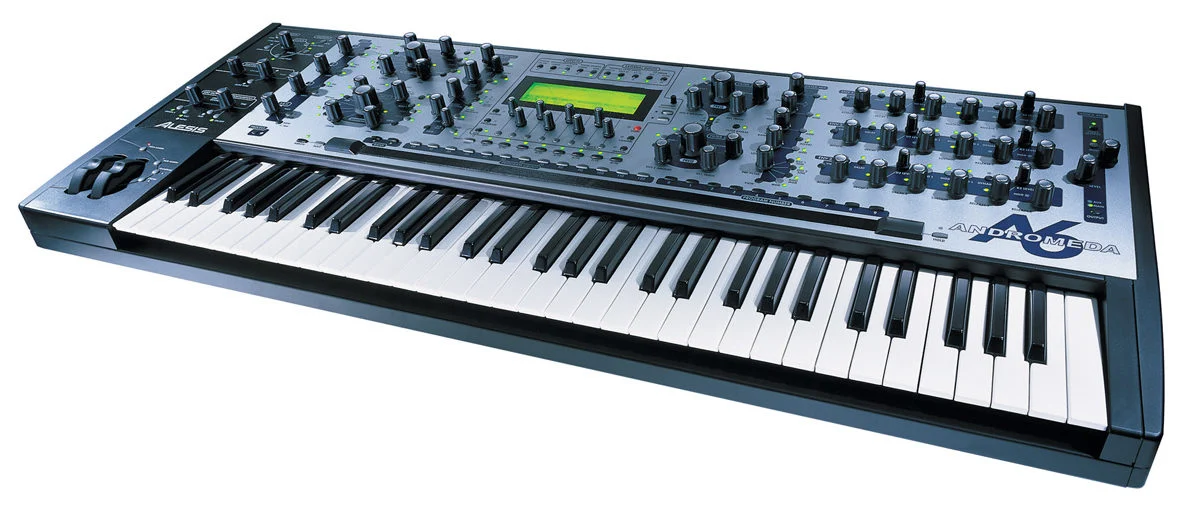
Isla Electronics, the boutique hardware manufacturer formerly known as Isla Instruments, has officially demonstrated a significant development in the capabilities of its upcoming Caladan hardware synthesizer. The company recently showcased ASICS, a sophisticated virtual instrument and internal synthesis engine designed to emulate the architecture and sonic characteristics of the legendary Alesis Andromeda A6. This new engine is not merely a sonic approximation; Isla Electronics has confirmed that ASICS is fully System Exclusive (SysEx) compatible with the original Andromeda A6, offering comprehensive bi-directional control. This development positions the Caladan as a potential modern successor or companion to one of the most complex analog synthesizers ever produced, bridging the gap between vintage 16-voice polyphony and contemporary hardware reliability.
The demonstration, shared via a technical update, highlights the integration of the ASICS engine within the Caladan’s multi-timbral framework. By achieving full SysEx compatibility, the Caladan can theoretically load original Andromeda A6 patches and respond to parameter changes from external A6 controllers or software editors in real-time. Conversely, the Caladan can serve as a controller for an original Andromeda unit, allowing for a level of integration rarely seen in modern recreations of legacy hardware. This announcement marks a pivotal moment for the Caladan project, which has been marketed as a "chameleon" synthesizer capable of hosting various synthesis models and hardware expansion cards.
Historical Context: The Legacy of the Alesis Andromeda A6
To understand the significance of the ASICS engine, one must look at the history of the instrument it seeks to emulate. Released in the year 2000, the Alesis Andromeda A6 was a monumental achievement in analog synthesizer design. At a time when the industry was pivoting heavily toward digital modeling and software, Alesis produced a 16-voice, 32-oscillator true analog powerhouse. The "A6" moniker referred to its 16 voices and the custom ASICs (Application-Specific Integrated Circuits) that powered its complex voice architecture.
The original Andromeda was famous for its dual-filter design—one based on the Moog 904 series (low-pass) and the other based on the Oberheim SEM (multimode)—allowing for incredibly dense and versatile textures. However, the complexity of the A6 was also its Achilles’ heel. The custom chips were difficult to manufacture, and over the decades, the units have become notoriously difficult to service. As components age and become obsolete, the synthesis community has long sought a way to preserve the Andromeda’s unique workflow and sound in a more reliable, modern format. Isla Electronics’ decision to name their emulation "ASICS" is a direct homage to the custom silicon that gave the original Andromeda its name and distinctive character.
Technical Specifications and Bi-Directional Control
The core of the ASICS engine on the Caladan is its ability to handle complex data streams. Bi-directional control via SysEx means that every knob movement on the Caladan can be mapped to its corresponding parameter on an Andromeda A6, and vice versa. This is achieved through high-speed MIDI processing within the Caladan’s internal architecture. For users who still own an Andromeda, the Caladan can function as a modern interface, solving the issues related to the original’s aging hardware buttons and encoders.
Beyond simple control, the ASICS engine aims to replicate the modulation matrix of the A6, which was one of the most expansive ever implemented in a hardware synth. The original featured 71 knobs and 144 buttons, providing nearly one-to-one control for its deep synthesis parameters. Replicating this in a virtual engine requires significant processing power. Isla Electronics has utilized the Caladan’s robust internal CPU to ensure that the emulation remains phase-accurate and responsive, avoiding the latency issues often associated with software-based emulations.
The Evolution of the Caladan Platform
The Caladan synthesizer itself represents a significant shift for Isla Electronics. The company gained widespread acclaim for the S2400, a modern recreation and expansion of the classic SP-1200 sampler. With the Caladan, founder Brad Holland and his team are moving into the realm of multi-timbral polyphonic synthesis. The Caladan is designed to be an expandable platform, featuring eight internal slots that can house various voice cards, such as those based on the SEM or the SID chip.
The ASICS engine functions as a "digital engine" within this ecosystem. While the Caladan can host physical analog voice cards, it is also capable of running high-resolution digital models. The inclusion of the ASICS engine demonstrates the platform’s versatility; it can operate as a pure analog synth, a digital emulator, or a hybrid of both simultaneously. This multi-engine approach allows users to layer the Andromeda-style sounds of ASICS with physical analog filters or other digital models, such as FM or wavetable synthesis, all within a single hardware unit.
Chronology of Development
The journey toward the ASICS engine has been a multi-year process for Isla Electronics. The Caladan was first teased as a concept for an "everything synth" that would address the limitations of modern workstations.
- Initial Concept (2021-2022): Following the success of the S2400, Isla Electronics began researching a hardware platform that could host multiple synthesis types. The idea of the Caladan was born out of a desire for a modular internal structure.
- Hardware Prototyping (2023): The company showcased early prototypes of the Caladan chassis, featuring a large high-resolution display and a tactile interface designed for deep menu diving and performance control.
- Engine Announcements (Early 2024): Isla began detailing the specific "engines" that would be available at launch. This included the revelation that the Caladan would support expansion cards from other manufacturers, creating an open-source hardware ethos.
- ASICS Reveal (Late 2024): The most recent update confirmed the Andromeda A6 emulation. The demonstration of bi-directional control served as a proof of concept for the engine’s maturity and the hardware’s processing capabilities.
Industry Implications and Market Impact
The introduction of the ASICS engine has significant implications for the professional audio and synthesizer markets. Firstly, it addresses the "vintage gap." As original 1980s and 90s hardware becomes increasingly expensive and fragile, there is a growing demand for "clones" or "tributes" that offer the same sound with modern features like USB-C, stable MIDI over WiFi, and reliable power supplies.
Secondly, the bi-directional SysEx compatibility sets a new standard for emulations. Most modern recreations are "closed" systems; they sound like the original but do not interact with it. By allowing the Caladan to communicate directly with the original A6, Isla Electronics is providing a tool for archival and preservation. Sound designers can transfer decades-old patch libraries from an A6 to the Caladan, ensuring their work survives even if their original hardware fails.
Industry analysts suggest that this move could force larger manufacturers to reconsider their approach to legacy support. While companies like Roland and Korg have released digital "Boutique" versions of their classic synths, they rarely offer full SysEx compatibility with the original hardware. Isla Electronics, by contrast, is catering to a niche of power users who require deep integration.
Official Responses and Community Feedback
While official statements from the original Andromeda design team (many of whom have moved on to other major audio firms) have not been formally issued, the community response has been overwhelmingly positive. On various synthesis forums and social media platforms, users have praised the transparency of the development process.
A spokesperson for Isla Electronics noted that the goal of the ASICS project was not just to copy a sound, but to respect the "logic" of the original instrument. "The Andromeda A6 was a masterclass in synthesis architecture," the company stated during a recent technical stream. "Our goal with ASICS is to bring that architecture into the 21st century, making it accessible to a new generation of musicians who may never have the chance to play an original unit."
The bi-directional control feature has specifically been highlighted by professional studio owners. The ability to use the Caladan as a "modern brain" for an older setup is a selling point that distinguishes it from a standard VST or a standalone hardware synth.
Future Outlook and Availability
As Isla Electronics moves toward the final production phase of the Caladan, the focus remains on refining the user interface for the ASICS engine. The Andromeda A6 was known for its steep learning curve and sometimes confusing menu system; Isla aims to use the Caladan’s modern display to make the ASICS engine more intuitive.
Further details regarding the launch date and final pricing of the Caladan and its various expansion modules are expected to be released on the official Isla Electronics website. The company has indicated that the ASICS engine will be a core component of the Caladan’s digital offerings, potentially included as a standard feature or a high-value add-on.
In conclusion, the ASICS engine represents more than just a software update; it is a bridge between the analog past and the digital future. By focusing on the Alesis Andromeda A6—a synth often cited as the pinnacle of analog complexity—Isla Electronics is positioning the Caladan as a premier destination for serious synthesis enthusiasts. The successful implementation of bi-directional SysEx control suggests a level of engineering rigor that could set the Caladan apart in an increasingly crowded hardware market. Musicians and sound designers now look toward the official release to see if the ASICS engine can truly capture the "soul" of the original Andromeda.
